
The warmth of something enormous deciding.
Darro held still.
He had practiced many things in thirty-one years. Patience. Quiet. The particular discipline of not explaining himself when explanations would only be performances. But he had not practiced this — whatever this was — because he had never believed he would survive long enough to be in this room, in this position, with this particular weight hovering above his open hand.
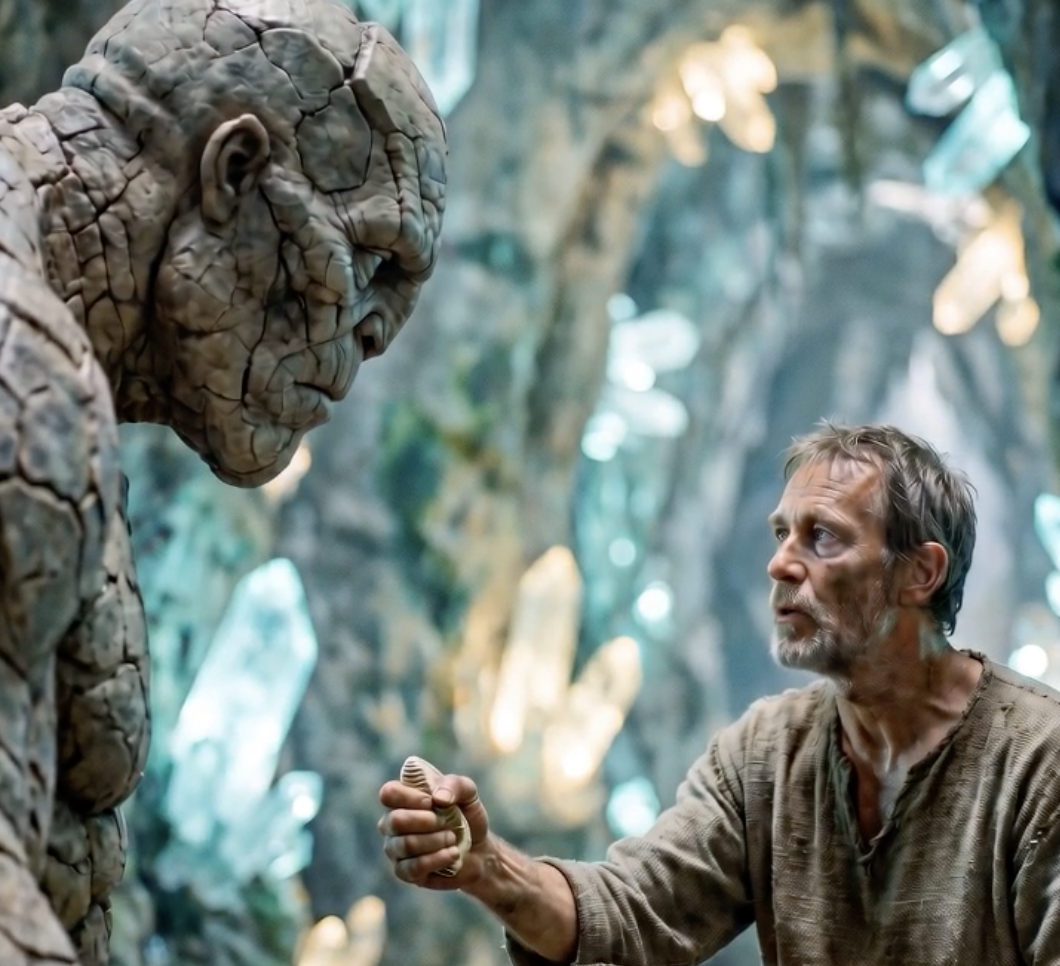
The Guardian’s palm — if you could call it a palm, if that word applied to something made of layered sedimentary plating, cracked along the seams of decades — descended with the slowness of geological time.
It did not take the shell.
It covered Darro’s hand. The entire hand. The shell and the fist and the thirty-one years, all of it, enclosed.
The heat was immense.
Darro did not pull away.
“You polished it,” the Guardian said. The voice came from somewhere deep inside its chest, like a word formed by the movement of tectonic plates. “I can feel the difference.”
“Every day,” Darro said.
“Why?”
It was a fair question. It was, perhaps, the only question that mattered, and Darro had been answering it in his head for three decades, trying out versions, discarding the ones that sounded like excuses, keeping the ones that felt like honesty.
“Because I couldn’t give you back what I took,” he said. “And I needed to do something with my hands.”
The cave breathed around them.
The crystals pulsed.
The Guardian did not speak for a long time.
When it had first been left in darkness — not the darkness Darro now lived in, but its own kind, the absence of the one sense that had given the world a texture worth inhabiting — it had spent years in fury. Not at Darro specifically. At the absence. At the thing that had been present and then was not. It had learned, slowly, to navigate by vibration, by smell, by the resonance of crystal formations against the unique geometry of every moving body. It had rebuilt a world out of sensation.
But the world it rebuilt did not have the man in it.
And then, thirty-one years after the fight, the man’s smell arrived at the cavern entrance.
The Guardian had known him immediately.
Not from anger. From the shell.
The specific mineral trace of that one piece of shed skin — its own dead surface, its own discarded self — arriving from the direction of the blind man’s body, worn smooth by handling, carried with the unmistakable care of something precious.
The Guardian had stood at the far end of the cavern for eleven minutes before Darro reached the center.
It had been deciding something of its own.
Now it lifted its hand.
The shell sat in Darro’s open palm, unchanged, still his.
“Keep it,” the Guardian said.
Darro’s jaw tightened. “It’s yours.”
“I know what it is,” the Guardian said. “I know whose it is. I’m telling you to keep it anyway.”
The distinction mattered. Darro turned it over in the dark of his mind until he understood.
The Guardian was not returning the shell because it was unwanted.
It was returning the shell because Darro needed it more — not as penance, not as punishment — but as the physical fact of something he had held onto and not dropped, even when it would have been easier to drop it, even when no one would have known.
The Guardian had been watching him the same way it had always watched him.
Not as prey.
As something worth watching.
“Stand up,” the Guardian said.
Darro stood. Slower than he would have thirty-one years ago. His knees registered the stone.
The Guardian rose with him.
They stood in the crystal light — one man, one thing older than any word for old — at the same height now, breathing the same underground air, both of them navigating a world they could not fully see.
“You can come back,” the Guardian said. Not an invitation. A fact.
Darro closed his fist around the shell.
“I’ll bring it back when I’m done with it,” he said.
The Guardian made the sound again — the deep chest sound, the one that had felt like recognition before.
This time it felt like something else.
It felt like: all right.
Darro turned and walked toward the entrance, his footsteps even, his cane still folded in his coat. He did not unfold it until he reached the light above ground, where the cave’s sound faded behind him and the ordinary world resumed its ordinary noise.
He stood at the entrance for a moment before he went back into it.
In his fist, the shell.
Polished by thirty-one years of daily grief.
Still his.
Still worth keeping.
Have you ever carried something for years — not because it was useful, but because putting it down felt like forgetting? Tell us what it meant to you in the comments.