
“Sera.”
She hadn’t heard her own name spoken aloud in eleven months.
It hit her the way cold water hits — total, immediate, before the brain has caught up with the body.
She looked up.
At the rim of the pit, leaning over the black stone edge with both hands gripping the iron rail, was a man in his fifties. Grey-bearded, heavy across the shoulders, wearing the clothes of someone who had traveled hard and slept in them afterward. He wasn’t dressed for the arena. He looked like he had arrived running and hadn’t stopped yet.
He was wearing a crest on his coat collar.
She looked down at the snow.
The same crest. The same stitching.
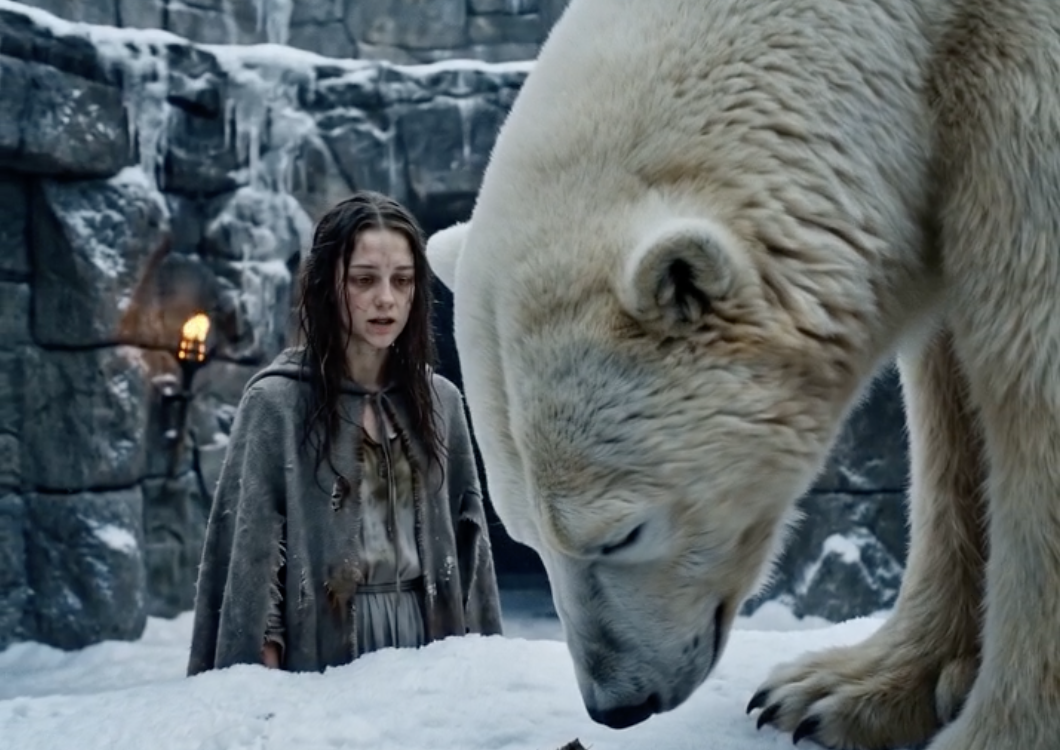
The bear made the sound again — that low exhale, the one that was not a roar — and this time its face turned upward. Toward the rim. Toward the man.
The man made a sound she had never heard a human being make. It was not a word. It was the sound of someone finding, after a very long absence, something they had believed to be gone.
He said: “Brann.”
The bear’s whole body shifted. Something moved through it the way weather moves across open ground — deep and full and total. It lifted its head. Its small amber eyes found the man at the rim and held there, unwavering.
The crowd did not move.
Hundreds of people in furs and torchlight, cups still raised, mouths still open from the shout that had preceded the silence, and not one of them moved. They were watching something they did not have a name for. They had come for sport and they were getting something else entirely, and they did not know what to do with it.
The Arena Warden appeared at the man’s shoulder. Grabbed his arm.
“You can’t be up here. Civilians aren’t —”
The man turned. Looked at him.
The Warden stepped back.
Sera watched all of this from the pit floor. Her feet had gone numb inside her boots. Her hands hung at her sides. She was aware that she was shaking, and equally aware that the bear — Brann, the bear had a name, the bear had always had a name — was no longer a threat. It had not been a threat since the moment the crest hit the snow. She understood that now. She had understood it the moment it happened, the way you understand certain things not through thought but through the body’s older knowing.
She picked up the crest.
It was damp from the snow. The embroidery was intact — all those hours of Maren’s quiet industry, all those tiny stitches, had held.
She held it out toward Brann, in her open palm.
He looked at it.
Then he pressed his nose against her hand — very gently, the way Maren had described, the way you let a frightened animal know you before you reach for it — and he held it there.
Sera closed her fingers softly around his muzzle. Her whole hand was shaking.
She heard, distantly, someone in the crowd begin to cry.
It took another twenty minutes for the man to reach the pit floor. His name was Eddan. He had been the frost-bear’s keeper for nine years before he was taken — wrongly accused, imprisoned, released three months ago when a witness recanted. He had spent those three months tracing the animal’s path from confiscation to auction to this arena.
He had not known where Maren was.
Sera told him.
She told him everything, in the way that people do when they have been carrying something alone for too long — fast, with pauses, and with the particular relief of speaking to someone who already understands the shape of the story before you’ve finished saying it.
Eddan listened. He wept once, briefly, when she described the pine forest house. He didn’t apologize for weeping. He just let it happen and then continued listening.
Brann lay down in the snow beside them.
Not because he was tired. Sera didn’t think bears lay down because they were tired, not like that — not with their chin on their paws and their amber eyes moving between two people the way a dog’s eyes move. He lay down because the situation had resolved. Because the people who were supposed to be together were together, and the thing that had been wrong for a long time had, in the middle of an ice-pit at the edge of a northern city, quietly become right.
The crowd dispersed in ones and twos.
Nobody asked for their money back.
The Warden, after a long conversation with Eddan that Sera did not hear, unlocked the pit gate without further argument. He looked at the bear for a long moment before he did it. He looked at the crowd — already thinning, already quiet. He looked at the crest in Sera’s hand.
He opened the gate.
They walked out. All three of them: the keeper, the girl raised by the keeper’s oldest friend, and the bear who had been waiting, in the only way it knew how, for someone who smelled like the person it loved.
The torches burned down. Snow began again, falling through the open roof of the arena in slow, indifferent curtains.
By morning, there was no trace of any of it.
Only the crest, which Sera kept. She had it still — years later, sewn back into the hem of a different cloak, in the same pine-forest house, where Eddan and Maren had finally argued and finally forgiven and finally settled into the particular quiet that people find when they have been separately broken and have chosen to be whole together.
Brann slept most winters in the woodshed. He was not a pet. He came and went as he chose.
But every year, when the first snow fell, he would press his nose into Sera’s open palm — gently, briefly — and hold it there.
She always let him.
Have you ever encountered a moment of unexpected grace that changed the way you understood the world — when something or someone chose kindness where cruelty was expected? Tell us in the comments.