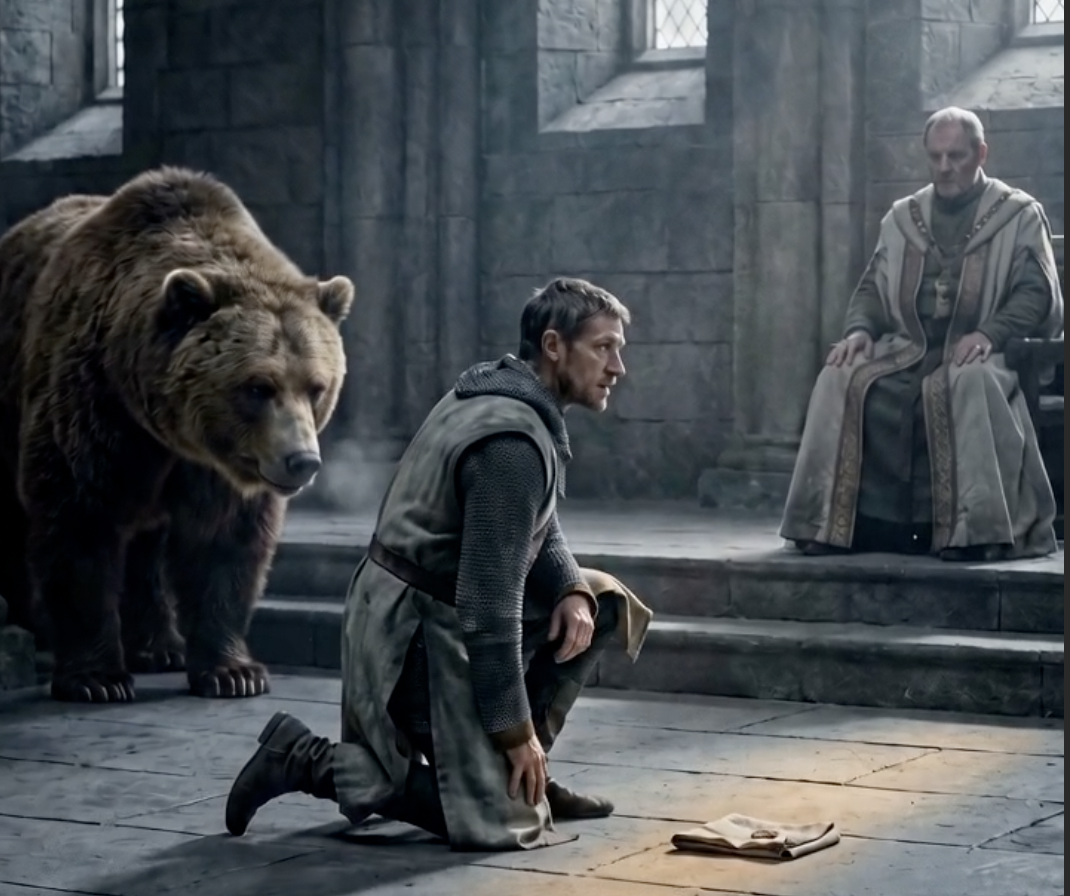

Aldric’s hands began to shake — not from cold, not from fear — but from the particular trembling of someone who has carried a weight for so long that the moment of setting it down becomes its own kind of violence.
Vorath stepped down from the dais.
Not striding. Not commanding. One step, then another, the way a man moves when his legs are deciding for him. His boots on the flagstone were the only sound in the hall.
He stopped two feet from the cloth.
He looked down at what lay inside it.
A ring. Iron, not gold — plain-banded, soldier-made, the kind a man hammers himself from a melted buckle when he has no money and no time and someone to give it to. Scratched along the inner face, almost worn away: four letters. V. & L. Hold.
Vorath’s face did not break. Men like Vorath don’t break in public. They simply become very, very still.
“Where did you get this,” he said. Barely audible.
Aldric’s voice, when it came, was steady. It had cost him something to make it steady.
“Your daughter gave it to me. The night she died.”
The hall guard Denn took one step forward, then stopped. Elder Maret closed her eyes.
The bear had not moved. It stood at the edge of the torchlight, its great silver head low, watching Vorath the way old animals watch things — without urgency, without judgment, with only the deep patience of something that already knows the outcome.
Seven years earlier, Lira Vorath had been twenty-two years old, newly married to a man her father had not chosen, living in the outer village in a house barely larger than a storage room. Vorath had not spoken to her in three years. Pride. Stubbornness. The specific cruelty of a man who loves deeply and doesn’t know how.
She had died in the winter. Fever. Fast.
Vorath had arrived two days after the burial.
What no one knew — what Aldric had carried alone for seven years, from the age of seven to fourteen — was that Lira had not died without a last act of her own.
She had found the bear cub in the northern wood the autumn before she fell ill. Wounded. Alone. She had nursed it through the cold months, in secret, in the small shed behind her house. She named it Sorra. She talked to it the way people talk to things that cannot report them — honestly, about everything.
When the fever came fast and she understood what it meant, she called the stablehand’s child — seven-year-old Aldric, son of her neighbor, the only person she trusted with something living — to her bedside.
She pressed the ring into his hand.
“Keep her safe,” she said. “And when you think the time is right — give this to my father. He’ll understand.”
Aldric had not known what the time was for seven years.
He knew now.
Because three weeks ago, Sorra — fully grown, silver-grey and enormous — had found a shepherd boy lost and freezing in the northern wood and stayed pressed against him through the night until morning. The same thing Lira had done for the bear when it was small.
The story had reached the village. Then the hall. Then Vorath.
Aldric understood then that Lira had kept a promise even after she was gone.
And so he went to the hunting ground — where Sorra had made her home for seven years, where Aldric had visited her in secret every season, where no one was permitted — and he brought the ring to the hall.
Because the time was right.
Vorath crouched down on the flagstone.
He picked up the ring between two fingers.
He looked at it for a long moment, the way a man looks at something he thought the world had swallowed.
Then, slowly, he looked up at the bear.
Sorra looked back at him — screen-left, head low, dark eyes patient and entirely calm. A sound came from her — not a growl, not a moan — something lower, slower. Like the first note of a song that has been waiting to be sung for seven years.
Vorath’s hand closed around the ring.
He didn’t speak. He didn’t need to. The men in the hall were very carefully studying the floor, the walls, the far corners of the ceiling — anywhere that wasn’t this.
Aldric waited.
Finally Vorath straightened. He turned to look at the boy still kneeling on the flagstone — this fourteen-year-old in a tunic patched at both elbows who had walked into a war council alone and set everything down.
“Get up,” Vorath said.
Aldric stood.
“She chose well.” Vorath’s voice had something in it that hadn’t been there before. Not softness exactly. Something older than softness. “You can go.”
Aldric nodded once. He bent down and picked up the cloth — empty now — and folded it neatly and put it back in his boot.
He walked to the hall door.
He paused.
“She talked about you,” Aldric said, without turning around. “Every time I came. Every season. Seven years.”
He went out through the door.
The hall stayed silent.
Vorath did not return to the dais. He stood where he was, in the center of the flagstone floor, and after a moment Sorra crossed the remaining distance between them and pressed the great grey weight of her head against his chest.
He put his hand on her.
The torches burned on.
Elder Maret opened her eyes. She said nothing. None of them did.
Some things that happen in the cold need no verdict — only a witness, and time, and the plain animal grace of something enormous choosing to be gentle.
Have you ever kept a promise for someone who couldn’t keep it themselves? Tell us in the comments.