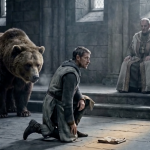

Aldric’s hand moved to his coat.
He pulled out his spectacles.
He put them on.
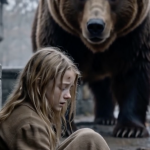
He looked at the bear. He looked at the boy. He looked at the small girl with one shoe who had her palm pressed flat against four hundred pounds of animal as though it were the most natural thing in the world.
Then he looked at his parchment.
The crowd watched him.
He had been magistrate of Selvarn for nineteen years. He had locked men in these stocks for genuine cruelty — for fraud, for violence, for the slow grinding theft of people who had less. He had also, if he was honest with himself, locked up people it was convenient to lock up. Men who couldn’t afford Hobb’s prices and took cheese anyway. Women who gathered windfall fruit from the wrong orchard.
He was not a cruel man.
He was not, he realized, always a just one.
The bear had not moved.
“Maren,” Aldric called out, to the woman on the cart.
She looked at him without expression. “Aldric.”
They knew each other. Not well. Enough.
“Your animal is obstructing a lawful sentencing.”
“My animal,” Maren said, “is sitting. He’s done nothing unlawful.”
“I could argue the case.”
“You could.” She settled her weight on the cart seat. “You’d lose.”
The crowd was no longer sure what to do. They had come for jeering and gotten something else. Something that required them to think, which was not what market day was generally for.
Hobb, the pie merchant, pushed his way to the front. A man with the complexion of someone perpetually aggrieved.
“This is my grievance,” he announced. “My stall. My pie. My right to redress.”
Aldric looked at him.
“How much was the pie, Hobb?”
“Four copper. Plus the principle of it.”
“I’ll pay you the four copper,” said a voice.
Everyone turned.
It was the flour-aproned woman. The one who had demanded to know where Cael’s shame was.
She was already holding the coins. She wasn’t looking at anyone in particular. Her jaw was set in the way of someone doing something they’ve decided to do and would rather not be thanked for.
Hobb blinked. “That’s—”
“Four copper,” she said. “For a pie. Which is what it’s worth.”
Someone in the crowd laughed. Not mockingly — the short, surprised sound of a thing suddenly becoming absurd.
“And another four,” said a man with a fisherman’s apron. He held up his own coins.
“And two from me,” said someone else. “For the children.”
Hobb’s complexion went through several colors.
Cael, still locked in the stocks, was watching all of this with an expression that had lost its blankness. He looked, Maren thought, the way people look when they realize something is happening around them that they did not plan and cannot stop and have no idea what to do with.
The bear hadn’t moved.
Aldric walked down the platform steps, slowly, the way a man walks when he is using the time to think. He stopped in front of the stocks. He looked at Cael.
“Did you take the pie?”
“Yes.”
“Knowing it was theft?”
Cael considered this seriously. “I knew Master Hobb would call it that.”
“That’s not the same answer.”
“No,” Cael agreed. “It’s not.”
Aldric studied him. The boy had a cut on his jaw from the first day in the stocks — someone had thrown something harder than a cabbage on Tuesday. He had not complained. He had not explained himself to anyone except in that one quiet sentence: I’d do it again.
Aldric pulled off his spectacles. Cleaned them on his coat. Put them back.
“The debt is settled,” he said.
He reached up and worked the lock of the stocks himself, which was not something magistrates typically did. He had to ask the boy to tuck his chin for a moment to get the top bar loose.
Cael straightened up slowly. His neck was stiff. His wrists were red from the wood.
Lena had not taken her hand off the bear.
Cael walked to her. He crouched down so they were the same height.
“You shouldn’t be in the crowd,” he said. “Where are your brothers?”
“Back there.” She gestured vaguely. “They can’t see anything. They’re too small.”
“Go back to them.”
“Are you free?”
He looked at his wrists. “Appears so.”
“Because of Bram.”
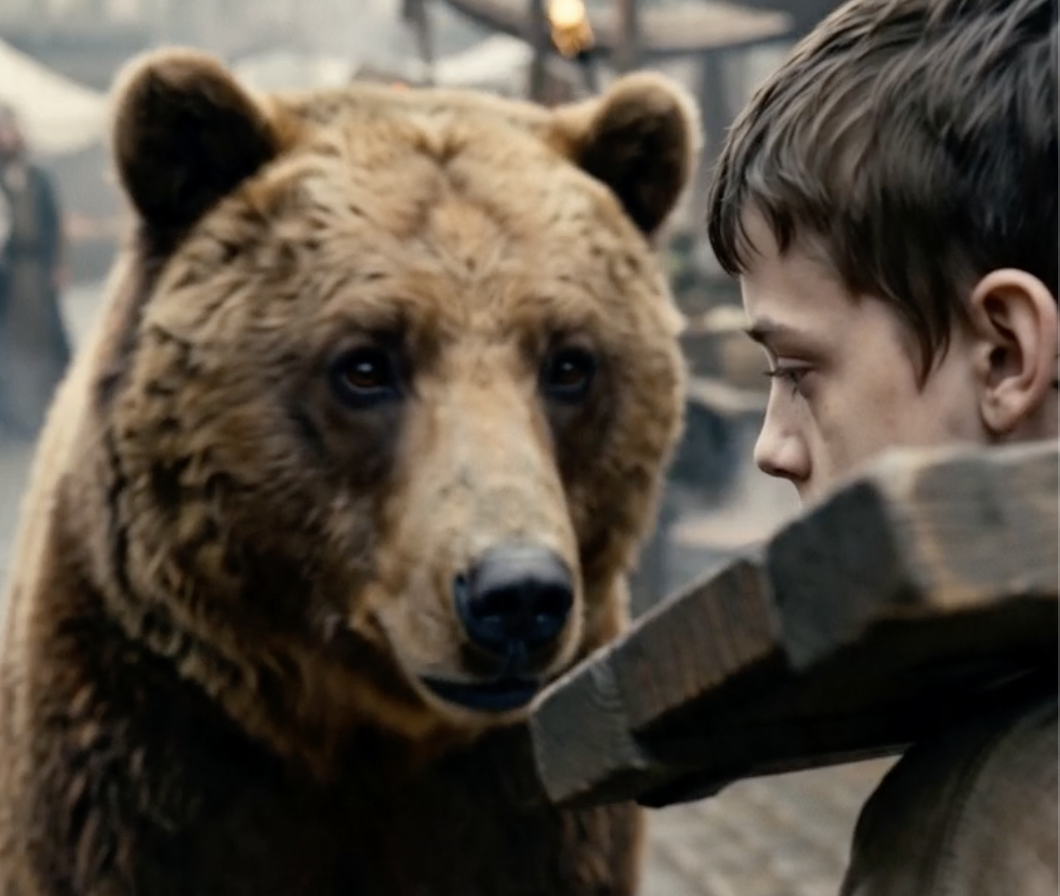
He looked at the bear. The bear regarded him with that vast, incurious calm.
“Because of a lot of things,” Cael said.
Maren had climbed down from the cart. She moved through the crowd without difficulty — people made space for her without quite knowing why. She stood beside the bear and put one hand on his neck.
“He came to you the first night,” she said quietly, to Cael. Not accusing. Just noting it.
Cael looked up at her. “I didn’t— I didn’t do anything. I was passing the east road. He was in the cart. He just— looked at me.”
“He did more than look.” She scratched behind the bear’s ear. “You gave him your supper bread.”
“He seemed hungry.”
“He’s always hungry.” She studied the boy. “Where do you sleep?”
“Inn kitchen. Floor.”
“Mm.” She looked at the bear. The bear looked at Cael. “We’re heading north. River road. I have a cart that doesn’t steer right and a bear that has opinions about everything.” She paused. “I could use someone who feeds hungry things without being asked to.”
The square had gone quiet again. Not with tension this time. With something lighter than that.
Cael stood up. He looked at Lena.
“What about them?”
Maren followed his gaze to where two small boys had now emerged from the crowd to stand beside their sister, both of them staring at the bear with enormous eyes.
Maren let out a breath through her nose. The sound of a woman revising her plans.
“How much do three children eat?”
“Not much,” Cael said. “They’re used to not much.”
Maren looked at the cart. Looked at the children. Looked at the bear, who had now extended his nose to sniff the eldest boy’s hair.
“That,” she said, “is going to have to change.”
The flour-aproned woman was crying, quietly, turned halfway away from the square so no one would see it. The fisherman with the coins had put his arm around her shoulders, which surprised them both.
Aldric stood at the edge of the platform and watched the cart eventually pull away — slowly, lopsided, a woman in old leather at the reins, four children packed in the back, and a bear who rode with his face into the wind as though reviewing the road ahead for anything worth judging.
He rolled up his parchment.
Hobb appeared at his elbow. “You let him go.”
“The debt was settled.”
“The principle—”
“The principle,” Aldric said, “was settled too.”
He tucked the parchment under his arm and walked home for lunch.
The square went back to being a market. Loudly, immediately, the way markets do.
But for the rest of that season, in Selvarn, when children came to the square on market day, the crowd made room for them at the stalls.
No one organized it.
No one announced it.
It was just something that happened, after the day the bear sat down.
Have you ever seen one small act of honesty change the way an entire room behaved? Tell us in the comments.