
The Bear and the Last Girl of Auclair
The village of Auclair — if it was ever called that; the name survives only in one marginal note in a Burgundian tax record that reads villa Auclara, deserta (the village of Auclair, emptied) beside a zero in the column for dues owed — died in the autumn of 1348 in the way that hundreds of French villages died that year.
Not in a day. In weeks. In the slow, relentless arithmetic of the plague, which did not discriminate between the miller and the lord, the priest and the child, the just man and the sinner who had been meaning to confess for years. The Church said God was punishing Christendom for its sins. The physicians said it was a corruption of the air. The flagellants said only suffering could atone. None of them were there when Auclair went quiet in October, because all of them had their own villages to lose.
The girl had no name in the tax record. She had a name in the world — her mother called her Margot, and there had been a time when her mother’s voice calling that name across a sunlit yard was the most ordinary sound imaginable. The most ordinary sound in the world is the one you cannot hear anymore.
Her mother died on a Tuesday.
Margot had been expecting it by then, the way you expect winter — not because you want it, but because the signs are all there and there is nothing to be done. She had held her mother’s hand. She had said the words she knew. She had waited until she was sure, and then she had closed the door of the cottage and gone into the cellar to count what was left.
There was not much left.
The men came from the Dijon road on a gray afternoon in the middle of October.
She saw them from the church steps and understood immediately what they were. Not plague. Not soldiers. Something older and simpler — men who moved through other people’s disasters the way crows move through other people’s fields. She had seen their kind once before, after the flood two years past, picking through what the water had left.
This time she was what the plague had left.
She ran. She reached the church wall and stopped, because the church wall was stone and the men were not, and stone does not negotiate. She turned to face them and pressed her back flat against the cold gray surface and breathed in the way her mother had taught her to breathe when things were very bad — slowly, through the nose, so that fear does not show on the face.
Fear still showed on the face. But she breathed.
One of the men had a rope coiled over his shoulder. He said something about the plague. He said something about no one noticing. His companion uncoiled the rope with the practiced ease of a man who had done this before and expected to do it again and did not think very much about it in between.
Margot looked past them.
At the treeline.
At the forest that had been pressing against the edges of Auclair for as long as there had been an Auclair — that had always been there, just beyond the carpenter’s yard, patient as stone, waiting for the day the village stopped fighting it back. The apple trees had already gone half-wild. The carpenter’s fence was rotting into the ground. The pigs, loose for six weeks, had churned the near edge of the forest into a ribbon of mud.
Something was standing in that mud.
It had been there, she realized, for longer than she had been watching — which meant it had been there when the men arrived, which meant it had watched them the way she was watching them now, with the particular quality of attention of something that has not yet decided what it will do.
It was very large.
It was a European brown bear, heavy with the fat it had been building for winter — which explained why it was still here, still eating, picking through the abandoned orchards and the miller’s grain stores and the beehives that no one had harvested. Auclair, emptied, had been good to it. Good to it the way abandoned places are good to the things that were there before the people came: quietly, generously, without ceremony.
It took one step into the square.
The cobblestones did not shake — that is the story Margot would tell later, and it is probably true — but the mud between the cobblestones shifted, and the sound was wrong, too heavy, too deliberate, and the man with the coiled rope turned around first.
The bear did not growl.
This was the part that nobody believed when she told it later. Everyone expected the growl. Everyone expected the dramatic moment — the risen fur, the displayed teeth, the great roar that sends men running. That is how bears behave in stories. In stories, every dramatic moment announces itself.
The bear simply looked at the men.
It was not an animal look, exactly. Not nothing-behind-it. It was the look of something that has been alive a very long time in a world that is mostly other things’ business, and has chosen, for a reason it cannot explain in any language that exists, to make this particular moment its own.
The man with the rope dropped it.
They ran. She did not watch them go. She was watching the bear.
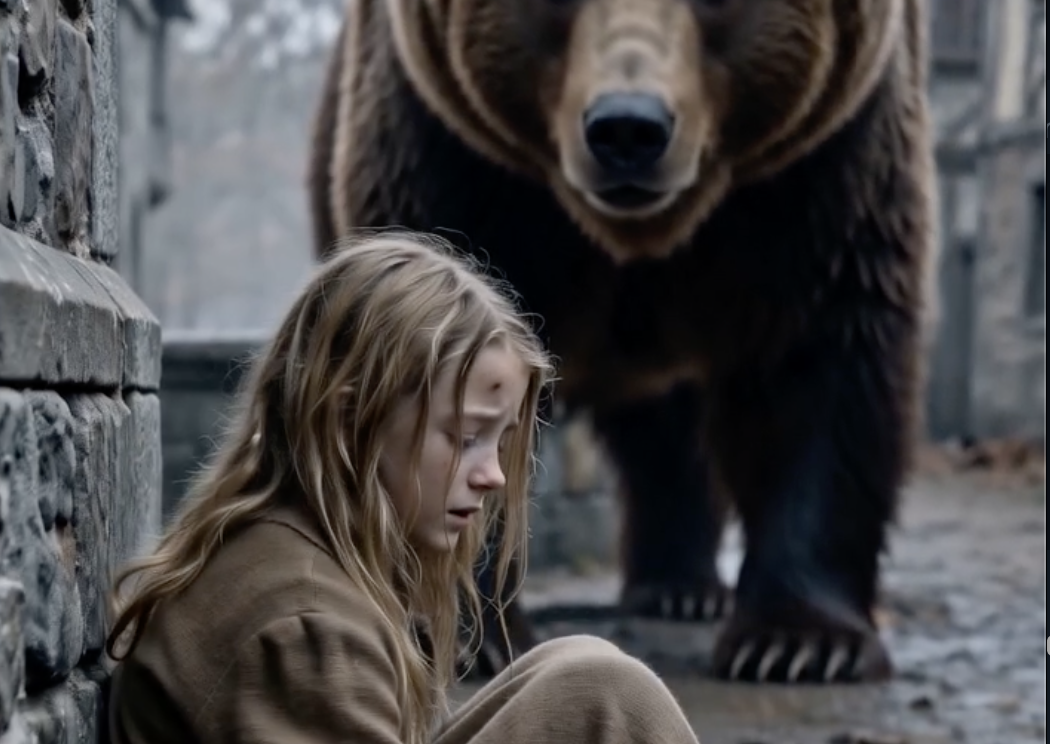
The bear’s small dark eyes moved from the place where the men had been to the girl against the church wall. It stood with its weight on all four feet, breath misting in the cold air, and it did not come closer. It was perhaps ten feet away. She could smell it — deep and wild and old, like the forest itself, like leaf mold and pine resin and something that had never been indoors.
Then it lowered its great head.
From the abandoned orchard gate — a latch swinging loose in the wind for weeks, the gate itself open — wild pears rolled across the cobblestones, dislodged by the bear’s approach, turning end over end in the uneven gaps between the stones, coming to rest at her feet.
Three pears.
She slid down the church wall to sit in the mud, because her legs had decided for her. She picked up one of the pears and held it with both hands and looked at the bear.
The bear looked back.
She stayed.
This is the part the records cannot account for, though one record tries. A Cistercian monk traveling through Burgundy in the spring of 1349 noted in his journal — in the margins, as monks will, where the important things go — that he passed through a village he called Auclara deserta and found it less deserted than its reputation suggested. A girl of perhaps eleven, he wrote, living in the church, which she had fitted out with straw and a firepit and a collection of preserved foods that suggested more practical intelligence than piety. She had a small flock of chickens she had gathered from the abandoned yards. A kitchen garden replanted from seed. A milk cow that had survived the autumn by following the pig trails into the forest.
The monk asked if she was alone.
She said — and the monk recorded this with the faint puzzlement of a man whose categories were not quite adequate for the situation — that there was a bear.
He looked around. He did not see a bear.
She said it came at night sometimes. It had taught her where the wild beehives were, and where the best stands of autumn mushrooms grew, and which parts of the forest were safe in winter. She said this as though it were ordinary. As though a bear teaching a child to live were a thing that happened.
The monk left a small donation of salt fish and continued on his way. He noted in the margin that the village did not seem, precisely, abandoned. He wrote: Puella sola, sed non deserta. The girl alone, but not deserted.
She was twelve when the surviving families from the neighboring villages began to drift back into the region, testing the air, finding it clean, finding the fields still there. She was thirteen when a merchant family from Dijon, moving through, stayed a night and then another. She was fifteen when Auclair had enough people in it to need a name again.
She grew up. The records found her again — land records, this time, small and modest, a holding on the edge of the village adjoining the forest. There is a note that she was known, locally, as a woman to consult for forest knowledge: where to find game, where the dangerous ground was, which plants healed and which did not.
No one in the records explains how she knew.
She knew because she had had a very thorough teacher, in the year when everyone else had gone and the forest sent what it could.
The bear was not seen again after the spring of 1349. The monk’s note is the only record of its presence in Auclair, and the monk was not even certain it existed.
Margot was certain.
She had the pear cores to prove it. She kept them on the windowsill of the church through the winter — three of them, dried to a pale wood, the seeds long gone, the shape still there. When the merchant family arrived from Dijon and asked what they were, she said they were from a gift, and she did not explain further, because some gifts are not meant to be explained.
Only kept.
The Black Death killed between 30 and 60 percent of Europe’s population between 1347 and 1353. Hundreds of French villages were recorded as “deserted” in the tax rolls of 1350–1352. Many were eventually resettled. Some were not. European brown bears once ranged across all of France; by 1348, they had been largely driven into the deep forests of Burgundy and the Pyrenees — present, but rarely seen, living in the margins of a civilization that had mostly forgotten they were there.
The girl is invented. The plague is not. The bear was already there, eating the abandoned apples.
It just needed the village to go quiet before it could be seen.