
His name, the histories suggest, was Marcus Papirius.
He was seventy-three years old. He had served Rome for fifty years — as soldier, magistrate, consul. He had watched younger men build careers on the foundations he had laid. He had buried a wife. He had outlived two of his sons. He had, by every measure, already given Rome everything it could ask of a man.
When the news reached the city — the Roman army destroyed at the Allia, Brennus and the Senones marching unopposed — most of Rome broke.
The streets filled with people running.
Families loaded carts with whatever they could carry. Women clutched infants. Men shoved through alleyways without looking back. The Vestal Virgins were smuggled out of the city in darkness, carrying the sacred flame of Rome cupped in their hands like the last ember of a dying world.
The Senate met one final time.
The vote was brief. Military-age men would take the Capitoline Hill — the high ground, the last defensible position in the city. They would hold it as long as they could.
The old senators — the ones too aged to fight, too frail to climb — would be left behind.
There was no cruelty in this decision. It was Roman mathematics: the useful go where they are needed; the rest accept what comes.
But Marcus Papirius had not survived fifty years of Roman life by accepting what came.
He called together seven of the oldest men remaining.
He did not give a speech. Romans of his generation did not make speeches to each other. They had no patience for men who explained things that were already understood.
He said only: “Put on your robes. Sit down. Do not move.”
They chose the portico of the Forum — the most visible place in Rome.
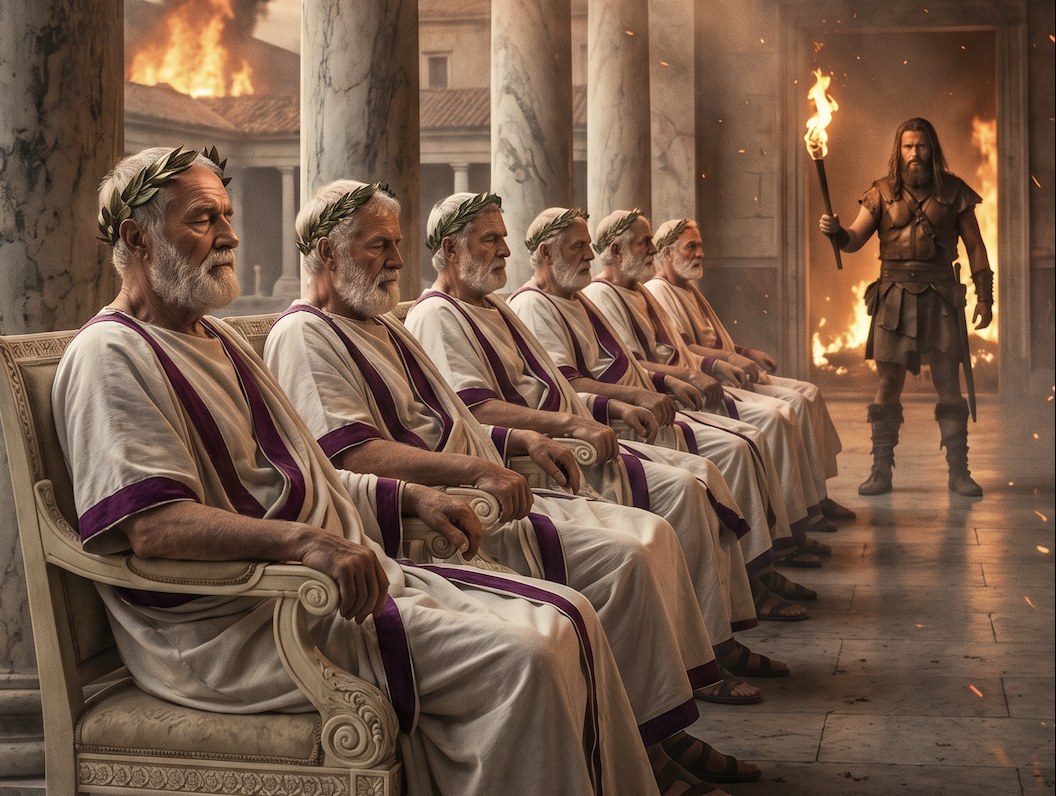
They dressed in full ceremonial regalia: white togas bordered in purple, the formal dress of the Roman state on its highest occasions. Laurel on their heads. Ivory rods resting across their knees. The complete costume of Roman authority — not the authority of soldiers, but the deeper authority of the institution itself.
They sat in their chairs.
And they waited.
The Gauls entered Rome at dawn.
Brennus had expected resistance. He had prepared his men for street fighting — the vicious, close-quarters killing that happens in burning cities where people have nothing left to lose. He had expected screaming. Chaos. The particular animal desperation of a population cornered.
What he found was silence.
The streets were empty. The fires were already dying — the Romans had set them deliberately, denying his army shelter and plunder. The Forum was empty.
Except for the hall at its edge.
Where eight old men sat perfectly still in the smoke-filtered dawn light, looking at nothing, saying nothing, draped in white and purple, with the unhurried gravity of men who had nowhere else to be.
The warriors stopped.
They had marched a thousand miles. They had killed ten thousand Romans on the banks of the Allia. They had watched the greatest city in the known world empty before them like a vessel draining.
Nothing in their world had prepared them for this.
A warrior named Bodvoc — large even by Gallic standards, a man who had taken heads from the battlefield and worn them as decoration — walked slowly into the hall.
He moved from senator to senator, studying each face.
They did not look at him. They did not look at each other. They held the particular stillness of men who have already made their decision and are now simply living inside it.
He stopped in front of the oldest.
Marcus Papirius.
Bodvoc stared at him for a long time. Then, slowly, he reached out and wrapped his hand around the old man’s beard — not with cruelty, but the way a man touches something he cannot explain, checking if it is real.
Marcus Papirius turned his head.
He looked at Bodvoc directly — the way a man looks at something that does not frighten him, not because he is brave, but because fear has already been considered and set aside.
He said, in the flat, economical Latin of a man who has spent a lifetime saying only what needed to be said:
“We are Rome.”
Bodvoc released his beard.
He stepped back.
He did not speak. He would say later — through translators, in the scattered accounts that reached Roman historians — that he had seen many men die well. He had never seen a man sit down and refuse to stop being what he was.
The histories disagree on what happened next.
Some say the senators were killed eventually — when a younger warrior, impatient and unconvinced, struck one of them and the spell broke.
Some say they were left untouched, that Brennus himself ordered his men not to harm what he could not understand.
What is agreed upon is this:
The Gauls sacked Rome. They burned what remained. They dragged the ransom gold onto the scales — and when the Romans protested the weights were fraudulent, Brennus threw his sword onto the scales and said the words that would echo through Western civilization for two thousand years:
“Vae Victis.”
Woe to the conquered.
But Marcus Furius Camillus — the exiled general, called back from his banishment — arrived with an army before the ransom was paid. The gold was never surrendered. The Gauls were driven from the city.
Rome rebuilt.
It always rebuilt.
The senators in their ivory chairs became legend — not as heroes who fought, but as something harder to explain and more difficult to forget. Men who understood that civilizations are not destroyed by swords alone. They are destroyed when the people inside them stop believing the civilization is real.
Marcus Papirius understood this.
He had nothing to fight with. No weapon, no army, no wall.
He had only the certainty of what he was — and the refusal to let anyone, including a man who could have ended him with one hand, take that certainty away.
The Capitoline Hill held.
Rome ransomed itself — or did not.
Camillus came.
And in the Forum, when the smoke finally cleared, eight ivory chairs stood empty in the ash.
Whatever had sat in them had already gone back to where it came from.
Rome.