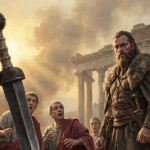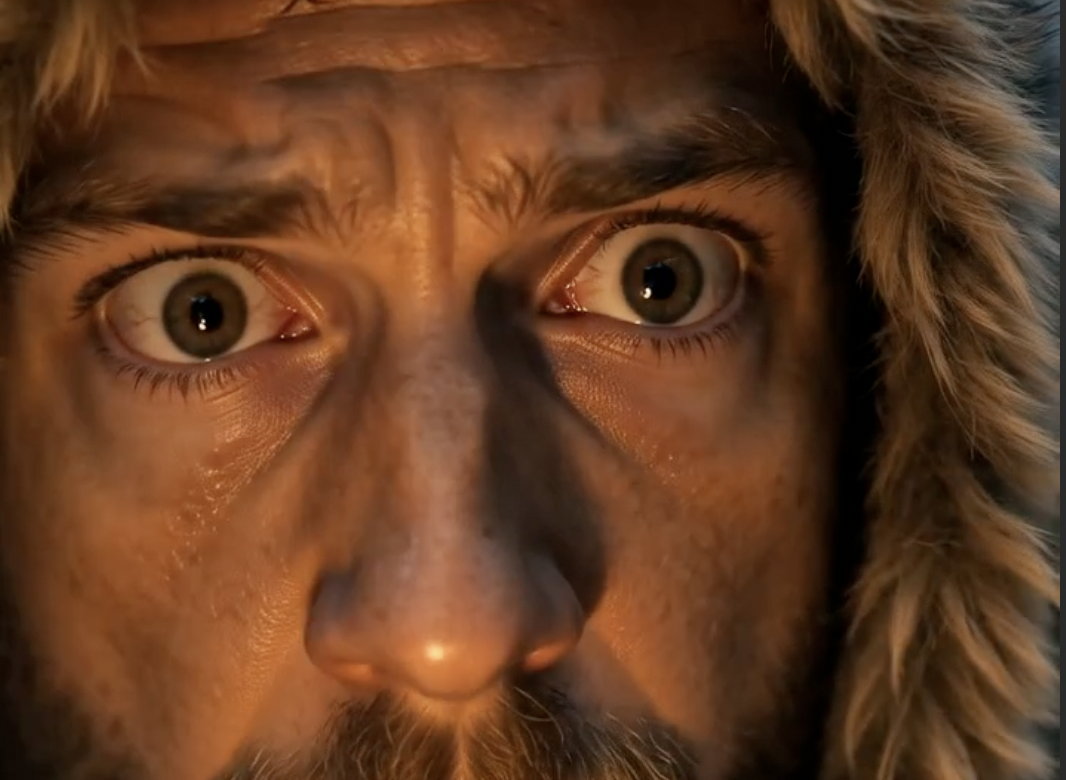

The chieftain’s name was Voclus — not Brennus himself, but one of his war-leaders, broad as a doorframe, wearing a wolf’s head over his own. He had been at the Allia. He had watched the Roman legions dissolve like salt in rain. He had walked through the Senate House that morning and found the old senators seated in their ivory chairs, motionless in white robes, eyes forward — and he had believed, for one cold moment, that he was looking at gods.
He was not a man easily frightened.
But the elephant frightened him.
Not because it was large — though it was enormous, taller than the temple doors, its armored flanks catching the firelight like a burning wall. Not because it moved — because it didn’t. It stood with an absolute stillness that nothing alive should possess. In the center of the burning Forum, surrounded by collapsed columns and the screaming of distant fires, Hanno stood like something that had already survived the end of the world and was simply waiting for this one to finish.
Voclus approached on foot. His warriors hung back.
He had a Gaulish boy with him who spoke passable Latin — stolen from a Roman trading post, raised among the Senones, useful for exactly this.
He spoke. The boy translated.
“Who are you, old man? And what is this creature?”
Caius Petronius looked up at Voclus without fear. This is worth noting. He was sixty-one years old. He was unarmed. He had not eaten in two days. The city was burning. And he looked at the largest Gallic war-leader to come down from the north in a generation without a single tremor in his face.
He answered in Latin. Slowly. Clearly. As if addressing a student who was slow but not hopeless.
“I am the man who feeds him. I am the man who speaks to him. I am the man who knows where he will walk and where he will not.”
The boy translated. Voclus said something back. The boy said:
“The chieftain asks — why did you not run? Every Roman ran.”
Caius was quiet for a long moment.
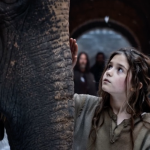
He placed his hand flat against Hanno’s leg. The elephant’s great ear moved — once, forward, like a door opening.
“Where would I go,” Caius said, “that he could follow?”
This is the sentence that changed everything.
Not the sentence itself — but what Voclus understood from it.
He had sacked seven cities. He had walked through temples, treasury houses, granaries, armories. He had taken gold, silver, grain, weapons, women, cattle. He had never once seen a Roman stand still for anything that could not buy him something.
And here was an old man standing still — in the middle of a burning city, beside an animal the size of a house — because the animal could not run with him.
Voclus stood for a long time.
His warriors shifted behind him. The fires crackled. Ash continued its quiet descent.
Then Voclus did something none of his men had ever seen him do.
He reached up and removed the wolf’s head from his own.
He set it on the ground between himself and Caius.
He said one word. The boy translated it:
“Stay.”
And Voclus turned and walked back to his men. He gave a short order. They moved on — past the elephant, past the old man, into other streets, toward other plunder, toward the Capitoline siege that would consume them for the next seven months.
They did not touch Caius.
They did not touch Hanno.
The historical record of the Gallic sack of 390 BC is fragmentary. Much was lost when the city burned — the records, the annals, the temple archives. What we know of Brennus and the ransom and the Vae Victis comes mostly from Livy, writing four centuries later, assembling pieces from pieces.
What we do not know is this: which Romans stayed.
We know who fled. We know who hid on the Capitoline. We know which Vestals carried the sacred flame to safety along the Tiber road, walking in the dark, carrying fire cupped in their hands.
But in any burning city, in any century, there are always the ones who stay — not because they are brave in the sword-and-shield sense, not because they have a military plan — but because there is something beside them that cannot be moved, and moving without it is simply not a thought they are capable of forming.
Caius Petronius had come to Rome from Carthage at the age of nineteen, a sailor’s son hired to accompany a cargo that no cargo manifest had ever described before.
The elephant was four years old.
He did not speak to it on the ship — or rather, he did, constantly, in the way you speak to very young things when you are also young and frightened and far from home: quietly, about nothing, just to fill the silence with sound.
By the time they reached Ostia, the elephant would not let anyone else approach its water bucket.
That was twenty-three years before the fire.
When Camillus returned — the exiled general, the man Rome called back from Ardea in its final desperation — he marched into a city of ash and geese feathers and silence.
His soldiers found Caius in the Forum.
He was sitting with his back against Hanno’s leg, asleep.
Hanno was awake. Watching the road the army had come in on.
One of Camillus’s centurions — a man named Servilius, who wrote a brief memoir that survived in fragments in a monastery in Umbria — recorded the scene with characteristic military economy:
“We found the elephant whole. The keeper beside him. Neither harmed. The chieftain had left the wolf’s head on the ground before them. We did not know what it meant. Camillus looked at it for a long time and said nothing. Then he told us to leave them.”
Hanno lived for nine more years after the sack of Rome.
He died in the winter of 381 BC, in the rebuilt stables near the Circus Maximus, with Caius beside him.
The Romans — newly proud, newly paranoid about omens and portents — argued for weeks about what to do with the body. Some wanted it preserved. Some wanted it thrown in the Tiber. Some wanted a monument.
Caius asked for nothing except permission to bury him where he fell.
Permission was given.
They buried Hanno in the stable yard, in the stony Roman earth, in a grave too large for anything else that would ever be put in it.
Caius died four months later.
They buried him in the same yard.
No monument was built for either of them.
The Gallic wolf’s head that Voclus left in the Forum was found by one of Camillus’s soldiers and hung on the wall of a tavern near the Subura until the building collapsed sometime in the next century.
No one recorded what happened to it after that.
But for a few decades, the tavern keeper told the story to anyone who asked what the wolf head was doing on his wall — the story of the old man who wouldn’t leave his elephant, and the Gallic war-chief who walked away from a burning Forum because he recognized, perhaps for the first time in his life of warfare and conquest, something he could not take.
Something he did not want to take.
The fire burned for three days.
In the center of it — in the center of the whole dying, screaming, crumbling city — one enormous creature stood perfectly still.
He was not a god.
He was not a soldier.
He was simply an animal who trusted one man.
And one man who had nowhere else to be.
Rome would be rebuilt. Camillus would be called its second founder. Brennus would vanish from history. The gold ransom would be argued about for centuries — whether it was ever fully paid, whether the sword on the scale was real, whether Camillus arrived in time to stop it.
The elephant left no such questions.
He simply stood in the fire.
And the fire went around him.