The Sword on the Scale: How Rome’s Most Humiliating Defeat Built the Greatest Empire in History

When Brennus placed his sword on the weighing scale in 390 BC, he didn’t know he was forging something more dangerous than any army. He was forging a wound — and wounds, in the right people, become obsessions.
The Moment Everything Changed
The gold sat in piles on the floor of what had been a Roman marketplace.
Senators watched. Survivors of the Allia watched. Men who had hidden on the Capitoline Hill for months — thin, humiliated, alive only because stone was harder to breach than pride — watched.
The Roman representative leaned forward and pointed at the counterweights on the scale. His voice was controlled. Measured. The voice of a man who believed civilization required rules even here.
“These weights are heavier than agreed,” he said.
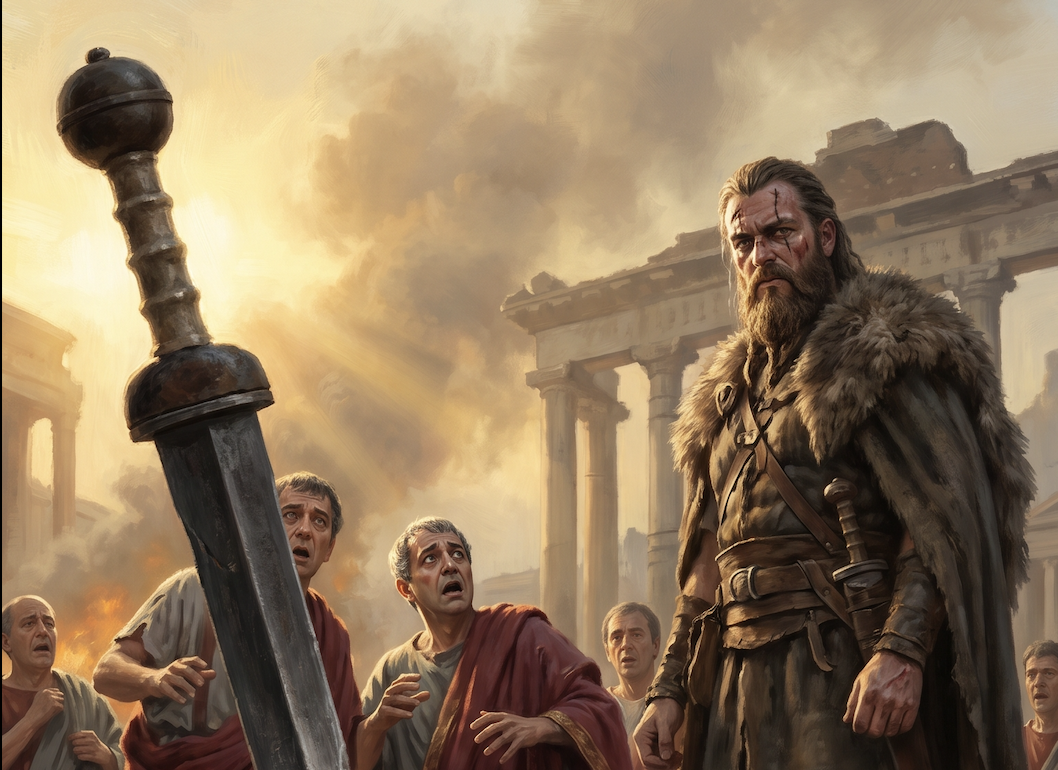
Brennus didn’t argue. He didn’t explain. He reached to his belt, drew his sword — a weapon longer than most Roman men were tall — and set it on the scale with a sound like a thunderclap.
The needle swung. The required gold increased. Just like that.
“Vae Victis,” Brennus said.
Woe to the conquered.
Three Latin words that Brennus probably spoke in Gaulish, preserved by Roman historians who understood immediately that this moment needed to live forever.
What Brennus Actually Meant
It would be easy to read Brennus as simply cruel. A bully with an army.
But his message was more precise than cruelty.
He was not saying: I enjoy your suffering.
He was saying: Fairness is not a universal law. It is a luxury of the powerful. You are no longer powerful. Therefore fairness does not apply to you.
This was not barbarism. It was philosophy — brutal, honest, and ultimately correct in every war ever fought before or since.
The Romans knew it. That was why it burned so badly.
Because they could not argue with it.
They could protest the rigged weights. They could point to the original agreement. They could invoke every legal and moral principle their civilization had developed. And Brennus could answer all of it by placing a sword on a scale.
He was right, and they knew he was right, and they paid.
The Ransom Rome Never Forgot
Some Roman historians — most notably Livy — added an epilogue to this story.
They claimed that just as the last gold was being weighed, the exiled Roman general Camillus arrived with a new army, declared the treaty void, and drove the Gauls from the city by force. Sword against sword, rather than gold against humiliation.
Whether this happened is genuinely uncertain. The timing is suspiciously perfect — almost too Roman, too clean, too redemptive. Many modern historians treat it as a story Rome needed to tell itself, not necessarily a story that happened.
But what is not uncertain is the aftermath.
Rome paid the ransom. The Gauls left. The city — burnt, plundered, stripped — slowly began rebuilding.
And then something extraordinary happened.
Rome decided to remember.
The Architecture of Shame
Most civilizations, after a catastrophe like this, work to suppress the memory. Minimize it. Reframe it. Explain why the loss didn’t count, or why the enemy cheated, or why circumstances were unique.
Rome did the opposite.
The Gauls became a permanent fixture of Roman cultural memory. Metus Gallicus — Gallic fear — became a formal psychological concept in Roman political thought. The terror of the north, of tribes descending without warning, remained vivid and institutionalized in Roman policy for centuries after the walls were rebuilt.
But more than fear, what Rome took from Brennus was a principle:
The world does not owe you fairness. You earn safety or you do not have it.
This was not a resignation. It was a blueprint.
Within decades, Rome began building the most systematic military machine the ancient world had ever seen. Not larger armies — smarter ones. Armies built around logistics, discipline, engineering, and the capacity to maintain force over enormous distances and time.
They built roads — not for commerce first, but so armies could move fast enough that no enemy would ever again walk unopposed to Rome’s gates.
They rebuilt the city walls. The Servian Wall, constructed after the Gallic sack, would ring Rome for centuries.
They developed a foreign policy built on one premise that Brennus had accidentally taught them: there is no such thing as a secure frontier. There is only an expanding one.
The logic was cold and not entirely wrong. A Rome that controlled all of Italy could not be raided from Italy. A Rome that controlled the Mediterranean coast could not be threatened from the sea. A Rome that conquered Gaul — which it did, several centuries later — could no longer be invaded from Gaul.
Every expansion carried the ghost of Brennus inside it.
What the Sword on the Scale Really Weighed
There is something worth sitting with in this story, beyond the drama and the empire-building.
Brennus was correct that day. The conquered had no right to fair treatment — not in that moment, not under those conditions.
But he was also wrong about something larger.
He assumed that humiliating Rome would end Rome.
He didn’t understand that some organisms, when wounded deeply enough, do not die. They adapt. They reorganize around the wound. They build systems specifically designed to ensure the wound never happens again.
Rome was not broken by Brennus. Rome was defined by him.
The city that would eventually stretch from Scotland to Mesopotamia, from the Rhine to the Sahara — that city was not built in its moments of easy victory. It was built in the long, disciplined, furious response to one afternoon on the Allia River and one sword on a scale.
Empires are not forged by the things that go right.
They are forged by the things that go badly — and the question of what you decide to do next.
The Lesson That Outlasted Both Rome and Gaul
Brennus’ tribe, the Senones, largely disappears from history after this period. The civilization that seemed so invincible on that day in 390 BC left behind almost no lasting record of itself.
Rome, the civilization that paid gold to a man who rigged the scales, left behind a legal system that still shapes courts on six continents, an architectural language still used in capital cities worldwide, a calendar still on your phone, and a concept of republican governance still argued about in legislatures today.
The man who said Vae Victis is a footnote.
The men who heard it built everything.
This is what history keeps trying to tell us, in different voices and different centuries:
The wound is not the end of the story.
Sometimes the wound is the beginning.
What do you think? Would Rome have become what it became without the humiliation of 390 BC? Or would a Rome that never lost have grown complacent and collapsed earlier?
Leave your answer in the comments. History’s best debates happen in the margins.