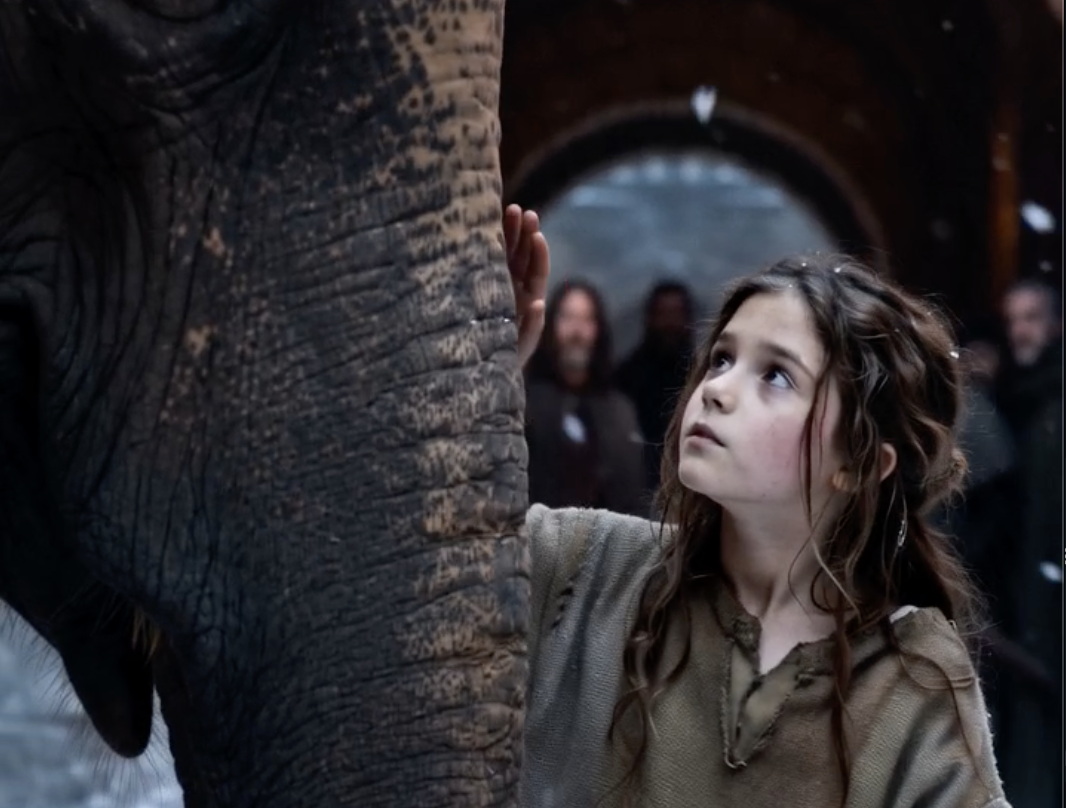

The courtyard stayed silent for a long time after Maren spoke.
Then Abul-Abbas opened his eyes.
He made a sound — low, from somewhere deep in his chest, below hearing almost, more felt than heard — and he turned his head so that her small palm moved from his cheek to the broad flat plane of his forehead. He leaned into her hand. Very slightly. The way something enormous does when it has decided, finally, that it is finished being afraid.
The old lord in the archway sheathed his dagger.
Nobody moved for a long time.
Later — much later, after Abul-Abbas had been led to the stable that three men had spent a week enlarging, after Maren had been given shoes and a proper wool cloak and a bowl of something hot and had eaten it sitting on the straw beside the elephant because she would not leave him — an old monk named Einhard came to find her.
Einhard was Charlemagne’s scholar, his record-keeper, the man who would one day write the Emperor’s biography. He was small, careful, and he noticed everything.
He stood in the stable doorway with a candle and watched the girl sitting beside the elephant in the straw, her back against his foreleg, her eyes already closing, and he thought about what to say.
He said: “Where did you learn that? The way you approached him.”
Maren looked up. “I didn’t learn it. I just knew he was frightened.”
“He killed three men.”
“Frightened things kill.” She said it simply, without drama, the way a child says a thing she learned before she had words for it. “It doesn’t mean they wanted to.”
Einhard held his candle and looked at this girl in the straw beside the most improbable animal in the Frankish Empire. Then he asked the question he had actually come to ask.
“Do you know where he came from?”
Maren shook her head.
So Einhard told her.
He had come from the court of Harun al-Rashid — the Caliph of Baghdad, Commander of the Faithful, ruler of an empire that stretched from the Atlantic coast of North Africa to the edges of Central Asia. The richest court in the world. A place of libraries and fountains and silk and scholarship at a time when most of the Frankish Empire was still burning its dead by torchlight.
The Caliph had sent Charlemagne three gifts as a mark of alliance: a water clock so complex it made the Frankish lords think it was sorcery, a set of keys to the Church of the Holy Sepulchre in Jerusalem, and the elephant.
The water clock was a marvel. The keys were a political gesture of extraordinary weight — the Caliph of Islam gifting the Emperor of the Franks symbolic custody of Christianity’s holiest site, as a message to their mutual enemy, Byzantium.
But the elephant was something else.
“The Caliph sent him,” Einhard said carefully, “because he knew Charlemagne would never reach Baghdad. The world between here and there is too wide. Too many wars. Too many faiths. Too many kings.”
He paused.
“The elephant had seen all of it. He walked through all of it. He is the closest thing to a message that could survive the journey.”
Maren looked at Abul-Abbas. His eyes were half-closed. His breathing had slowed. For the first time in — she somehow knew this, felt it in his warmth beside her — for the first time in months, possibly, he was not afraid.
“What is the message?” she asked.
Einhard smiled, a scholar’s smile, the smile of a man who had spent his life knowing that the best questions had no clean answers.
“That the world is larger than any king’s claim on it. That somewhere on the other side of every war, there is a court where men read books and argue about mathematics and send elephants as gifts instead of armies.”
He looked at her.
“And perhaps — that the things which have survived the longest road deserve someone who understands what that costs.”
Maren stayed with Abul-Abbas for nine years.
She learned Arabic from the mahout’s notes that had survived the journey — a water-stained roll of papyrus tucked into the elephant’s travel harness, written by a man named Yusuf who had raised Abul-Abbas from a calf in a royal stable outside Baghdad and who had died of a fever somewhere in the Alpine passes. His notes were instructions, observations, a log of the journey — and at the end, a single personal entry, written the night before he died, in handwriting that had gone shaky with fever.
He does not like to be alone at night. He has always been like this. Since he was small. He does not like the dark.
If someone is with him he will sleep. He needs to hear breathing.
I do not know who will read this. I do not know who will be with him when I am not.
Please. Someone stay with him.
Maren read this — or had it read to her, and then read it herself once her Arabic was sufficient — and she did not cry, because she was not a girl who cried easily. Instead she pressed the papyrus flat between two boards and kept it. She kept it for the rest of her life.
She slept in the stable. She learned his moods — the slow ear-fold that meant he was content, the tight stillness of his shoulders that meant something had frightened him, the particular rumble in his chest that meant he remembered something from very far away and was not sure if he was sad about it.
She learned that he was afraid of fire. She learned that he was not afraid of storms. She learned that he liked the sound of singing, specifically the kind of low, sustained singing the monks did at Vespers, and that on evenings when the wind carried the sound from the chapel to the stable, Abul-Abbas would turn toward it and be very still and listen in a way that was almost, if you were willing to believe it, devotional.
She learned that he was kind. That his size was not the truth of him. That the killings on the road — she eventually learned the full story — had been panic, darkness, a handler who had not understood what Yusuf’s notes would have told him, and a situation that had escalated in the specific way that situations escalate when large frightened things are handled by frightened people.
Frightened things kill. She had known it before she could name it. She had been a frightened thing herself.
Charlemagne came to the stable once, in the spring of the second year.
He was an old man by then — over fifty, which was genuinely old in 802, old enough that he knew it. He had fought more wars than he could remember and built more churches than he had time to consecrate and crowned himself Emperor in a ceremony in Rome that he later said he had not wanted, which no one entirely believed.
He stood in the stable doorway — tall, white-haired, wearing a plain wool cloak because he was not a man who dressed for stables — and he looked at the elephant for a long time.
Then he looked at Maren.
“He eats more than a village,” he said. “You know that.”
“Yes, my lord.”
“And he will never be useful. He is not a war elephant. He is too old, and too — “ he paused, searching. “Too particular.”
“Yes, my lord.”
Charlemagne was quiet for a moment.
“The Caliph sent him because he wanted me to understand something.” He was not speaking to Maren anymore, exactly — he was working something out, the way old men do, aloud. “I have spent forty years trying to make the world smaller. To make it mine. The Caliph — “ he stopped. “The Caliph sent me an animal that has seen more of the world than I will ever see. I think he was laughing at me.”
A pause.
“Or he was being kind. I am never entirely sure, with that man.”
Maren said — and she was not sure, afterward, whether she should have — “Maybe both, my lord.”
Charlemagne looked at her for a long moment with the eyes of a man who had been surrounded by flatterers for fifty years and could recognize the absence of one.
Then he almost smiled.
“Keep him comfortable,” he said. “Whatever it costs.”
He left without another word.
Abul-Abbas died in the summer of 810 AD, in a marshland near the Rhine, during a military campaign he had accompanied — not as a weapon but as a presence, because by then he went where Maren went, and Maren had become, in the particular informal way of Medieval courts, indispensable.
He waded into the water — he loved water, she had always known this about him — and he did not come back out.
He was not in distress. He simply lay down in the shallows with a slowness that was not collapse but choice, and he breathed for a while, and the water moved around him in the evening light, and Maren sat beside him with her hand on his forehead the way she had placed it there eight years before in a snow-covered courtyard, and he closed his eyes.
He died as he had spent his final years: with someone nearby. With someone breathing.
She stayed until after dark.
Then she found Einhard, who was — as Einhard always was — nearby with a candle and a stylus.
“Write it down,” she said. “He deserves to be written down.”
Einhard wrote it down. He recorded the elephant’s name, his origin, his journey, his years in Aachen, and his death by the Rhine. It survived. It is why we know the story at all — a monk’s careful notation in a court record, four lines in Latin, about an animal who walked four thousand miles and a girl who understood what that cost.
He did not record her name. Girls were not always recorded.
But she was there.
She was always there.
The elephant Abul-Abbas is documented in Frankish court records as a gift from the Caliph Harun al-Rashid to Charlemagne, arriving in 802 AD and dying in 810 AD. He remains the most famous individual animal of the early Medieval period. The girl in the stable has no name in the historical record.
She deserved one.
“The world is larger than any king’s claim on it.”
— attributed to no one, which means it belongs to everyone