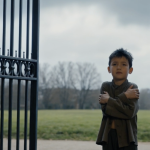
The Storm That Bowed — Part 2
The plank tore loose with Old Maren still clinging to the railing.
Eira didn’t think.
“GO!” she screamed — at a dragon. At a two-hundred-year-old terror. As if it were a sheepdog.
And it went.
The wing snapped shut. The wind of its launch knocked Eira backward into the shallows, Tomos still locked in her arms, and the grey shape crossed the river in two heartbeats.
Maren was in the water now. A grey head, a white braid, going under.
The dragon didn’t dive. It dropped — wings flared, talons open — and plucked the old woman out of the flood the way a hand lifts a kitten from a basin. Gently. Impossibly gently.
It set her on the high rock above the far bank and turned its head back toward Eira across the roaring water.
Waiting.
“It wants you,” Tomos whispered.
Eira’s legs were water themselves. But she stood.
The dragon returned, landed, and lowered its foreleg like a step on a carriage.
Up close, she could see scars under the scales. Old ones. A tear in the wing membrane, long healed, the shape of a spear-point.
“You knew my grandmother,” Eira said.
“I knew her hands,” the dragon said. Its voice was rockslide and hearth-fire at once. “They pulled three spears out of me when your village’s hunters left me to die in the high snow. Sixty winters ago.”
The rain hammered down between them.
“She never told anyone.”
“She promised she wouldn’t.” The amber eye blinked, slow as a door closing. “And I promised that if the water ever rose against her blood, I would rise against the water.”
Eira’s throat closed.
The letter. The candle. A debt we don’t speak of.
Her father hadn’t been hiding shame.
He’d been keeping a promise so old he was afraid saying it aloud would break it.
“My grandmother died four years ago,” Eira said.
“I know.” The dragon’s head dipped lower. “I watched the lanterns from the crags the night they carried her up the hill. I have watched every storm since. Waiting to pay.”
Across the river, forty people were pressed against the chapel wall as the water climbed the steps.
“Then pay,” Eira said, and climbed onto its shoulder.
The first flight of her life lasted eleven seconds, and she would remember every one of them until she was older than Maren.
They worked until dark.
The dragon could carry four at a time — two in each foreclaw, cradled like eggs — and Eira rode its neck, shouting names, pointing, keeping panicked people calm because the healer’s girl is up there, look, she’s not afraid — though she was, she was terrified, and she did it anyway.
The miller. The twins. The blacksmith who had once sworn he’d put a bolt through the beast’s eye on sight — who now wept openly into its scales as it lifted him over the flood.
Old Maren was last to be carried down from the rock. She looked up at the great grey head and laughed — a cracked, astonished sound.
“Sixty years,” she said. “Branwen, you sly fox. You never said a word.”
The dragon made a sound Eira would later swear was a chuckle.
By midnight, the rain broke.
Forty-one people stood on the high meadow above the drowned valley, soaked, shaking, alive. Every single one.
The dragon stood apart from them at the meadow’s edge, steam rising off its scales, suddenly awkward — a mountain that didn’t know what to do with its hands.
It was Eira’s father who moved first.
Bran walked across the wet grass, stopped before the creature his mother had saved in secret, and bowed. Low. The way you bow to a king, or a debt finally settled.
“The letter,” he said hoarsely. “She wrote that if you ever came, we were to give you a name in front of everyone. She said you’d never had one spoken aloud by people.”
The meadow went silent.
The dragon went very, very still.
“She called you Vyrren in her letters,” Bran said. “Is that right?”
Something moved through the great body — a tremor, nose to tail.
“No one,” the dragon said quietly, “has said it where others could hear. In three hundred years.”
“Vyrren,” said Eira.
“Vyrren,” said Tomos, from behind her skirt.
“Vyrren,” said forty soaked, exhausted, weeping villagers, one after another, the name passing down the line like a torch.
The dragon closed its eyes.
When it opened them, it looked only at Eira.
“Your grandmother pulled spears out of me,” Vyrren said. “But this — this is the wound healed.”
He stayed.
Not in the village — he was far too large, and besides, dragons like high places — but on the crags above it, where for two hundred years children had been told a monster lived.
Now children climbed up on clear days with baskets of smoked fish they pretended he needed.
The valley rebuilt. The bridge went up new and stronger, and into its keystone the blacksmith — the same one who’d sworn to kill him — carved a single wing.
And every year, on the anniversary of the flood, the whole village walks to the high meadow at dusk, and forty-one voices say one name into the evening air, so it is never unspoken again.
Eira’s grandmother never told a soul what she did in the high snow sixty winters ago.
She just trusted that kindness, buried long enough, becomes a root.
And roots hold — even when the whole forest falls.
Have you ever discovered that someone you loved was quietly carrying a secret act of kindness for years? Tell us in the comments.