
…reached up and touched the window.
Just his fingertips. Against the glass.
The way you touch something you thought you’d lost.
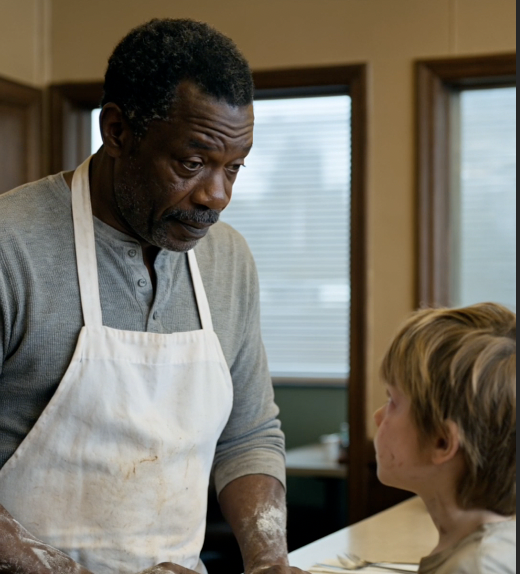
Marcus had his back turned when the bell above the diner door rang. He was filling the coffee station, the same motion he’d done ten thousand times in twenty years, his hands moving from habit while his mind moved somewhere quieter.
He heard the door.
He heard the room change.
Not the sound of it — the weight of it. The particular stillness that falls when something unusual walks through a door and the people already inside sense it before they understand it.
He turned.
The man standing at the entrance was around thirty. Dark suit, no tie. A face that was arranged calmly but not easily — the kind of face that had learned composure the hard way. He was looking directly at Marcus.
And Marcus didn’t recognize him.
Not at first.
The man walked slowly to the counter.
He sat down on the same stool.
He placed something on the formica between them.
A coin.
Old. Silver, or close to it. Scratched on both faces, worn smooth at the edges.
Marcus’s hand stopped moving.
“You kept it,” he said.
“I kept it.”
Ethan — because it was Ethan, of course it was Ethan — looked at the chef without performance. No smile yet. Just looking. The way you look at a place that existed inside you for longer than it existed in your memory.
“I wasn’t sure you’d still be here,” Ethan said.
“Where else would I go?”
The diner was watching again. Same as before. Different faces, same instinct — the sense that something was happening that didn’t belong to them but that they were witnessing anyway.
Ethan didn’t seem to notice.
“I thought about you,” he said. “More than made sense, probably. I thought about you when I was still in the system, when I got my first placement. When I got my second. I thought about you the night I decided to stop being angry about all of it.”
Marcus leaned against the counter. He was quiet. Some people are quiet because they have nothing to say. He was quiet because he understood that this moment wasn’t his to fill.
“I thought about you the morning I signed the papers,” Ethan continued.
“What papers?”
Ethan reached into his jacket. He set a folded document on the counter beside the coin.
Marcus opened it.
It took him a moment to understand what he was reading.
It was a deed. Commercial property. The address printed at the top was the same address they were sitting in.
He looked up.
“I bought the building,” Ethan said simply. “Six months ago. I’ve been waiting to make sure the numbers were right before I came back.”
“Ethan—”
“I’m not giving it to you.” He shook his head. “I’m giving it back to you. There’s a difference.”
Marcus set the paper down.
His hands were not entirely steady.
“I fed you breakfast,” he said. “That’s all I did.”
“No.” Ethan’s voice didn’t rise. “You saw me. In a room full of people who were looking directly at me and choosing not to. You saw me, and then you did something about it. That’s not nothing. That doesn’t get filed under breakfast.”
The manager — a different one now, younger, standing near the register — hadn’t moved in three minutes.
The woman at the window table had stopped pretending to read her book.
Marcus picked up the coin.
He turned it over in his fingers.
“You were going to give this to me,” he said. “A ten-year-old boy with nothing was going to give me the only thing he had.”
“You wouldn’t take it.”
“I know.”
“So I kept it. And I thought — if I ever made it, if any of it ever worked out — the first thing I’d do is come back and make sure you were all right.”
Marcus set the coin down gently.
He reached under the counter.
He brought out a plate.
Pancakes. Eggs. Sausages. Orange juice, cold enough that the glass had already begun to fog.
He placed it in front of Ethan.
“Then you’ll eat first,” he said. “And we’ll talk after.”
Ethan looked at the plate.
Something moved across his face — not grief exactly, not joy exactly. Something older than either.
He picked up the fork.
He ate.
And Marcus stood across the counter and watched him the way you watch something you’d almost stopped believing in.
The diner kept moving around them — coffee cups refilling, plates clattering, the door ringing its small bell every few minutes. Life doing what life does, indifferent and ongoing.
But at that counter, between an old chef and the man who used to be a hungry boy, something had come full circle quietly enough that most of the room didn’t notice.
Only the woman at the window table was still watching.
She had her hand pressed to her mouth.
She didn’t know why she was crying.
Maybe she did.
When Ethan finally set the fork down, he reached into his jacket one more time and slid a second document across the counter.
“That’s yours too,” he said. “Full ownership. No conditions.”
Marcus looked at it for a long moment.
“You didn’t have to do this.”
“I promised.”
“You were ten.”
Ethan met his eyes.
“A promise is a promise.”
Marcus folded the document. Held it in both hands. Looked at this man who had been a child, who had been hungry, who had been invisible in a room full of people — and who had carried a scratched coin through twenty years of whatever life had required of him, just to come back and keep his word.
“Thank you,” Marcus said.
It was quiet and it was enough.
Ethan nodded.
He picked up the coin from the counter and held it out one final time.
“Now you take it,” he said.
This time, Marcus did.
Have you ever been shown kindness by a stranger that changed the direction of your life? Tell us about it in the comments.