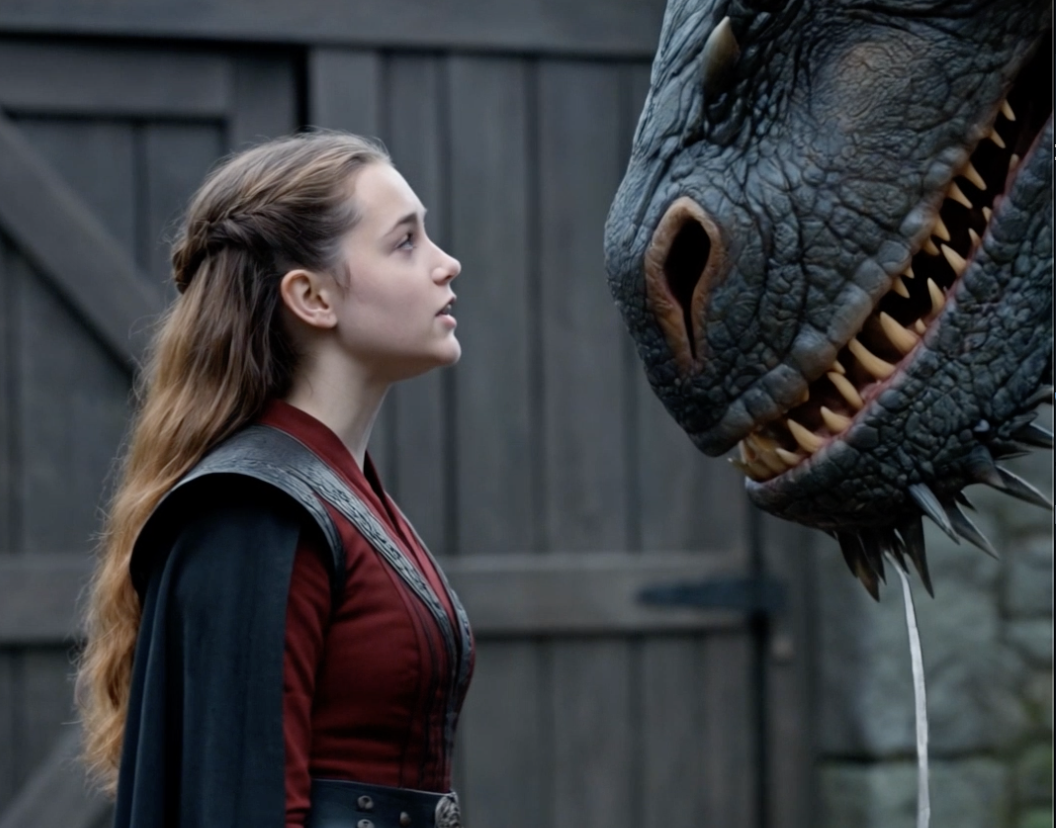

Her fingers touched the edge of his jaw.
The sound stopped.
Ash went absolutely still — not the stillness of a predator before a strike, but the stillness of something that has been bracing for a blow for so long it has forgotten what the absence of one feels like.
Mira kept her hand where it was.
The scales under her palm were rough at the edges and warm in the grooves, warmer than she expected. Like stone that has held the sun all day. She could feel him breathing — slow and uneven, the rhythm of something exhausted.
She didn’t speak.
Neither did he.
Outside the garrison walls, she could hear the soldiers’ morning routines beginning. Boots on stone. A horse being led to water. The distant clang of the farrier’s hammer.
None of it mattered in here.
After a long time, Ash’s eye closed again.
But this time it wasn’t the closing of something shutting the world out.
It was the closing of something that had, for just a moment, stopped having to.
She came back the next morning.
And the one after that.
On the fourth morning, Old Brennan found her inside the gate and grabbed her arm hard enough to leave a mark.
“You have no idea what you’re doing,” he said.
“I know.” She looked up at him steadily. “But neither does anyone else.”
He stared at her for a long moment.
Then he let go of her arm.
“His last keeper,” Brennan said, his voice going flat, “was a man named Cavel. He trained Ash from a hatchling. Eighteen years.” He paused. “The Commander had him executed for refusing to fly Ash into a burning village.”
Mira didn’t look away.
“And Ash saw it,” she said. It wasn’t a question.
Brennan looked at the dragon. At the dulled scales, the untouched food, the wings that hadn’t opened in two months.
“He saw it,” he said.
She didn’t bring chains.
She didn’t bring commands.
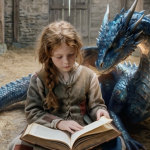
On the sixth morning she brought a small brush — the kind used for horses — and spent three hours working the grit out of the scales along Ash’s left flank while he stood with his eyes half-closed and his breathing steady.
On the ninth morning, he ate.
Not from the bucket.
He ate when she was sitting beside him, her back against his foreleg, talking quietly about nothing — about the laundry pots, about the way her mother hummed when she thought no one could hear, about a dog she’d had once that was taken for the army.
She wasn’t talking to him, exactly.
She was just talking.
And at some point, without ceremony, he lowered his head to the bucket and ate.
Commander Aldric summoned her on the eleventh day.
She stood in front of his desk — barefoot, tunic still damp from the morning courtyard — and he looked at her the way men like him look at things they don’t understand but have decided to use.
“You’ve done what a dozen trained keepers couldn’t,” he said.
“I didn’t do anything,” Mira said.
“You got him eating.”
“He decided to eat.”
Aldric studied her. “I want you reassigned. Full keeper’s wages. You’ll be responsible for — “
“No.”
The room went quiet.
Aldric set down his quill.
“No?” he repeated, carefully.
“Not if you’re going to fly him into villages.” She held his gaze. Her hands were completely still at her sides. “Not if he’s a weapon. I won’t be part of that.”
The silence lasted a long time.
Outside, a crow called once and went quiet.
“You are a serf girl,” Aldric said, “with no land, no name, and no protection.”
“Yes,” Mira said. “And Ash is a dragon with no freedom, no choice, and no one who sees him as anything but an instrument.” She paused. “So we understand each other.”
Aldric looked at her for a very long time.
Then he looked at the window, toward the courtyard, where Ash’s iridescent neck ridge was just visible in the grey morning light.
Something shifted in his face — not softness exactly, but a kind of fatigue. The fatigue of a man who has enforced things for so long he has stopped asking whether they were worth enforcing.
He picked up his quill.
“Keeper’s wages,” he said, not looking at her. “And the dragon does not fly until I have spoken with the Northern council about — revised deployment terms.”
It wasn’t freedom.
But it was the first bend in a wall she had thought was solid.
She went back to the courtyard.
Ash raised his head when she came through the gate.
She crossed the wet cobblestones and sat down with her back against his foreleg the way she always did.
His exhale came warm over her shoulder.
She tilted her head back against his scales and closed her eyes.
Two creatures who had been told, every day of their lives, that they belonged to someone else — sitting in the grey morning, in the particular silence of those who have found, in each other, the strange and stubborn fact of their own worth.
She didn’t know what came next.
Neither did he.
But for the first time in longer than either of them could remember, that was all right.
Have you ever met someone — or something — that made you remember you were more than what the world had decided you were? Tell us in the comments.