
…was waiting.
The room went silent.
Every head turned toward the door.
It shuddered again — not violently, not frantically, but with the patient, deliberate pressure of something that had walked a long way through deep snow and was simply announcing itself.
Aldric stepped backward without appearing to mean to.
Voss gripped the arms of his chair.
Mira did not move.
She closed her eyes for one breath.
Then she crossed the room, lifted the latch, and opened the door.
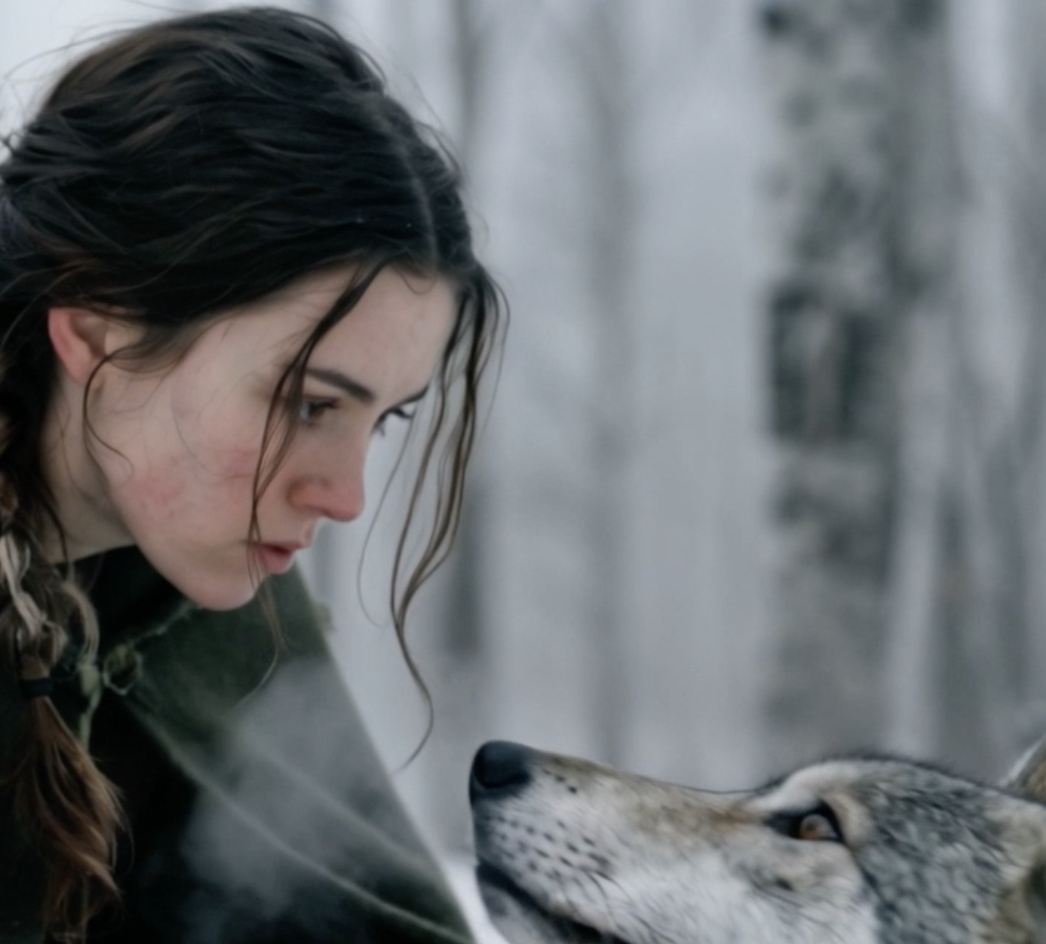
Ash stood in the doorway.
Upright. Standing on all four legs in the snow, her silver fur dusted white, her breath rising in slow curls in the torchlight. The wound in her shoulder was wrapped in the same cloth Mira had used that morning — still clean, still tied exactly as Mira had tied it.
She was thin. She was not fully steady.
But she was standing.
And she was looking, past Mira, directly into the room — at the crowd of people pressed backward against the far wall, at Aldric with his folded arms now hanging open at his sides, at Elder Voss in his chair with his mouth slightly open and his authority visibly deserting him.
The wolf looked at all of them.
Then she turned her head and looked at Mira.
The hall was so quiet that the fire was the loudest thing in it.
Mira looked back at the wolf for a long moment.
Then she spoke — to the room, not to Ash, but without turning around.
“She was shot,” Mira said. “Four days ago. At the tree line. A careless shot, in low light, by someone who didn’t wait to see what they’d hit.” She paused. “I found her before dawn. I stayed with her until she could stand.”
Nobody spoke.
“That is what I was doing in the forest,” Mira said. “That is all I was doing.”
Voss found his voice first.
“You brought it here,” he said. The fear in him was working to become anger, the way fear usually does when it needs somewhere to go. “You brought a wolf to my door—”
“She brought herself,” Mira said.
She turned now to face the room fully.
“I didn’t call her. I didn’t lead her here. She followed my tracks through two feet of snow across half a mile of forest because—” She stopped. Steadied herself. “Because that is what living things do when someone has been kind to them.”
The room was very still.
Aldric’s face had gone a particular color. Not anger. Not fear. The specific pallor of a man standing in a room full of his neighbors with evidence of his own carelessness wrapped in clean cloth and standing in the doorway looking at him.
“That arrow,” Mira said quietly. “Was it yours?”
Aldric said nothing.
The answer was in his face.
“I’m not asking for anything,” Mira said. “I’m not asking you to apologize to me. I’m asking you to look at her and understand that what you shot at in the dark was not a threat. It was a living creature going about its life at the edge of a forest it had every right to be in.”
She turned back to the door.
Ash had not moved. She stood in the snow with the patience of something that had learned, over a difficult week, that Mira was worth waiting for.
Mira crouched down to the wolf’s level.
She looked at the wrapped shoulder. At the legs that were trembling slightly with the effort of standing. At the eyes that had found her face and were not letting go.
“You walked all this way,” she said softly.
Ash pressed her nose briefly against Mira’s cheek.
Then she turned, carefully, and began walking back through the snow toward the tree line.
She didn’t look back.
She didn’t need to.
Behind Mira, the hall remained silent for a long time.
It was Petra who spoke first.
She spoke from the back of the room, where she had been standing since the door opened, with her hands pressed together in front of her and her eyes fixed on the floor.
“I’m sorry,” Petra said. “I shouldn’t have—”
“I know,” Mira said.
She didn’t say it coldly. She said it the way she said most things — simply, without decoration, with the particular economy of someone who has long since decided that holding things against people costs more than it returns.
“You were frightened,” Mira said. “People do things when they’re frightened.”
She picked up her cloak from where she’d left it by the door.
“I’m going to go make sure she gets back safely,” she said to the room. To no one in particular. To all of them.
She walked out into the snow.
Elder Voss sat in his chair for a long time after she left.
The crowd that had gathered for a trial dispersed quietly, in ones and twos, back into the cold night. They went home to their fires and their families and the private reckoning that happens in the space between what a person nearly did and what actually occurred.
Aldric was the last to leave.
He stood in the doorway of the hall for a moment, looking out at the tracks in the snow — Mira’s boots, and beside them, the four-point press of wolf paws, side by side all the way to the tree line.
He stood there for a long time.
In the spring, when the snows broke and the forest edge became passable again, the village children began reporting something strange. A silver wolf, seen at the tree line in the early mornings. Never threatening. Never coming closer than the edge of the trees.
Just present.
Watching the village with amber eyes and then turning back into the forest when the day fully broke.
The elders said nothing about it.
Aldric, for his part, stopped hunting at the tree line.
He didn’t explain why.
He didn’t need to.
And Mira continued what she had always done — moving quietly through the village and its edges, staying with whatever needed staying with, asking nothing, explaining nothing, simply present in the way that certain people are present, which is to say completely, which is to say enough.
Some healings are of the body.
Some are of something older and less nameable.
Mira had always known how to do both.
Have you ever shown kindness to something the world had given up on, and found it changed you more than it changed them? Tell us in the comments.