
…from a portrait in the palace gallery she had walked past ten thousand times.
The third king. The one who had ordered the ledger made.
The one whose reign had ended, the histories said, when he simply disappeared.
No body. No successor named. Just — gone, between one season and the next, and the court had moved on because courts always move on, and three hundred years of other business had buried the question under everything else.
She looked at the scarred eye.
The portrait had shown a man of about sixty. Pale. Long-faced. A quality in the eyes she had always found difficult to name — something between intelligence and damage.
She was looking at that same quality now.
In a dragon.
“You refused,” she said.
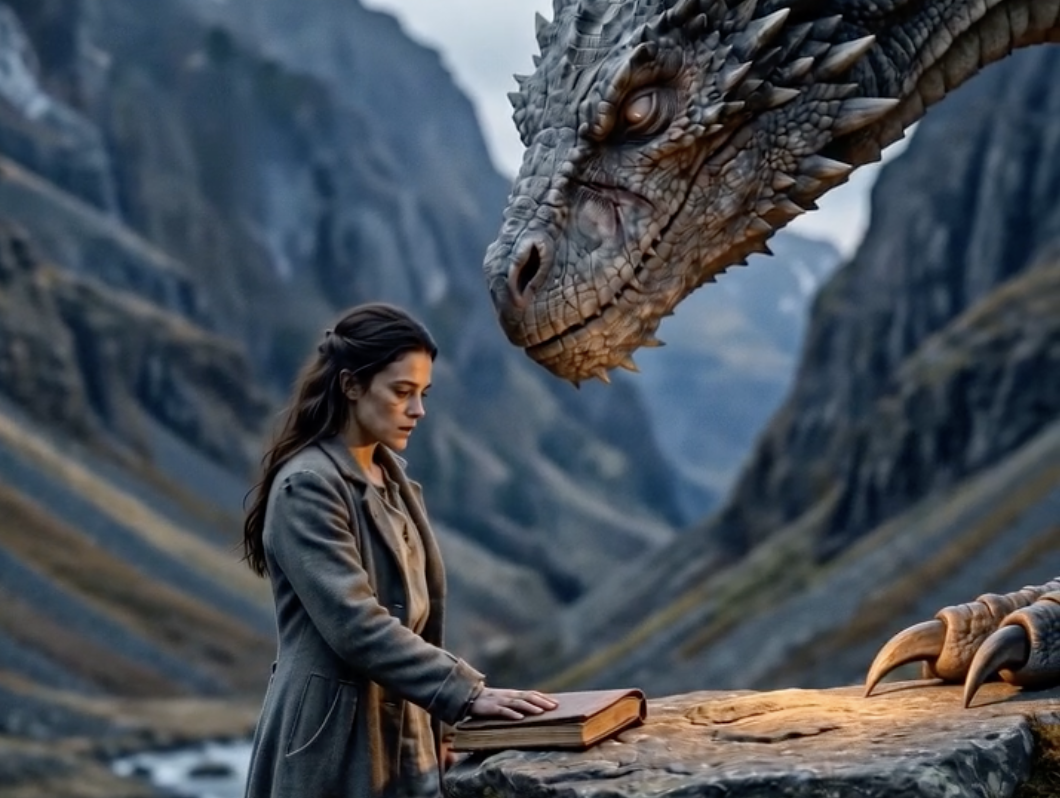
Orin did not answer immediately. He lowered his great head until it was closer to her level — not all the way, but enough that she could see the individual scales around his jaw, each one layered like old roof tiles, some cracked and dark at the edges.
“I was the one who built the law,” he said. “I knew its mechanism. I knew that if I spoke my own name into the fire, I would become what I had made others become.” A slow exhale. “I found I could not do it.”
“So you gave yourself to yourself.”
“I gave myself to the punishment’s other option.” The scarred eye moved — a slow blink. “I did not anticipate that I would live this long. Or that I would remember everything.”
Sela sat down on the rock beside the ledger.
She didn’t plan to. Her legs simply decided.
“The others,” she said. “The ones in the book. They’re all —”
“Gone. Yes. Dragons don’t live as long as the stories claim. Most lived a generation. Two at most.” He paused. “I have had considerably more time to think about what I did.”
She looked at the closed ledger under her hand.
All those names. Court officials, merchants, healers, minor lords. People who had known something, or refused something, or simply been inconvenient. Three hundred years of inconvenient people, transformed and eventually gone.
And one king who had built the machine and then stood inside it and found he couldn’t pull the lever on himself, and had been living inside the consequence ever since.
“Voss is going to do it again,” she said.
“Yes.”
“He found the original texts. The mechanism. He’s been —” She stopped. Reorganized. “He’s been looking for someone who knows the cipher. Someone who could reconstruct the full process from the archive documents.” She looked up. “He sent me to the archive.”
“I know.”
“He thinks I’ll lead him here.”
“You have.”
The word landed flat and cold.
She stood up immediately, turning to scan the canyon entrance — but Orin’s voice came again, unhurried.
“He followed you from the palace. He is at the canyon mouth. He has been there since this morning.”
She turned back.
“You knew.”
“I have been waiting three hundred years for someone to come with that ledger and that particular look in their eyes.” The ancient gaze held hers steadily. “Someone who read the sealed documents. Who understood what they held. Who came here not to destroy me but to understand.”
“I came here because I didn’t know where else to go.”
“I know that too.”
She stood very still.
“What do you want from me?”
Orin was quiet for a long moment. The canyon breathed around them. Somewhere at its mouth, Chancellor Voss was waiting with whatever he had brought and whatever he intended.
“I want you to take the ledger,” Orin said. “Out of this canyon. Past him if you can. To the capital archive, the open one — the one the public can enter. I want it on a shelf where anyone can find it.”
“That’s all?”
“That, and your testimony. Written. Filed. Under your name.” He paused. “Your real name. Not the one in the ledger. The one you chose.”
She picked up the ledger.
It was heavier than it looked. Or perhaps she was only now feeling its full weight.
“And you?”
Orin lifted his head — slowly, back to its full height, the broken edges of him reassembling into something that was not quite dignity and not quite ruin but somewhere true between the two.
“I have been here long enough,” he said.
She didn’t ask what he meant. She understood.
She tucked the ledger inside her coat, against her ribs. She checked the blade at her belt — not much, but something. She looked once more at the ancient face above her.
“I’ll file it under both our names,” she said.
Something shifted in the amber eye.
She turned and walked toward the canyon mouth, into the cold wind, toward whatever Voss had brought.
She did not look back.
But she walked like someone who had been given a reason.
Have you ever discovered a truth that was buried on purpose — and had to decide whether the cost of telling it was worth it? Tell us in the comments.