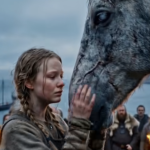

He stopped himself after one step.
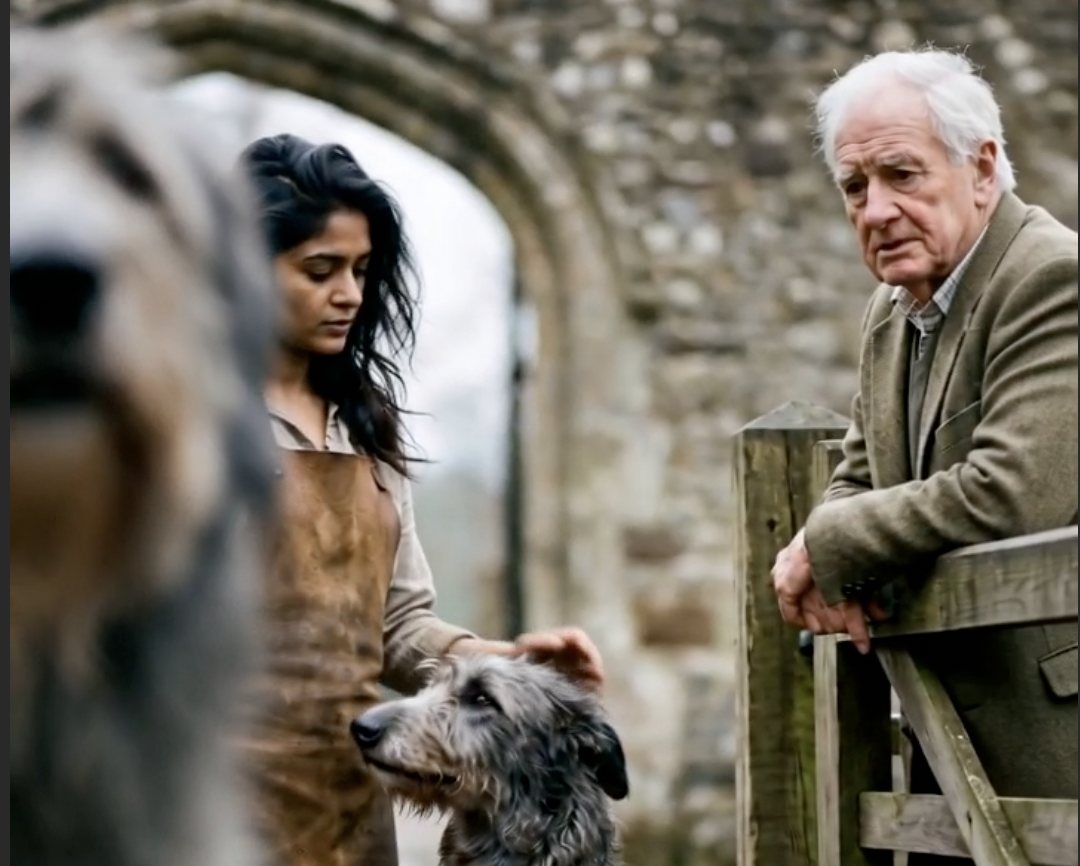
The yard was still watching her. The lords, the lady, the earl with his hands clasped behind his back — all of them with their eyes on the girl and the hound. No one was watching an old man at the fence.
Calder made himself breathe.
He studied her the way you study something you are afraid to believe. The set of her shoulders. The way she stood — not triumphant, not performing. Just present. The way a person stands when they have always been that way, quietly, without needing anyone to confirm it.
She was looking back at the crowd now.
Her eyes moved through the faces and slid past him again, and he understood, then, that she wasn’t looking for him. She didn’t know there was anything to find.
She had been told, like everyone else, that the child had drowned.
He had been told the same.
He had believed it for six years.
He took another step forward. The gravel shifted under his boot and she heard it — she glanced toward the sound — and for a moment her gaze snagged on his face.
She looked away. Then looked back.
Something in his face, perhaps. The stillness of it. The particular way grief and recognition wear the same expression when they arrive together.
“You,” he said.
It came out barely above a whisper. Not loud enough for the lords to hear.
She heard it.
“I don’t know you,” she said carefully.
“No.” His voice was steady only because he had spent a lifetime making it steady. “You wouldn’t.”
He crossed the yard toward her, slowly, and the earl made a sound of mild irritation at the disruption, but did not intervene — Calder had been a guest of this house for thirty years, and one did not call across a yard at Calder.
He stopped a few feet from her.
He was looking at her the way you look at something returned from a great distance. Like you are checking the margins, verifying the edges.
“Where did you learn that call?” he asked.
She frowned. “I didn’t learn it.”
“No,” he said again. Softer now. “You were taught it. Before you could properly remember being taught.”
The brindle hound was still leaning against her leg.
She looked down at it, then back at him. Her face was careful — not frightened, not yet — just the face of someone weighing something unfamiliar.
“There was a flooding,” he said. “On the Hartwick estate. Six years ago. They told me—”
He stopped.
He tried again.
“You had a way with the animals,” he said. “Even then. You were twelve. I used to bring you into the runs before dawn so you wouldn’t wake the handlers.”
Her hand, still resting on the brindle’s head, went very still.
She didn’t speak.
“I taught you the call,” he said, “because you asked me why the hounds always calmed when I hummed, and you wanted to learn, and I—”
He stopped again. Something behind his eyes was doing what old grief does when something moves it unexpectedly.
“I thought you were gone,” he said.
The yard was entirely quiet now.
She looked at his face — his clouded eye, his jaw set against itself — and something moved in her expression that she didn’t have a name for yet. Not recognition, not exactly. More like the feeling of a word you’ve always known without knowing you knew it.
“You called me something,” she said slowly. “Didn’t you. Before my name.”
He nodded, once.
“Little wren,” he said.
She had carried that word her whole life and never known where it came from. Had thought it was nothing. Had thought it was just something someone had said once, the way people say things to small children that don’t mean anything.
She looked at him for a long time.
Then she said: “You never told anyone your name when you came to the kennels. Not even me.”
“No,” he said. “I didn’t.”
“I called you the man who smells like woodsmoke.”
Something very close to a smile crossed his face — brief, involuntary, undone almost immediately by everything else.
“That’s fair,” he said.
Around them, the yard had ceased to be a performance. The lords were quiet. The earl had taken his hands from behind his back and was watching with an expression he hadn’t worn in a long time, if ever. Lady Ashmore had put down her glove.
The brindle hound had not moved from Wren’s side.
She didn’t reach for Calder. Not yet. She was eighteen and she had learned, over the course of eighteen careful years, not to move toward things before she understood them. But she stayed very still, and she did not look away from him, and that itself was a kind of answer.
“I don’t know what to do with this,” she said.
“Neither do I,” said Calder.
He offered his hand. Not dramatically — just an open hand, held at his side, the way you might offer a hound the back of your knuckles before you ask it to trust you.
She looked at it.
Then she placed her calloused, cold hand in his.
Have you ever met someone who gave you back a piece of yourself you didn’t know was missing? Tell us in the comments.