
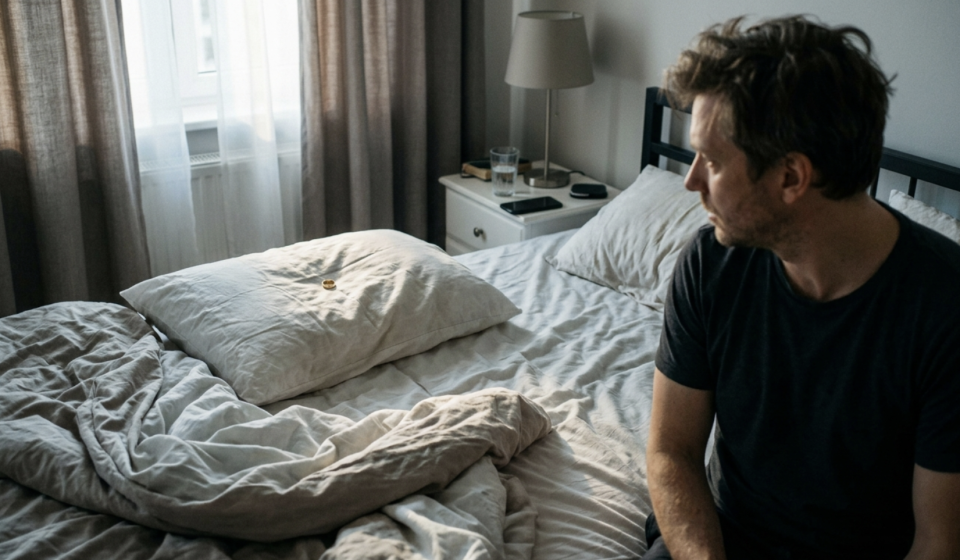
I Spent One Night With My Ex-Wife After Our Divorce—Then She Left Her Wedding Ring on My Pillow.

PART 3
My heart began to pound.
“Serious enough?”
Hannah lowered her voice.
“Mr. Bennett, Vivian has been receiving treatment for a serious illness. She has been trying to manage it for quite some time.”
The hallway seemed to tilt beneath my feet.
“What illness?”
“I’m not authorized to discuss her entire medical history with you. But she’s awake, and she knows we called. She asked whether you had arrived.”
For the first time since the phone rang, I felt something other than fear.
Hope.
“She asked about me?”
Hannah nodded.
“Then, when I told her you were on your way, she asked me to make sure you understood that she hadn’t called you here to ask for anything.”
I didn’t understand.
Not her words.
Not the ring she’d left on my pillow.
Not the message telling me to be happy.
For three years, I had believed Vivian wanted a life without me.
Now I was standing outside a hospital room, learning that the woman I had loved for more than two decades had been carrying a secret she had never trusted me enough to share.
I looked at Hannah.
“Please take me to her.”
She opened the door.
And there, in a narrow hospital bed beneath a white blanket, was Vivian.
My Vivian.
The woman who used to sing off-key while making pancakes on Sunday mornings. The woman who cried during old movies and pretended she had allergies. The woman who once drove forty minutes in a thunderstorm because I had forgotten my lunch at home.
She looked so small that I barely recognized her.
Her cheeks had hollowed. Her hair was shorter than it had been at Emma’s wedding, and a pale scar disappeared beneath the collar of her hospital gown.
But when she turned her head and saw me, her eyes filled with tears.
“Lucas.”
I couldn’t move.
She tried to smile.
“You came.”
Something inside me broke.
I crossed the room in three steps and stopped beside her bed.
“What happened to you?”
She looked down at her hands.
“I’m sorry.”
“No.” My voice came out harsher than I intended. “Don’t do that. Don’t start with an apology. Tell me what’s happening.”
Her lower lip trembled.
“I didn’t want you to see me like this.”
“Like what?”
She looked up.
“Like someone who might not get better.”
For several seconds, I couldn’t hear anything except the steady beeping of the monitor beside her bed.
Then I pulled a chair closer and sat down.
“Vivian, look at me.”
She did.
“Whatever this is, you don’t get to decide by yourself that I can’t handle it.”
A tear slipped down her cheek.
“You always did that.”
“Did what?”
“Made everything sound simple.”
I reached for her hand.
It was cold.
Three years earlier, I had held that same hand on our porch while she told me she wanted a divorce. I had held it at the courthouse when we signed the final documents. I had held it one last time the night she came home, believing we might finally have found our way back to each other.
Now I was terrified that this would be the last time I ever touched her.
“Tell me the truth,” I whispered. “All of it.”
Vivian closed her eyes.
And finally, after three years of silence, she began.
“About four years ago,” she began, “I started feeling tired all the time.”
I listened without interrupting.
“At first, I thought it was work. Then I thought it was my age. I was waking up exhausted, losing my appetite, and sometimes I felt pain in my abdomen. I kept telling myself it would pass.”
“Why didn’t you tell me?”
She looked at me with an expression I couldn’t understand.
“Because I didn’t know how to tell you that something might be seriously wrong with me when you were already carrying so much.”
“Carrying what, Vivian? I was working in a woodshop. I wasn’t fighting a war.”
“You were taking care of everything.”
“That’s what being married means.”
She gave a small, sorrowful laugh.
“I know. That’s what you always said.”
She paused to catch her breath before continuing.
“Eventually, I went to see a doctor. They found something during the examination, and after more tests, I was diagnosed with ovarian cancer.”
The word cancer seemed to echo through the room.
I had heard it before. Friends had fought it. Coworkers had lost parents to it. I’d attended funerals where people whispered that terrible word as though saying it too loudly might make it worse.
But I had never imagined hearing it from Vivian.
“When?” I asked.
“Almost four years ago.”
I stared at her.
“Four years?”
She nodded.
“That was before the divorce.”
“Yes.”
I stood up so abruptly that the chair scraped against the floor.
“You knew you had cancer, and you asked me for a divorce?”
“Lucas—”
“No. I need to understand this. You were sick, and instead of letting me help you, you ended our marriage?”
Tears filled her eyes.
“I thought I was doing the right thing.”
“For whom?”
She couldn’t answer.
I walked to the window, pressing my hands against the sill.
For years, I had replayed the night she asked for a divorce. I had examined every conversation, every argument we hadn’t had, every evening we had spent sitting silently in the same room.
I had blamed myself for not noticing that she was unhappy.
I had wondered whether I had become boring, whether my work mattered more to me than our marriage, whether she had spent years waiting for me to become the man she needed.
And all that time, she had been fighting cancer.
I turned around.
“Did you ever consider giving me the chance to decide what I could handle?”
Vivian covered her mouth with one hand.
“Yes.”
“Then why didn’t you?”
“Because I knew you, Lucas.”
“You knew me for twenty-two years, and you still didn’t know that I would want to be there for you?”
“I knew you would be there.”
“Then what was the problem?”
She looked at me through her tears.
“You would have given up everything.”
I shook my head.
“You don’t know that.”
“I do. You would have closed the shop. You would have stopped seeing your friends. You would have spent every night beside my bed and every morning pretending you weren’t tired. If I got better, you would have told me it was nothing. If I got worse, you would have blamed yourself for not doing enough.”
My anger faltered because, in the quietest corner of my heart, I knew she wasn’t entirely wrong.
I would have done all those things.
But that didn’t make her decision right.
“You made me a stranger to my own wife,” I said.
She bowed her head.
“I know.”
“You made me believe I wasn’t enough for you.”
“I know.”
“You let me spend three years thinking that the woman I loved had simply stopped loving me.”
She began to cry harder.
“I know, Lucas. I know.”
I returned to the chair.
For a while, neither of us spoke.
Then I asked the question that had been tearing at me since I found the ring on my pillow.
“Why did you come to my house that night?”
Vivian looked up.
“Because I was tired of pretending.”
“Pretending what?”
“That I didn’t miss you.”
Her answer was so quiet that I almost didn’t hear it.
She took a shaky breath.
“I had been in remission for a while. My doctors were hopeful. I started thinking that maybe I could have a normal life again. Maybe I could go back to work without everyone looking at me with pity. Maybe I could stop thinking about hospitals every time I woke up.”
She smiled faintly.
“And then I saw you at Emma’s wedding.”
I remembered the way she had looked at me across the table.
The green dress.
The familiar smile.
The hand pressed against her side.
“I had told myself that seeing you would be easy,” she continued. “I thought three years was enough time to become strangers. But when you looked at me, I remembered everything. The good things. The bad things. The ordinary things I had taken for granted.”
Her fingers tightened around mine.
“I remembered how you used to leave the porch light on when I worked late. How you always saved the last piece of pie for me. How you pretended not to notice when I fell asleep during movies.”
“You always said you were resting your eyes.”
“I was resting my eyes.”
“You snored through the entire second half of The Notebook.”
She gave a weak laugh, and for a moment, I saw the woman I had married.
Then her smile faded.
“I came to your house because I wanted one night when I didn’t have to be the sick woman. I wanted to be Vivian again. Your Vivian. I wanted to sit in our kitchen, drink terrible coffee, and talk to you without wondering whether every conversation might be our last.”
I swallowed the lump in my throat.
“Then why did you leave?”
She looked toward the bedside table.
“Because I woke up before you did, and I panicked.”
“About what?”
“About how much I still loved you.”
I stared at her.
She continued before I could respond.
“I watched you sleeping. You looked peaceful. I thought about all the years we’d spent together and how easily I had destroyed the life we built. Then I thought about what would happen if I stayed. I would want another morning. Then another. Before long, I would be asking you to love me again, and I was terrified of making you go through everything I was facing.”
“So you left me a ring instead of a conversation?”
“I didn’t know how to say goodbye.”
“You could have started by telling me the truth.”
“I know.”
She looked down at her empty ring finger.
“I took it off because I thought you deserved to keep the memory of our marriage without being tied to what was happening to me now.”
I reached into my pocket.
I had brought the ring with me.
I didn’t know why. Perhaps some part of me had never accepted that the story was over.
I placed it on the blanket between us.
Vivian stared at it.
“I couldn’t throw it away,” I said. “I couldn’t put it in a drawer. I carried it around for two weeks, wondering whether I should send it back to you.”
She covered her eyes.
“I am so sorry.”
I let the silence settle before asking another question.
“What did Hannah mean when she said you had arranged for them to contact me?”
Vivian wiped her cheeks.
“After the divorce, I updated my medical records. I kept you listed as my emergency contact.”
“Why?”
“Because you were the person I trusted most in the world.”
I looked at her.
“Even after you divorced me?”
“Especially after I divorced you.”
I shook my head, unable to find the right words.
She continued.
“I know how that sounds. I know I had no right to keep asking you to be part of my life after I walked away from yours. But I couldn’t bring myself to replace your name with someone else’s.”
“Did Melanie know?”
“Everything.”
“Rebecca?”
“She knew about the cancer. She knew I still loved you. She was furious with me for leaving, but I begged her not to tell you.”
I leaned back in my chair.
Suddenly, the wedding made sense.
Rebecca’s insistence that we sit together. Her knowing smile. The song from our wedding playing just as the evening began to settle around us.
She hadn’t merely been trying to entertain two divorced people.
She had been trying to give us a chance to speak.
“Does everyone know except me?” I asked bitterly.
“No.” Vivian shook her head. “Most people know only that we divorced. I didn’t want anyone to pity me, and I didn’t want you to feel pressured to come back.”
I looked at her for a long time.
“Vivian, I loved you when we were young. I loved you when our hair started turning gray. I loved you when we barely spoke at dinner. I loved you when you told me you wanted to leave.”
My voice cracked.
“And I loved you after you left.”
She pressed my hand against her cheek.
“I know that now.”
“No,” I said gently. “I don’t think you do. Because if you did, you would have understood that I wasn’t looking for a perfect wife. I was looking for my wife.”
She closed her eyes.
For the first time since I had entered the room, I stopped being angry.
I was still hurt. I suspected I would be hurt for a long time.
But beneath that hurt was something stronger.
Love.
Not the young, uncomplicated love we had felt when we first married, but something that had survived loneliness, mistakes, distance, and three years of unanswered questions.
I leaned forward and kissed her forehead.
“We have a lot to talk about.”
She nodded.
“Yes.”
“But we’re not doing it all today.”
She looked at me uncertainly.
“What do you mean?”
“I mean you’re in a hospital bed, and I’m exhausted, and neither of us is going to solve three years of silence before lunch.”
A small smile appeared on her face.
“You always did make schedules for everything.”
“Someone has to.”
She laughed softly.
And for the first time that morning, the room felt a little less frightening.
But I still needed to know something.
“Are you going to get better?”
Vivian’s smile disappeared.
She looked at the window, where sunlight was slowly moving across the floor.
“I don’t know.”
It was the most honest answer she had given me.
And somehow, it was the one I needed most.
The next morning, I met Vivian’s oncologist.
His name was Dr. Harris, a gray-haired man with kind eyes and the tired expression of someone who had spent many years delivering news people never wanted to hear.
Vivian had given permission for him to discuss her condition with me.
He showed me the latest scans and explained what the doctors had discovered.
Her cancer had returned.
It had spread beyond its original location, and she had been experiencing symptoms for several weeks before her admission. The immediate problem that brought her to the hospital was treatable, but the underlying disease was serious.
There were treatment options.
There were risks.
There were no guarantees.
I listened to every word.
I asked questions until I understood what the doctors knew, what they didn’t know, and what decisions Vivian would face in the coming weeks.
When I finally returned to her room, she looked at my face and knew.
“What did he say?”
I sat beside her.
“He said there are things we can try.”
She searched my expression.
“Lucas, don’t tell me what you think I want to hear.”
“I’m not.”
“Is it bad?”
“Yes.”
Her eyes filled with tears.
“But he hasn’t told us to give up,” I continued. “And neither have I.”
She turned her face away.
“I don’t want you to watch me die.”
I felt those words like a blow.
I took her hand.
“Then don’t ask me to leave while you’re living.”
She stared at me.
I continued.
“I don’t know what the next six months will look like. I don’t know what the treatments will do to you or how many difficult days we’ll have. I don’t know whether we’re going to get the ending we want.”
I paused.
“But I know I don’t want to spend another day pretending you don’t matter to me.”
Vivian began to cry.
I moved closer and held her carefully, mindful of the tubes and wires.
For a long time, she rested her forehead against my shoulder.
Then she whispered, “What if I get worse?”
“Then we’ll face that day when it comes.”
“What if I can’t do the things I used to do?”
“Then we’ll find new things to do.”
“What if I become someone you don’t recognize?”
I pulled back just enough to look into her eyes.
“Vivian, I watched you grow older for twenty-two years. You watched me grow older too. We both changed. That’s what happens when people share a life.”
I brushed a strand of hair away from her forehead.
“You don’t have to stay the woman I married to remain the woman I love.”
She covered her mouth and wept.
And I held her until she was ready to let go.
Vivian was discharged five days later.
I drove her to Melanie’s house, where she had been living since the divorce.
Her sister opened the front door before we reached the porch.
She looked at Vivian, then at me.
For a moment, nobody spoke.
Then Melanie wrapped her arms around her sister and began to cry.
“Oh, Vivi.”
Vivian held her tightly.
“I’m okay, Mel.”
“No, you’re not.”
“I will be.”
Melanie closed her eyes.
“You don’t have to keep saying that.”
I stood on the porch, suddenly aware that I had entered a family conversation that had begun long before I arrived.
When they finally separated, Melanie turned to me.
“Lucas.”
I nodded.
“Melanie.”
She wiped her face.
“Thank you for coming.”
“I wasn’t going to stay away.”
Her expression changed.
“That’s what I was hoping you’d say.”
Inside, Melanie had prepared a room for Vivian with fresh sheets, flowers, and a small table beside the bed.
I helped carry her bag upstairs.
When I returned to the living room, Melanie was waiting for me.
“She needs people around her,” she said.
“I know.”
“She won’t always tell you when she’s hurting. She doesn’t want anyone to worry.”
“I know that too.”
Melanie studied me.
“Are you sure you can do this?”
I understood what she was asking.
Could I return to the life of a husband after three years of being told I was no longer one?
Could I endure the fear of losing someone I had already lost once?
Could I watch Vivian become weaker without letting fear consume every moment we had left?
I thought about it before answering.
“I can’t promise I’ll do it perfectly,” I said. “But I can promise I won’t disappear when things get difficult.”
Melanie nodded slowly.
Then she reached into a drawer and took out a thick envelope.
“There’s something else you should know.”
Inside were several notebooks, a folder of medical records, and a stack of envelopes.
On the front of the first notebook, Vivian had written a single word.
Lucas.
I stared at it.
“What is this?”
“Her journals,” Melanie said. “She started writing after the diagnosis.”
I opened the first notebook.
The first entry was dated almost four years earlier.
Today, I learned that my life might not be as long as I thought it would be.
I closed the notebook.
“I shouldn’t read these without her permission.”
Melanie nodded.
“I agree. But she asked me to give them to you if she ever became seriously ill.”
I looked at the stack of envelopes.
“Did she write all of these?”
“Yes.”
“Why didn’t she send them?”
“Because every time she finished one, she convinced herself that sending it would make everything worse.”
I stared at the envelope on top.
My name was written in Vivian’s familiar handwriting.
I took it with me when I left that afternoon.
But I didn’t open it until I reached home.
My house felt different that evening.
The porch swing creaked in the wind.
The rosebush beside the garage was still alive, just as Vivian had once asked.
Inside, the kitchen smelled faintly of the coffee grounds I had left in the machine that morning.
For years, I had tried to make the house feel less empty.
I had bought a new television. I had repainted the living room. I had replaced the old curtains Vivian had complained about for a decade.
None of it had helped.
Now, standing in the same kitchen where she had once asked me for a divorce, I realized that the emptiness had never been about the furniture.
It had been about the person who was missing.
I sat at the dining table and opened the envelope.
Dear Lucas,
If you’re reading this, Melanie has probably decided that I can no longer keep everything to myself.
I’m sorry. I know those words have become meaningless between us, but I don’t know where else to begin.
The day I learned about the cancer, I sat in my car outside the hospital for almost an hour. I watched people come and go. A woman carried a sleeping baby. An old man struggled to fold his umbrella. A young couple argued over where they had parked.
Everyone was living an ordinary day.
I remember thinking that I would give anything to have an ordinary day with you again.
I wanted to come home. I wanted to tell you everything. I wanted to let you hold me while I cried.
But then I pictured your face when I told you.
I knew you would try to save me.
You would find the best doctors. You would read every article. You would spend your nights searching for answers and your mornings telling me not to worry.
You would turn your entire life into a promise that I would survive.
And I was terrified that one day, when I couldn’t survive, you would believe you had failed.
I stopped reading.
My eyes were burning.
I walked to the sink, splashed water on my face, and returned to the table.
The letter continued.
I told myself that leaving you was an act of love.
I told myself that if I gave you enough time, you would meet someone who could grow old beside you without asking you to spend your final years in hospitals.
But there was another truth I was too ashamed to admit.
I was afraid.
I was afraid of becoming dependent on you. I was afraid you would see me sick and remember me that way. I was afraid that every beautiful memory we had made would eventually be replaced by the sound of hospital machines.
Most of all, I was afraid that I would need you so much that I would forget how to be myself.
I know now that I was wrong about what love required.
I thought love meant protecting you from my pain.
I didn’t understand that love also meant trusting you enough to let you choose whether you wanted to share it.
I lowered the letter.
For three years, I had believed Vivian left because she no longer wanted me.
But the truth was more complicated.
She had loved me so much that she had convinced herself she needed to disappear.
And in trying to protect me from losing her, she had made me lose her while she was still alive.
I continued reading.
There is one more thing I need you to know.
I have never stopped wearing my wedding ring in my heart.
The night I came to your house, I wanted to ask you to let me stay.
I wanted to wake up beside you again.
I wanted to make coffee in our terrible machine and complain that you had forgotten to buy milk.
I wanted to spend the rest of my life with you, however long that life might be.
But when I woke up, I remembered the promise I had made to myself: that I would not pull you back into a life you had already been forced to leave.
So I took off my ring.
I placed it on your pillow because I thought it was the only way I could leave you something honest.
I see now that it was another dishonest thing I did in the name of love.
I am sorry.
If I recover, I hope I can find a way to become brave enough to tell you everything.
If I don’t, I hope you will remember that the years we shared were the happiest years of my life.
You were never the burden I needed to escape.
You were the home I was too frightened to return to.
Love always,
Vivian.
I folded the letter carefully.
Then I sat at the table and cried.
Not because I had discovered that Vivian loved me.
I had always suspected that some part of her did.
I cried because I finally understood how fear had taken three years from us.
And because I knew we could never get those years back.
But we still had today.
For the first time in a long time, I knew what I wanted to do with it.
The following morning, I opened the woodworking shop at my usual time.
For twenty-eight years, the shop had been my refuge.
I had built dining tables, cabinets, rocking chairs, and custom bookshelves for families who wanted something that would last.
I liked wood because it taught patience.
You couldn’t force a crooked board to become straight simply by wishing it were different. You had to understand the grain, work with what was there, and accept that some marks would remain no matter how carefully you sanded.
I had spent years trying to repair furniture.
Now I wondered whether I had been equally determined to repair everything except my marriage.
My longtime employee, Tom, arrived at eight.
He took one look at me and put down his toolbox.
“You look terrible.”
“Good morning to you too.”
“Did you sleep?”
“Not much.”
He studied me.
“Is everything okay?”
I hesitated.
Then I told him the truth.
“Vivian’s sick.”
Tom’s expression softened.
“How sick?”
“Very.”
He didn’t ask me to explain.
He had known Vivian for almost as long as he had known me. He had attended our wedding and helped me build the kitchen cabinets in our first house.
After a moment, he said, “What do you need?”
I looked around the shop.
For years, I had believed that keeping the business running was one of the things that made me a responsible man.
But the machines could run without me.
Orders could be delayed.
Wood could wait.
“I’m going to need you to manage things for a while,” I said. “I’ll still handle the important decisions, but I may not be here every day.”
Tom nodded.
“Then that’s what we’ll do.”
Just like that, a burden I had spent years imagining became something simple.
I called Vivian after lunch.
She answered on the second ring.
“Lucas?”
“Have you eaten?”
There was a pause.
“Hello to you too.”
“Hello. Have you eaten?”
“Melanie made soup.”
“Did you eat it?”
“Some of it.”
“That’s not an answer.”
She laughed softly.
“You sound exactly like you did when I was pregnant with Emma’s godmother’s baby shower cake.”
“That was a completely different situation.”
“You insisted I needed three meals and two snacks.”
“You were trying to live on crackers.”
“They were very good crackers.”
I smiled.
For several minutes, we talked about ordinary things.
The weather.
The rosebush.
The ridiculous price of groceries.
Then I asked, “Would you like me to come over tonight?”
She became quiet.
“Are you sure?”
“No, Vivian. I’m not sure about anything anymore. But I know I want to see you.”
Her breath caught.
“Then yes.”
I went to Melanie’s house that evening with groceries, a small toolbox, and a bag of coffee beans from the shop near my house.
Vivian looked at the coffee.
“You brought your own?”
“I know how particular you are.”
She smiled.
“I thought you were the one who liked it strong enough to stand a spoon in.”
“I learned from the best.”
We sat at the kitchen table while Melanie went upstairs to make a phone call.
For a while, neither of us mentioned the future.
We talked about Emma’s wedding.
We talked about our old neighbors.
We argued about whether the blue paint in our first house had been a mistake.
Then Vivian reached across the table.
“Thank you for coming back.”
I took her hand.
“I didn’t come back, Vivian. I never really knew how to leave.”
Her eyes filled with tears.
And this time, she didn’t try to hide them.
The weeks that followed were not easy.
There were appointments, blood tests, scans, and long conversations with doctors. There were days when Vivian felt strong enough to walk around the garden and days when getting out of bed required more energy than she had.
Some mornings, she was optimistic.
On others, she was frightened and angry.
I learned that loving someone through illness did not mean knowing what to say.
Sometimes, it meant sitting quietly beside her while she cried.
Sometimes, it meant arguing with her when she refused to eat.
Sometimes, it meant leaving the room for five minutes because we were both exhausted and neither of us wanted to admit it.
We also had difficult conversations about our marriage.
One afternoon, while we sat in the garden, Vivian said, “I don’t expect you to forgive me.”
I looked at her.
“Why not?”
“Because I hurt you.”
“Yes, you did.”
She nodded.
“I know.”
“I don’t think forgiveness works the way you imagine it does,” I continued. “You don’t apologize once and then everything becomes fine.”
She looked down at her hands.
“I understand.”
“But I also don’t want to spend whatever time we have left punishing you for something we can no longer change.”
She lifted her eyes.
“So what happens now?”
I thought about the question.
“We tell the truth. We stop making decisions for each other. And when we’re afraid, we say we’re afraid instead of pretending we’re fine.”
She let out a shaky breath.
“That sounds difficult.”
“It will be.”
She smiled sadly.
“You always did prefer difficult projects.”
I laughed.
Then I reached for her hand.
“There is one thing I need you to promise me.”
“Anything.”
“Don’t tell me to leave because you think it will hurt less.”
She looked at me for a long time.
Finally, she nodded.
“I promise.”
I believed her.
Not because I was certain she would never become afraid again, but because this time we were making the promise together.
Three months after the hospital called, Vivian began another course of treatment.
The doctors had explained the possibilities carefully. They could not promise a cure, but they believed the treatment might control the disease and improve her quality of life.
Vivian decided to proceed.
I accompanied her to the hospital whenever she wanted me there.
On the days she preferred to go with Melanie, I respected that too.
We were learning how to love each other without turning love into control.
One afternoon, after a particularly exhausting appointment, Vivian sat in the passenger seat of my truck and stared out the window.
“I have a question.”
“Go ahead.”
“If I get better, what happens to us?”
I glanced at her.
“What do you mean?”
She twisted the strap of her bag between her fingers.
“I mean, we were divorced. We can’t pretend that everything is the same just because we still love each other.”
I nodded slowly.
“You’re right.”
She looked disappointed, though she tried to hide it.
I reached for her hand.
“I don’t want to go back to the marriage we had before. I want to build something better.”
“What if we make the same mistakes?”
“Then we talk about them before they become three years of silence.”
She laughed faintly.
“And if we discover we’re too different now?”
“Then we face that honestly too.”
She studied my face.
“You would really be willing to start over?”
“Vivian, I built a dining table for a customer last year who changed his mind about the finish four times. I can handle starting over.”
She burst out laughing.
It was the kind of laugh I hadn’t heard in years, full and unguarded, and it made me smile even as my eyes filled with tears.
Then she grew serious.
“I don’t want you to choose me because you’re afraid I’ll die alone.”
I turned toward her.
“I’m choosing to be here because I love you. Your illness didn’t create that love. It just forced us to stop pretending we didn’t have it.”
She held my hand against her cheek.
“Then I want to try again.”
I kissed her forehead.
“So do I.”
We didn’t rush into remarrying.
We didn’t need a ceremony to prove what we were trying to rebuild.
Instead, we began dating again.
At first, it felt ridiculous.
We had shared a bed for twenty-two years, and now I was picking Vivian up for dinner and asking what time she wanted me to arrive.
She insisted that I knock on Melanie’s front door instead of walking in with groceries.
I brought her flowers.
She made fun of me for choosing the same roses every time.
I took her to the little Italian restaurant where we had celebrated our fifth anniversary. The owner recognized us and asked whether we were celebrating another milestone.
Vivian looked at me.
“What should we tell him?”
I smiled.
“That we’re trying to get our first date right.”
The owner laughed and brought us a complimentary dessert.
For the first time in years, Vivian ate an entire meal without looking at the clock or apologizing for needing to rest.
It was a small evening.
But it became one of my favorite memories.
Around the fourth month, Vivian’s test results showed encouraging signs.
The treatment was helping.
Her doctors were careful not to promise too much, but the latest scans suggested the disease had responded.
When the oncologist explained the results, Vivian covered her face with both hands.
I reached for her.
“Is it good news?” I asked.
The doctor smiled.
“It’s encouraging news. We’ll need to continue monitoring her closely, but we’re pleased with what we’re seeing.”
Vivian began to cry.
So did I.
In the parking garage afterward, she sat in the passenger seat with the results folded in her lap.
“Lucas?”
“Yes?”
“I thought I would feel different.”
“Different how?”
“I thought if I got good news, all the fear would disappear.”
I nodded.
“I think fear is stubborn.”
She smiled faintly.
“Like you.”
“I’m much more handsome than fear.”
She laughed.
Then she reached for my hand.
“I want to go home.”
The word caught me by surprise.
“Your house or mine?”
She looked at me.
“Ours.”
I didn’t answer immediately.
I couldn’t.
I started the engine, then switched it off again.
Vivian turned toward me.
“What is it?”
I looked at her.
“For three years, I thought I was the only person who still considered that place home.”
Her eyes filled.
“I never stopped.”
We sat there holding hands until the parking garage began to empty.
That evening, I drove her to my house.
She walked slowly through the front door and stopped in the kitchen.
The same cabinets.
The same dining table.
The same ugly coffee maker.
She ran her fingers over the counter.
“You really haven’t changed anything.”
“I changed the curtains.”
She looked toward the living room.
“Oh, those curtains.”
“You hated them.”
“I still do.”
I laughed.
Then she turned toward me, and her expression became serious.
“Can I stay tonight?”
I looked at the woman I had once watched disappear before sunrise.
“Yes.”
She took a breath.
“But this time, I won’t leave without talking to you.”
I held out my hand.
“Then this time, we’ll make coffee in the morning.”
She placed her hand in mine.
And for the first time in three years, Vivian slept in our house without leaving a ring behind.
The next morning, I woke to the sound of a cupboard closing.
For one disorienting second, I thought I was dreaming.
Then I smelled coffee.
I walked into the kitchen.
Vivian stood beside the counter wearing one of my old sweatshirts, her hair untidy and her face still sleepy.
She looked over her shoulder.
“You bought the wrong coffee.”
I stopped in the doorway.
“What?”
“This isn’t the one we usually buy.”
“We haven’t bought coffee together in three years.”
“Exactly. You should have remembered.”
I stared at her.
Then I started laughing.
Not because it was funny.
Because it was ordinary.
Because she was there.
Because for the first time in years, I was standing in my kitchen with the woman I loved, arguing about coffee as though the world had briefly forgotten to be cruel.
She turned toward me.
“What?”
I crossed the room and wrapped my arms around her.
She rested her head against my chest.
“I missed this,” I whispered.
“Me too.”
We stayed like that for a long time.
Then the coffee machine made a terrible grinding noise.
Vivian pulled away.
“Honestly, Lucas. That thing sounds like it’s dying.”
“It’s been making that noise for fifteen years.”
“Then perhaps it’s time to let it go.”
I looked at her.
She looked at me.
And suddenly we were laughing so hard that I had to sit down.
It was the happiest morning I could remember.
Not because everything was fixed.
But because nothing had to be perfect for us to be happy.
Six months after Vivian came home, we sat together on the porch swing.
The rosebush beside the garage had bloomed.
It was late afternoon, and the sunlight had turned the garden gold.
Vivian leaned against my shoulder.
“Do you remember the first time we sat here?”
“Of course.”
“You had just bought the house.”
“And you told me the porch was too small.”
“It was too small.”
“You also said the kitchen needed renovating.”
“It did.”
“You said the garden was a disaster.”
“It was.”
I smiled.
“You were very difficult to please.”
She tilted her head toward me.
“And yet you married me.”
“Terrible judgment.”
She laughed, then grew quiet.
“Lucas?”
“Hmm?”
“There’s something I’ve been wanting to ask you.”
I turned toward her.
“Ask.”
She took a deep breath.
“Would you marry me again?”
I didn’t answer immediately.
She hurried on.
“I know it sounds foolish. We’ve already been married. We don’t need a wedding, and I don’t want you to feel obligated. I just keep thinking about the way we ended things. I don’t want the last official decision we made about our marriage to be the divorce.”
Her eyes glistened.
“I want us to choose each other again. Not because we’re afraid of losing time. Not because I’m sick. Just because we want to.”
I looked at her for a long moment.
Then I stood up.
She stared at me.
“Lucas?”
I walked into the house and returned with a small wooden box.
I had made it in the workshop the previous week.
Inside lay her wedding ring.
I had polished it carefully, though I had left a tiny scratch on the band because she had always said that the marks of a life well lived were nothing to be ashamed of.
I sat beside her and opened the box.
CONTINUE READING NEXT PART
