
— but it was not Nara who flinched.
It was the Head Arena Master, stepping back from the railing above the sand, his hand gripping the iron bar so hard his knuckles had gone white.
Because the bull had done something no amount of training, no amount of cruelty, no amount of isolation had ever produced in that arena.
He had bowed.
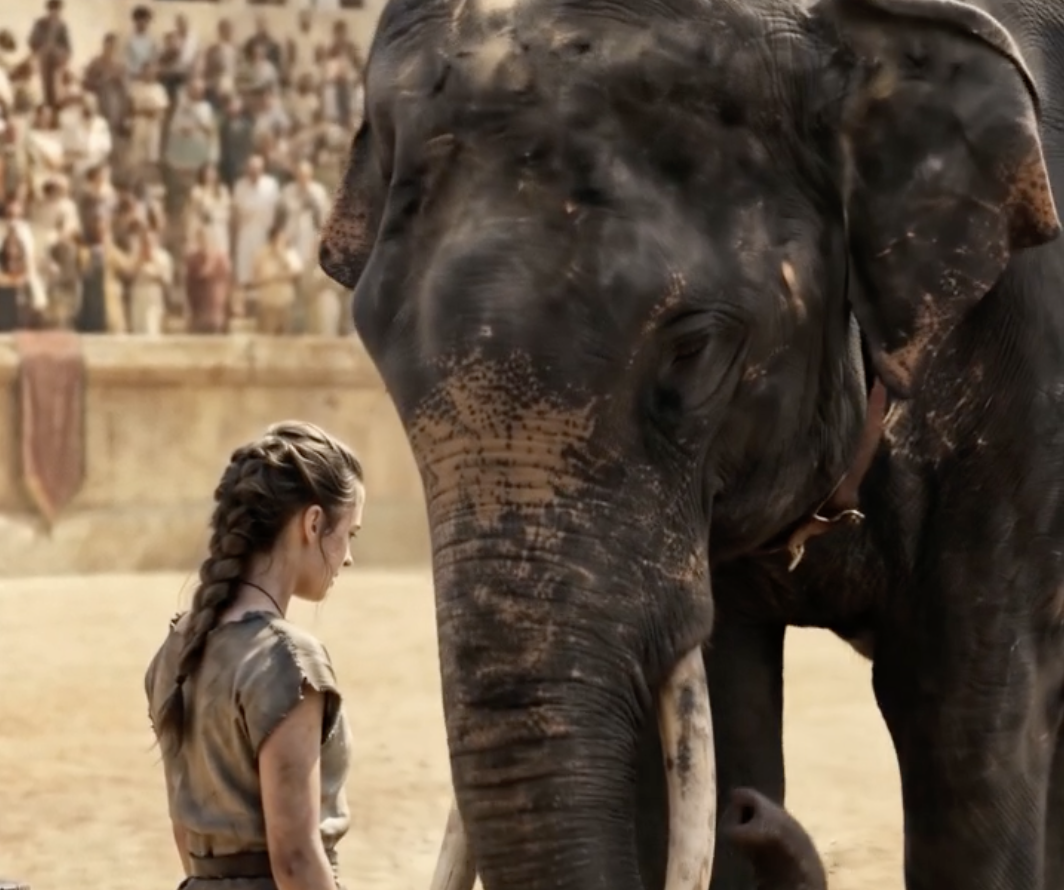
Not a trained bow. Not the kind beaten into an animal over weeks of repetition. The kind that comes from somewhere beneath obedience — a lowering of the great head, slow and deliberate, the crown pressing forward and down until it met the open palm of Nara’s raised hand.
She did not pull away.
She pressed her palm flat against the warm, rough skin of his forehead — the exact spot, the exact gesture — and the working song rose a little louder. It had no words. It never had. It was just the shape of being together.
The crowd of four thousand people made no sound.
In the honor box, Ambassador Halverson’s tea cup had rolled off the velvet armrest. He had not noticed. He was gripping the railing with both hands, leaning so far forward that the aide behind him put a cautious hand on his shoulder.
Halverson did not feel it.
He was looking at the bracelet.
The frayed rope bracelet on Nara’s wrist — identical to the one he had knotted himself, twelve years ago, on the wrist of a six-year-old girl beside a river. He had given the village the calf as a gesture of diplomatic goodwill. He had written it in his report as a line item under community engagement.
He had not thought of it again.
He was thinking of it now.
What, Halverson said — not to his aide, not to anyone — have I almost let happen.
He turned to the arena official seated to his left.
His voice, when it came, was very quiet. That particular kind of quiet that fills a room.
“Release her.”
The official blinked. “Ambassador, the masters have jurisdiction over—”
“Release. Her.”
Below, Nara was still singing.
The elephant’s eyes were closed.
Around them, the four thousand people in the stands had begun to understand that they were not watching a spectacle of punishment. They were watching something they did not have a word for — something that made several of them feel, inexplicably, that they owed an apology to someone, though they could not have said to whom.
The arena gates opened.
Two guards crossed the sand toward Nara. Not to restrain her. She understood that the moment she saw their faces — something chastened there, something they would not name.
She sang one last note. Let it go.
The bull lifted his head slowly, the way a tide goes out.
He turned and walked, unhurried, back through the open gate.
Nara watched him go. She did not wipe her eyes.
Later, Halverson found her outside the handlers’ corridor. He stood in front of her for a long moment without speaking.
Then he held out his wrist.
An identical bracelet — his own — was there. Faded almost to nothing. He had never taken it off.
She looked at it for a long time.
“You gave him to me,” she said.
“Yes.”
“He remembered.”
Halverson looked at the sand still on her feet, the torn shoulder of her tunic, the raw marks on her wrists.
“I should have,” he said.
She looked at him with the particular patience of someone who has had to be patient for a very long time.
And then, without a word, she walked back toward the gates — back toward her elephant — and did not look behind her.