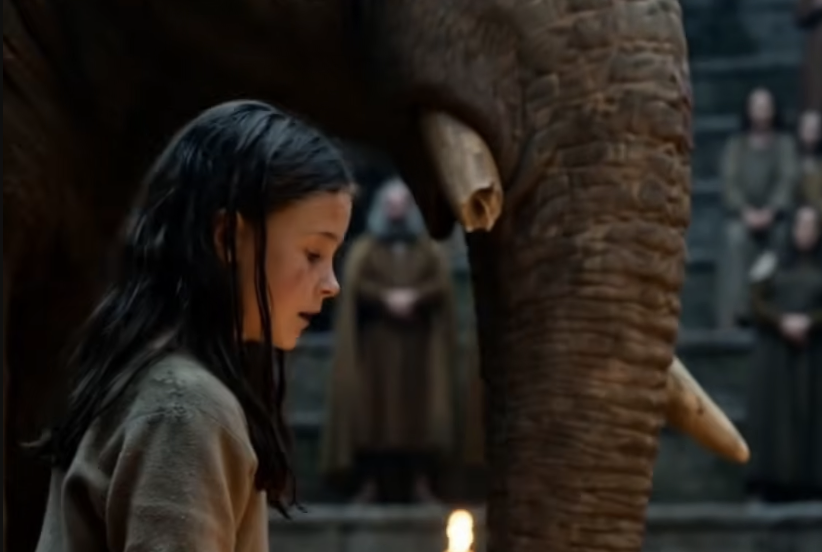

His forehead came to rest against the side of her head.
Gently.
The way you lean into someone when words have become unnecessary.
The crowd on the terraces did not cheer. Did not gasp.
They breathed.
All of them, together, one long exhale through the humid night air — as though they had been holding something in their chests for years and had only now been given permission to release it.
The head priest stood at the edge of the ring.
He did not step forward.
He did not speak.
His hands, which had held ceremonial objects for four decades in this temple, hung open at his sides.
The young acolyte beside him said quietly: “What do we do?”
The head priest watched the girl. Watched her arm wrap slowly around the base of the elephant’s trunk, her small forearm unable to reach even halfway around it, clutching it anyway.
“Nothing,” he said.
“But the ceremony—”
“Is happening.”
The acolyte looked at the ring. At the weeping girl. At the old bull standing motionless, his weight distributed across four ancient legs, his breathing slow and enormous and calm.
He did not argue further.
The elder pilgrim woman in the first row was the first to set her oil lamp down on the stone in front of her.
She pressed both palms together.
Not in the gesture of the formal ceremony.
Something older than that.
The woman beside her did the same.
Then the man behind them.
Lamp by lamp, palm by palm, down the terraced rows — until the entire assembly had set their lights down on the stone and pressed their hands together in silence.
No priest had instructed this.
No ritual text prescribed it.
It simply moved through the crowd the way certain truths move — not announced, just recognized.
Nila did not see any of it.
Her eyes were closed.
Her forehead pressed against his jaw.
She was whispering.
No one could hear what she said.
Later, the head priest would write in the temple record that the ceremony had been completed — that the elephant had been led into the ring, that the crowd had gathered, that the moment of offering had occurred.
He did not record what the offering was.
He did not need to.
Everyone who had been present on those terraces already knew.
It was not the torch.
It was never the torch.
It was a girl who had learned a broken old creature’s name and whispered it in the dark every evening for a year, asking nothing in return — and a crowd that had watched her do it and remembered, for one humid torchlit night, what it felt like to love something simply because it was alive.
The drums never resumed.
No one complained.
Have you ever loved something quietly, without ceremony or audience, and found that it was the most sacred thing you ever did? Tell us in the comments.