
It was low and resonant and felt more than heard — a vibration in the air of the barn, in the stone walls, in her chest.
She would later learn the word for it.
A contact call.
It is what elephants make when they are separating from someone they are bonded to. A frequency so low it travels through the ground. Through walls. Through miles of open grassland if it has to. A sound that says: I know where you are. I will always know where you are.
Elara didn’t know any of that yet.
She just felt it move through her ribs, and something gave way.
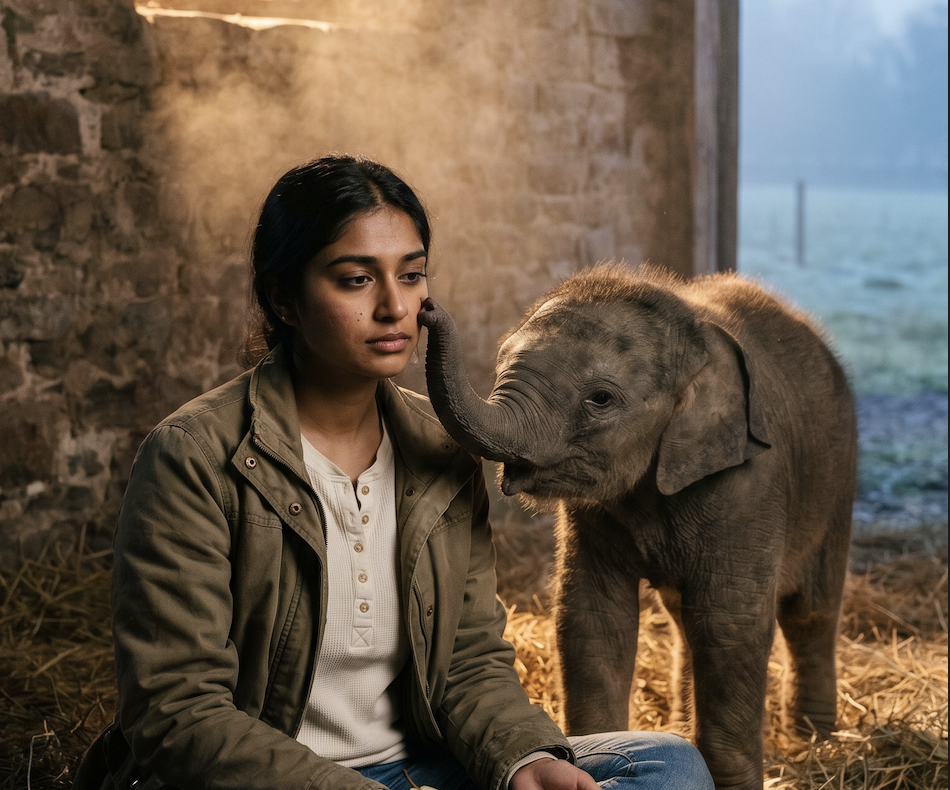
She pressed her hand against the side of his trunk. He didn’t pull back.
“Good boy,” she said.
Two words. The only ones she had left.
Outside, the van pulled through the estate gate. She could hear the engine cutting off. Doors. Voices. Her father’s low greeting, measured and careful, the way he spoke to people when he needed them to understand something without being told directly.
She stayed in the hay.
Pip stayed with her.
For another four minutes — she counted them without meaning to, the way you count things you don’t want to end — he stood beside her with his trunk resting in her open hand. His tail wagged again, small and certain.
When her father appeared in the barn doorway, he looked at his daughter for a long moment. Then he looked at the elephant. Then he took off his hat and held it against his chest and said nothing at all, which was how she knew he was about to cry.
The handlers were kind. They had done this before. They spoke to Pip in soft, even voices, and he regarded them with his half-closed eyes, curious and unhurried, as though he had all the time in the world and had decided to be generous with it.
He walked out of the barn on his own.
He didn’t look back.
She had expected that to be the worst part. It wasn’t.
The worst part was the silence afterward. The barn without his breathing in it. The hay that still held the shape of where he’d stood.
She sat in it for a long time.
Her father brought her tea. Set it on the low wooden rail. Went back to the house without saying anything, which was the kindest thing he could have done.
She thought about the contact call. About what it meant. About an animal who had never once been shown cruelty deciding that a goodbye was worth marking — that she was worth marking — with the oldest sound he knew how to make.
She thought: I will spend the rest of my life trying to be the kind of person he believed I was.
The mist burned off the orchard by ten o’clock.
She drank the tea cold.
Later that year, she enrolled in a wildlife biology program. She specialized in elephant cognition. She published, eventually, a short paper on contact calls and what they signify about memory and attachment in captivity-raised calves.
She dedicated it to no one.
But she thought about him when she wrote the title.
One More Morning.