
The huntsman’s lips parted. The word did not come out clean.
“Princess —”
It was barely a word. More breath than sound. But the page boy by the arrow basket heard it, and his head came up like a deer’s.
The girl heard it too.
Her fingers stopped on the daisy knot. She lifted her chin — not toward the duke on the dais, not toward the laughing riders. Toward the second rank. Toward a tanned old man on a dark bay horse, his left hand curled stiff around a loose rein.
She did not know him. She was sure of that. She had never seen his face.
But he was looking at her hands the way her nurse used to look at her hands.
“Bren,” the duke said lazily, from the dais. “Is there a problem with my huntsman?”
The old man did not answer. His mouth was still open around a word he had stopped saying forty years ago, when the messenger had come down from the north with the news that the entire royal house had burned in their beds.
“Bren.”
“No, Your Grace.” His voice came back wrong. Rougher. “No problem.”
The duke tapped his signet ring against the rim of his cup. Tick. Tick. “Then have the girl finish, and let’s get on with the hunt.”
The stag had not moved.
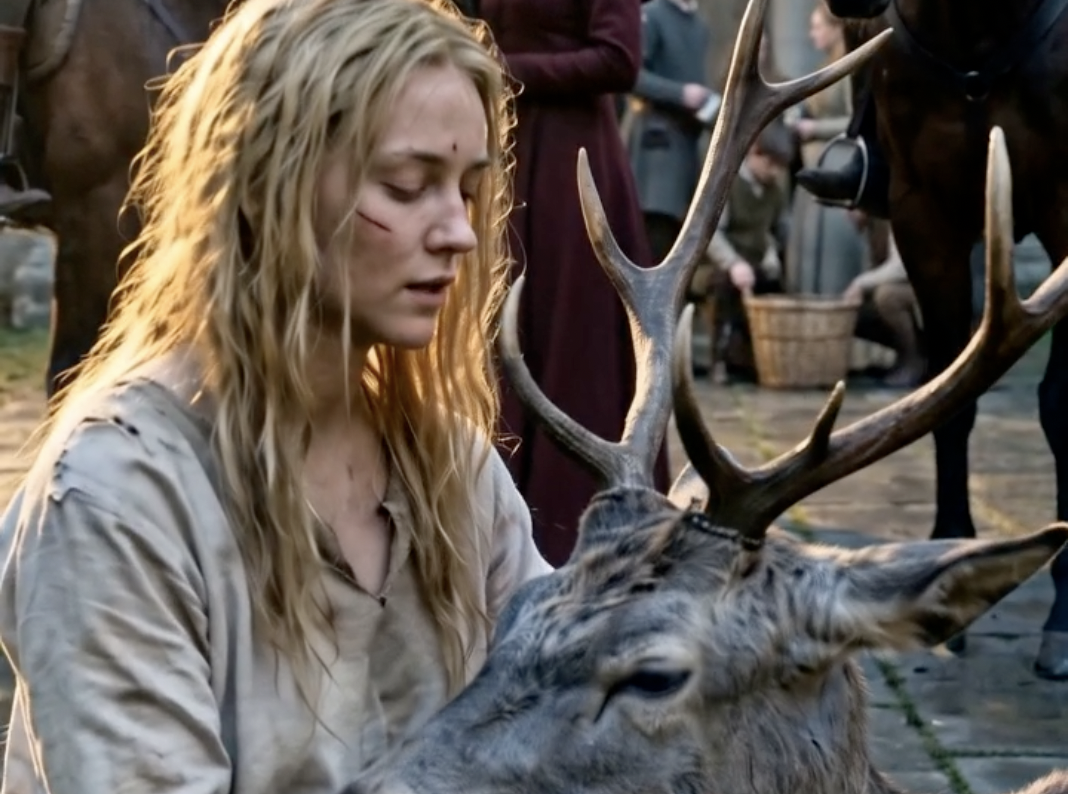
Liesl looked down at her own hands. The daisies. The knot. Under, over, under. She had braided it without thinking about it. She had braided it a thousand times before, on a chestnut pony, in a stable yard that did not exist anymore, while a woman who smelled of lavender laughed behind her and said that’s our knot, my love, nobody else’s.
She had not remembered the woman in eleven years.
She remembered her now.
Her hands began to shake.
The stag, very gently, pressed his great muzzle into her palm. The rope-gash on his flank glistened. He was not asking to be released. He was telling her he knew.
“Finish the crown, girl.” That was Lady Verein, in oxblood silk, her voice pitched a little too high.
Liesl finished the crown. Her fingers were certain again. She placed it over the snapped lower-left tine of the stag’s antler, the daisies catching the gold light, and she stepped back one pace.
She did not curtsy. She did not weep. She looked at the duke, and then she looked past him, at the old huntsman in the second rank, and the old huntsman — sixty-three years old, three houses served, a left hand curled from an old bite — slowly, with great care, took off his huntsman’s cap.
In a courtyard of sixty mounted nobles, nobody else moved.
The page boy was still staring. The woman in oxblood had set down her cup without realising. Somewhere behind the duke, a single laugh tried to start again and could not.
The duke saw the cap come off.
He set down his own cup.
“Bren,” he said, and his voice had changed. “Who is the girl.”
The huntsman did not look at his duke. He was looking at the girl in the torn linen shift, and at her bare feet planted in the dew, and at the stag who had refused to lift his head, and at the daisy knot none of them in this courtyard had been alive to see the last time it was tied.
“Your Grace,” he said quietly, “I do not think she is mine to name.”
How long can a person be no one, before the one person who remembers her finally says her name out loud?