
Wren stood with the jug in her hands and waited.
The baron’s ring-hand hovered over the cup he had set down. His eyes had not left the pendant at her throat. Around the long table, the hush moved outward in slow rings — first the guests nearest him, then the middle benches, then even the servant in russet at the far end who finally noticed the silence and stopped pouring.
“Where did you get that.” It was not a question. His voice had gone flat the way iron goes flat when it’s struck wrong.
“It was my mother’s, my lord.”
“Your mother.”
“Aenna of Thornholt. She came to your gates in the snow. Nine winters past. With a child.”
Lady Marra reached, slowly, and took her husband’s wrist. Not to comfort him. To stop him standing.
“She died in the road,” Wren said, the same evenness she used with frightened kennel pups. “Two days after you turned her away. The hound-master at the south kennels took me in. He didn’t know what the chain was. He thought it was a trinket.”
The baron’s mouth worked. “Who told you it was hers.”
“She did. Before she stopped speaking.”
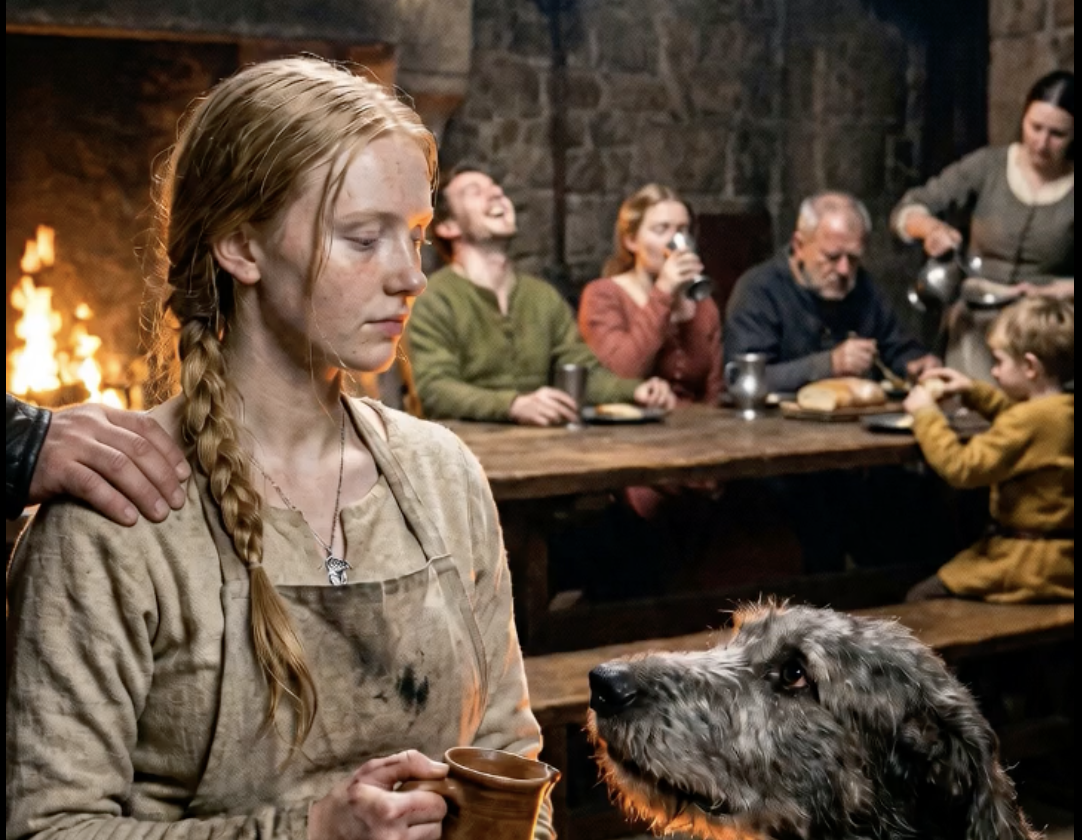
A log split in the hearth and sent up a small spray of sparks. The old wolfhound did not flinch. It was still watching her, the way it had watched her every morning at the kennels for nine winters, the way no one in this hall had ever bothered to watch her at all.
Sir Bren the Steward — the one who had pushed her forward — had taken one step back from her without realising. His limp had brought him up against the bench.
“Show it to me,” the baron said.
She did not move.
“I said show it to me, girl.”
“You set down your cup, my lord. You already know what it is.”
Lady Marra made a small sound. Not a word. The chipped tooth showed and was hidden again.
The pendant at Wren’s throat was a hound’s head in silver, with a single garnet for the eye. The same crest worked into the iron above the great doors. The same crest stamped into the baron’s gold ring. The kind of token a lord gave only to a woman whose child was his.
She had not raised it. She had not pointed at it. She had only stood in the firelight long enough for the room to see.
At the far end of the table, the guest who had been mid-laugh in the first moment of all this — the one whose laugh had died first — set his goblet down very carefully, as if afraid of the sound it might make. The woman across from him with the faded madder dress folded her hands in her lap and lowered her eyes, the way a person lowers their eyes at a funeral they did not expect to attend.
The wolfhound rose, chain dragging on the stone, and stepped to Wren’s side. It pressed its great scarred head against her hip and stayed there.
“My lord,” Wren said, and the word was no longer a servant’s word, “where would you like me to pour.”
The baron did not answer.
He could not.
And in that long unanswered moment, with a hound at her hip and a hall full of nobles unable to lift their cups, what does it mean that a girl can change the shape of a room without ever raising her voice?