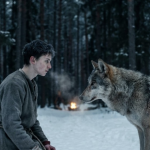

The rod never came down.
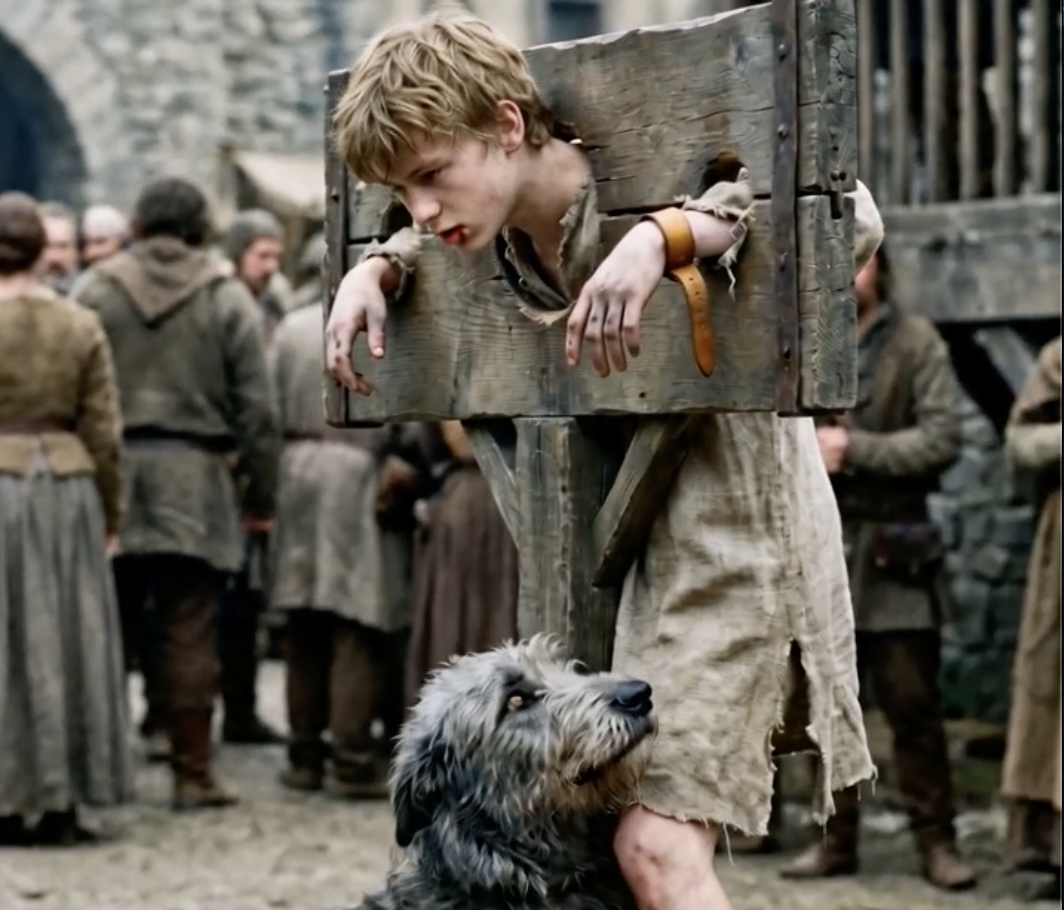
The wolfhound at Tomás’s feet rose — slowly, without sound — and stood between the bailiff and the boy. Its hackles did not lift. It did not bare its teeth. It simply stood, shoulders level with the bailiff’s belt, amber eyes fixed on the rod.
The bailiff stepped back. His parchment slid from his hand.
“Wait,” the old huntsman said again, louder now, pushing through the crowd. “Wait, in the Duke’s name — wait.”
The crowd parted for him. He had been Master of the Kennels for forty years. Men who had thrown turnips a moment ago now lowered their eyes.
He reached the pillory. He knelt. Not on one knee — on both.
“Boy,” he said. “Where did you get the strap on your wrist?”
Tomás’s voice was hoarse. “I have always had it, sir. The foundling-house said it came with me.”
The old man’s hands were trembling. He reached out — slowly, as one reaches for something one has already mourned — and turned the leather over. On the inside, burned into the hide with a kennel-iron, were two letters. E. H. Eberhart’s mark. The mark he had pressed into every collar he had ever made, including the one he had cut from a wolfhound’s neck the night he carried a dying woman’s child through the snow.
He had been told the child died.
He had been told for eighteen years.
He looked up at the boy.
“What is your name?”
“Tomás, sir.”
“Your mother’s name?”
“I never knew her.”
The old man’s mouth moved before the words came. “Her name was Lina. She was a kennel-maid. She died the night you were born, and I — I was told you went with her.”
Tomás stared at him. He did not speak.
From the Duke’s box, a chair scraped. The Duke himself was standing now, his face the color of ash. Because the Duke had known Lina. The Duke remembered who her child’s father had been said to be.
The huntsman turned to the bailiff. His voice was very quiet. “Unlock the stocks.”
“Sir, the charge—”
“The charge is false, and the magistrate’s son knows it. Unlock the stocks.”
The bailiff fumbled with the key. The wood lifted. Tomás’s wrists came free, raw and red, and he sank forward onto his knees on the cobblestones. The wolfhound pressed its great head against his chest.
The old man wrapped his cloak around the boy’s shoulders. His hand cupped the back of Tomás’s head the way one cups something one has been afraid to touch.
“You hummed,” he whispered. “You hummed the dusk-call. I only ever taught it to one pup. And I only ever taught it because I was singing it to you.”
Across the square, the magistrate’s son had already begun to back away.
But no one in the crowd was looking at him anymore.
They were looking at an old man kneeling in the dirt beside a boy in a torn tunic and a great grey hound that had known what none of them had — that some debts are paid not in coin, but in recognition.
Have you ever watched the truth find its way home after years of being buried? Tell us in the comments.