I married a stranger from a hospital waiting room so he wouldn’t d!e alone — after our one-week marriage, his lawyer handed me his backpack, saying, “He wanted you to know the truth.”

I was twenty-nine and still trying to find my way through the grief of losing my mother.
Volunteering at a hospital became the only thing that made that pain feel like it had some purpose.
For almost a year, I spent time with patients who had no family beside them during their final days.
That’s how Julian came into my life.
He was seventy-two, frail, and dying from heart failure.
He always looked exhausted, but somehow he still smiled gently whenever I came to see him.
We began talking.
And within just a few days, our conversations became something both of us looked forward to.
Then one afternoon, Julian reached for my hand.
“Marry me, Nora,” he whispered.
My heart started pounding.
“Julian… you’re seriously ill. We barely know each other.”
“I don’t want the state handling my final hours,” he said, touching my fingers. “My last wish is to leave this world as a husband, not as a nameless file.”
I knew how strange the request was.
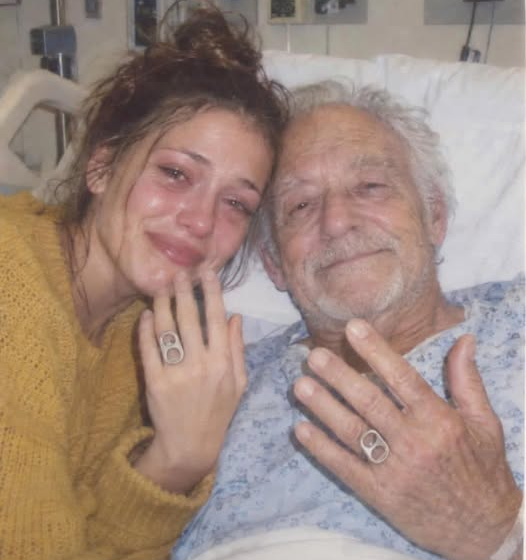
Still, two days later, a hospital chaplain married us.
I wore a yellow sweater.
We didn’t have a wedding ring, so Julian slipped a soda can pull tab onto my finger instead.
For the next seven days, I never left his side.
I held his hand through every difficult breath until his heart stopped.
Afterward, I sat alone in his empty room, stunned by how much silence someone I’d known for such a short time could leave behind.
Then an elderly man walked in carrying a green backpack.
“Nora?” he asked. “I’m your husband’s attorney. He left this backpack for you.”
He placed it in my hands.
I immediately noticed how heavy it was.
The lawyer watched my face for a moment, then lowered his voice.
“Julian wasn’t who you thought he was, Nora,” the old man whispered. “He wanted you to know the truth.”
Part 2: The Red Dress and the Ledger
I unzipped the heavy green backpack with trembling fingers while the lawyer, an elderly man named Arthur Pendelton, stood by the window of the empty hospital room, watching me in solemn silence.
Inside rested three distinct items: a worn, leather-bound notebook, a legal deed wrapped in oilskin, and a folded piece of bright red silk fabric.
I pulled out the red silk first. As it unfolded in my lap, I realized it was a handmade vintage dress, small enough to fit a young child. The stitching was delicate, executed with meticulous care, though the hem was slightly frayed from age.
“What is this?” I whispered, my voice echoing in the quiet room.
“Forty-five years ago,” Arthur explained softly, “Julian was a master tailor in Chicago. He lived a quiet life with his first wife and his five-year-old twin children—a boy named Caleb, and a girl named Lily.”
My heart gave a sudden, painful lurch. Julian had never mentioned a family. He had presented himself to the hospital staff as a man completely alone in the world, a forgotten soul with no living kin.
“Lily’s favorite thing in the world was that red dress,” Arthur continued. “Julian made it for her fifth birthday. But that winter, a tragedy struck their home. A house fire caused by a faulty heating unit swept through their residence. Julian managed to pull his wife and his son Caleb out of the flames, but by the time he went back for Lily…” Arthur paused, clearing his throat against a sudden swell of emotion. “…it was too late. All he could save from her room was that red dress.”
I touched the soft silk, tears welling in my eyes. The grief I had carried for my own mother seemed to reach out and touch the ancient, agonizing sorrow sewn into every thread of the garment.
“After the tragedy,” Arthur said, “Julian’s marriage collapsed under the weight of grief. His wife moved away with young Caleb, cutting off all contact. Julian spent the next four decades living like a recluse, pouring every penny he earned from his tailoring business and quiet investments into a private trust fund.”
“Why did he marry me, Arthur?” I asked, looking up from the red dress. “Why a stranger he met in a hospital room?”
Arthur reached into his coat pocket and pulled out a sealed envelope, handing it to me. “Because Julian knew his time was short, and he knew his estranged son, Caleb—now a ruthless corporate developer—was searching for him. Caleb didn’t want reconciliation. He had discovered that Julian owned a prime piece of commercial real estate downtown—the original building where his old tailor shop stood—now worth millions. Under state law, if Julian died unmarried and intestate, the entire estate would automatically revert to Caleb.”
My breath caught in my throat. “And if he was married…?”
“Under the explicit terms of your marriage certificate and the deed in that backpack,” Arthur smiled faintly, “the entire estate, valued at over fourteen million dollars, belongs exclusively to you, Nora. Julian didn’t marry you just to avoid dying alone. He married you because he spent eleven months watching you comfort dying strangers, and he knew you were the only person who would use his legacy to do good.”
Arthur pointed to the leather notebook. “Open it. Julian wrote his final instructions to you on the last page.”
I opened the journal to the marked page, recognizing Julian’s neat, flowing handwriting:
My dear Nora,
If you are reading this, my heart has finally found its peace. Forgive me for keeping the truth from you during our short week together. I needed to know that your kindness was genuine, unpolluted by the promise of wealth.
The pull tab on your finger was a placeholder for a promise. The red dress belonged to my late daughter, Lily. The estate is yours. But beware: my son Caleb knows I am gone, and he will come for what he believes is his. Protect Lily’s memory. Protect the shop.
With all my gratitude, Julian.
Before I could process the weight of his words, the heavy wooden door of the hospital room slammed open.
Part 3: The Confrontation
A tall man in a bespoke charcoal suit walked into the room, flanked by a younger corporate associate carrying a briefcase. He had sharp, cold features, but there was an unmistakable resemblance around his eyes that sent a chill through my spine.
It was Caleb.
He scanned the empty hospital bed, then turned his gaze toward Arthur, completely ignoring me at first.
“Pendelton,” Caleb said, his voice cold and transactional. “I got the notification from the nurse’s station. Where are the estate authorization forms? My legal team needs to file the probate claim before the courts close today.”
Arthur didn’t flinch. “You’re too late, Caleb. Your father’s estate is not entering probate.”
Caleb’s eyes narrowed. “What are you talking about? He had no living spouse, and I am his sole surviving heir. The downtown commercial lot reverts to me.”
“Your father was married,” Arthur replied calmly, gesturing toward me. “Meet Nora Vance. Julian’s lawful wife.”
Caleb turned his head slowly, assessing me from my worn sneakers to the yellow sweater I was wearing. His eyes landed on the green backpack sitting in my lap, and then on the red silk dress resting over my knees.
For a second, his face went completely pale. The sight of his dead twin sister’s dress seemed to strike a hidden nerve deep within him. But the emotion vanished as quickly as it had appeared, replaced by a sneer of pure contempt.
“A hospital volunteer?” Caleb let out a harsh, bitter laugh. “Is this a joke? My father was an old, senile man suffering from end-stage heart failure! She took advantage of an incapacitated patient to orchestrate a deathbed marriage scam!”
“I took care of him when he had no one else, Caleb,” I said, standing up from the chair, holding the red dress carefully against my chest. “He was fully lucid when we were married by the hospital chaplain. He knew exactly what he was doing.”
“We will have the marriage annulled by Monday morning!” Caleb barked, stepping into my personal space, his hands clenching into fists. “You think you can walk out of a hospital room with fourteen million dollars of Vance family assets because you held an old man’s hand for seven days? You are a nobody, Nora. A fraud.”
“I am his wife,” I said, holding my ground, my voice steady despite the adrenaline racing through my veins. “And under the terms of Julian’s trust, I am the sole executor of his estate and the sole owner of the Oak Tailor property downtown.”
Caleb leaned in, his tone dropping to a dangerous whisper. “Listen to me very carefully, little girl. My firm is developing a fifty-story luxury tower on that block. That property is the anchor of the entire project. I have spent three years positioning investors for this deal. If you try to stand in my way, my legal team will bury you in litigation until you don’t have a single penny left to your name. Hand over the deed, or I will destroy you.”
Arthur stepped smoothly between us, pulling a document from his coat. “Actually, Caleb, Julian anticipated your legal threats. He filed an irrevocable transfer deed forty-eight hours ago, backed by a video deposition certified by two independent psychiatrists confirming his mental competency. The property doesn’t belong to the Vance family anymore. It belongs to Nora.”
Caleb stared at the certified document in Arthur’s hand. His corporate composure finally cracked, his face flushing deep red with fury.
“This isn’t over,” Caleb spat, turning his glare back onto me. “You think you can keep that building? You don’t know the first thing about real estate, business, or power. You’re just a lonely girl holding onto a dead child’s rag.”
He turned on his heel and stormed out of the room, his associate scrambling to catch up as the door slammed shut behind them.
I sank back into the chair, clutching the red dress, my chest heaving.
Arthur looked down at me gently. “He won’t give up easily, Nora. He has millions behind him.”
I looked down at the soda can pull tab still resting on my ring finger, then at the bright red silk of Lily’s dress.
“Neither will I,” I said quietly.
Final: The Masterpiece Kept
Three weeks later, the morning sun broke over the historic district of downtown Chicago.
I stood on the sidewalk across from a two-story brick building nestled between gleaming modern skyscrapers. The windows were dusty, and the old painted sign above the entrance read: The Oak Tailor — J. Vance, Est. 1974.
Beside me stood Arthur Pendelton and a small team of historic preservation architects.
Caleb’s legal team had tried everything over the past twenty-one days—filing temporary restraining orders, contesting the marriage validity, and offering massive off-the-books cash settlements to buy me out. But Julian’s legal defense was an impenetrable fortress. Every psychiatric evaluation was flawless, every signature legally binding.
The property was mine.
Instead of selling the land to Caleb’s corporate group for demolition, I used a small portion of Julian’s liquid investment trust to execute the vision he had outlined in the final pages of his journal.
The heavy front door unlocked with a quiet click, and I stepped inside the building for the first time.
The interior smelled of old cedar, polished brass, and historic textiles. Industrial sewing machines from the 1970s sat along the back wall, pristine and meticulously maintained. Bolt after bolt of fine wool, silk, and linen lined the shelves.
It wasn’t just a shop; it was a museum of love, craft, and memory.
Later that afternoon, a sleek black town car pulled up to the curb outside. Caleb stepped out, dressed in his tailored suit, walking into the shop with heavy, furious strides.
“You turned down the twenty-million-dollar cash offer,” Caleb said, his voice echoing in the high-ceilinged room. He looked around the dusty shop with utter disdain. “You’re keeping this decaying pile of bricks out of spite.”
I stood behind the central cutting table, where the red silk dress sat carefully mounted inside a museum-quality glass display case.
“I didn’t keep it out of spite, Caleb,” I said calmly. “I kept it because your father spent forty years inside these walls pouring his heart into his work while mourning the daughter he couldn’t save.”
Caleb stopped in front of the glass display case, staring at his twin sister’s red dress. For the first time, the cold, corporate armor he wore seemed to crack.
“He abandoned us,” Caleb murmured, his voice suddenly sounding less like a powerful developer and more like a hurt child. “After the fire… he couldn’t even look at me.”
“He didn’t abandon you because he didn’t love you, Caleb,” I said gently, sliding a small, faded photograph across the counter toward him.
It was a photo I had found in the back of Julian’s journal—a picture of a young Julian holding a little boy on his shoulders outside this very shop, both of them laughing under the afternoon sun. On the back, in Julian’s handwriting, were the words: My boy Caleb. My greatest hope.
Caleb picked up the photograph, his hand trembling slightly.
“He left this property to me,” I continued softly, “not to keep it from you, but to protect it from being erased. He knew you were trying to tear down the only place where his memories of your family still lived.”
Caleb stared at the photograph for a long, silent moment. The anger in his eyes slowly faded into a quiet, heavy sorrow. He set the picture back down on the table, looked at the red dress inside the glass case one last time, and swallowed hard.
“My developers will re-route the tower foundation around this lot,” Caleb said quietly, his tone devoid of hostility. “The historical footprint remains untouched.”
He turned and walked toward the door, stopping at the threshold without looking back. “Keep the shop, Nora.”
The door closed softly behind him.
Six months later, The Oak Tailor officially reopened its doors—not as a commercial business, but as the Lily Vance Memorial Textile Center and Community Workshop.
Funded by Julian’s trust, the center provided free clothing design, sewing classes, and formal wear tailoring for low-income students, foster youth, and young people preparing for job interviews.
On opening day, the shop was filled with light, laughter, and the steady hum of sewing machines.
I stood by the front window, wearing a simple blue dress, watching a young high school senior smile brightly as an elderly volunteer tailor adjusted the hem of her donated prom dress.
I reached down and touched the silver soda-can pull tab, which I had crafted into a permanent pendant on a thin gold chain around my neck.
I had married a stranger in a hospital waiting room so he wouldn’t die alone. And in return, he had handed me a legacy that healed my own grief, protected a sacred memory, and gave dozens of forgotten souls a place to belong.
I looked over at the glass case where Lily’s red dress shone softly under the warm workshop lights, and whispered into the quiet air:
“We protected it, Julian. Your masterpiece lives on.”
THE END.
NEW STORY👇👇