
My Parents Chose My Adopted Brother Over Me for 10 Years—At 18, I Left With Two Bags. Five Years Later

PART 3
Dad immediately answered.
“Because that’s what we need.”
“How much do you owe on Steven’s car?”
He shifted uncomfortably.
“That’s not really important.”
“It seems pretty important if you’re asking me to pay for it.”
Mom reached for her glass of water.
“The monthly payments are higher than we expected. And there were some other expenses. Insurance, repairs, and a few things Steven needed.”
“What things?”
“Adam, please. We didn’t invite you here to interrogate us.”
I leaned back against the booth.
There it was.
The familiar tone.
The same tone Mom had used when I was twelve and asked why Steven got a new bicycle while mine had a broken chain. The same tone Dad used whenever I questioned why my school events were less important than Steven’s soccer games.
I was allowed to help.
I was allowed to understand.
I was allowed to sacrifice.
But I was never allowed to ask questions.
“Does Steven know you’re asking me for money?” I asked.
Mom’s eyes moved toward Dad.
“He’s aware that we’re trying to work things out.”
“That’s not what I asked.”
Dad rubbed his forehead.
“Adam, your brother is embarrassed about the situation. We don’t want him feeling like a failure.”
I stared at him.
“Then why don’t you ask him to get a job and make the payments himself?”
Mom’s expression immediately hardened.
“He’s looking for something.”
“Looking for something?”
“He’s been applying.”
“How long?”
She didn’t answer.
I pulled my phone from my pocket and glanced at the time.
I had taken time away from work to attend this meeting. I had told myself that maybe my parents had finally understood what they had done. Maybe the years apart had forced them to reflect.
Instead, I was sitting in the same restaurant where they had turned my sixteenth birthday into another celebration for Steven.
And they were still doing it.
Only this time, they wanted my money instead of my birthday cake.
“Adam,” Mom said softly, “I know things weren’t perfect when you were growing up.”
I looked at her.
“Not perfect?”
She swallowed.
“Your father and I made mistakes. We were trying to give Steven the stability he never had before he came into our family. We thought you understood that.”
“I was eight years old, Mom.”
“I know.”
“No, I don’t think you do.”
My voice remained calm, but my hands were trembling beneath the table.
“When Steven came home, I was excited. I wanted to be a good big brother. I gave him my toys. I shared my room. I tried to make him feel welcome. I never once asked you to love him less.”
Mom looked down.
“But somehow, every time he needed something, I was expected to need less. Every time he wanted something, I was expected to wait. Every time I accomplished something, I was expected to understand that his feelings were more important.”
Dad shook his head.
“That’s not how it happened.”
“Then tell me what happened, Dad.”
He opened his mouth.
Nothing came out.
I continued.
“Do you remember my science fair trophy?”
Dad looked confused.
“What trophy?”
I nodded slowly.
“Exactly.”
Mom began to look uncomfortable.
“Adam, we can’t go back and change those things.”
“You’re right. You can’t.”
“Then why are you holding on to all this?”
I looked directly at her.
“Because you never apologized. Not once. You never even acknowledged that I was hurt.”
Mom’s eyes filled with tears.
For a moment, I thought she might finally say it.
I thought she might reach across the table and tell me that she was sorry for making me feel invisible in my own home.
Instead, she said something that made my stomach tighten.
“We were hoping that helping Steven would give us all a chance to become a family again.”
I stared at her.
“What does that mean?”
Dad cleared his throat.
“We’re getting older, son. Your mother and I can’t keep carrying all the expenses. We thought that if you helped us now, perhaps Steven could eventually get back on his feet. Then we could all move forward.”
“All of us?”
“Yes.”
“Does that include me?”
Mom looked almost offended.
“Of course it includes you. You’re our son.”
I almost smiled.
For five years, I had lived without being anyone’s son in that house.
Now, when a bill arrived, I suddenly belonged again.
I placed both hands on the table.
“Do you know what I did on my nineteenth birthday?”
Mom blinked.
“What?”
“I worked an eight-hour shift at the grocery store. Then I went back to my apartment, cooked a frozen dinner, and studied for an exam.”
Neither of them spoke.
“Do you know what I did on my twentieth birthday?”
Dad shifted.
“Adam—”
“I worked again. Do you know why?”
I didn’t wait for an answer.
“Because nobody was paying my rent. Nobody was buying my groceries. Nobody was covering my tuition. I had to do everything myself.”
Mom wiped her cheek.
“We didn’t know.”
“That’s because you never asked.”
The words settled between us.
I could hear people laughing at another table. A child was asking his father for another slice of pizza. Somewhere near the entrance, a server was calling out an order.
The world continued as if nothing important was happening.
But something important was happening to me.
For the first time, I wasn’t trying to convince my parents to see my side.
I was finally accepting that they might never want to.
“How much money do you have saved?” Dad suddenly asked.
I looked at him.
“What?”
“You’ve been working for five years, and you went to college. You must have something put away.”
I stared at him for several seconds.
Then I understood.
They hadn’t simply come to ask for help.
They had already decided I had enough money to solve their problem.
Dad continued.
“We’re not asking you to give us everything. We just need to know what you can afford.”
I slowly pushed my chair back.
“I think we’re finished here.”
Mom immediately grabbed my wrist.
“Please, Adam. Don’t leave like this.”
I gently pulled my hand away.
“Why did you really call me?”
Her lips trembled.
“I told you. We need help.”
“No. Why did you spend five years without contacting me, and then suddenly decide you needed to see me?”
She looked toward Dad.
He stared at the table.
I waited.
Finally, Mom spoke.
“Because Steven is in trouble.”
“What kind of trouble?”
She took a shaky breath.
“The dealership has been calling. Your father signed the loan documents, and we’ve missed several payments. They’re threatening to repossess the car.”
“Then let them repossess it.”
Mom’s face changed.
“You can’t say that.”
“Why not?”
“Because Steven needs that car.”
“Then Steven should have paid for it.”
Dad slammed his palm against the table.
“Enough! He’s your brother!”
I looked at him quietly.
“And I’m your son.”
That shut him up.
I picked up my jacket.
Mom began crying harder.
“Adam, please. We don’t have anyone else.”
I stopped.
For a moment, I looked at the woman who had once held my hand when I was afraid of thunderstorms. I remembered her making pancakes on Sunday mornings when I was little. I remembered sitting beside her on the couch while she read bedtime stories.
Those memories were real.
And that was what made everything so painful.
I hadn’t grown up with strangers.
I had grown up with people who knew how to show affection but somehow forgot to show it to me.
“Mom,” I said quietly, “you had another son sitting right beside you when you decided to ask me for money. Why didn’t you ask him?”
She looked away.
“He’s not in a position to help.”
I nodded.
“Neither am I.”
That wasn’t entirely true.
I had savings. I had a decent job. I had managed to build a stable life.
But I had no intention of giving them money simply because they had finally remembered my phone number.
I walked toward the restaurant entrance.
Behind me, Mom called my name.
“Adam!”
I stopped but didn’t turn around.
“Please don’t do this to us. We’re still your parents.”
I closed my eyes.
Then I answered.
“And I was still your son when you let me walk out of that house at eighteen.”
I left.
Outside, the afternoon air felt cold against my face.
I stood beside my car for a long time, staring at the restaurant window.
Through the glass, I could see Mom crying while Dad spoke angrily with his hands.
I wondered whether either of them was thinking about the little boy who had once stood in the kitchen holding a science fair trophy.
I wondered whether they remembered the sixteen-year-old who had walked out of his own birthday party.
Mostly, I wondered why some part of me still wanted them to care.
My phone vibrated.
It was Mark.
Mark: How did it go?
I stared at the screen before typing.
Me: They asked me for fifteen thousand dollars.
His reply came almost immediately.
Mark: Seriously?
Me: For Steven’s car.
A few seconds passed.
Mark: Adam, I’m sorry.
I leaned against the driver’s door.
Then I typed something I had never said to anyone before.
Me: I think I finally understand that they weren’t waiting for me to come home. They were waiting until they needed something.
Mark called immediately.
I answered.
“Hey.”
“Listen to me,” he said. “You don’t owe them anything just because they share your last name.”
I swallowed.
“I know.”
“Do you?”
I looked through the restaurant window one last time.
“Yeah. I think I finally do.”
We talked for a few more minutes before I drove home.
I thought that would be the end of it.
I was wrong.
Three days later, I received a message from an unknown number.
It was a photograph.
The picture showed Mom and Dad standing outside a small house. Steven was between them, holding a set of car keys and smiling.
Beneath the photograph was a short message.
“Your parents are going through a lot. I hope you can find it in your heart to help your family. Steven deserves a chance.”
I read it twice.
Then I recognized the number.
It belonged to my aunt, Dad’s younger sister.
I hadn’t spoken to her in years.
I typed a polite response.
“I hope they’re doing well, but I won’t be giving them money.”
She replied almost immediately.
“You have no idea how much your parents sacrificed for you and Steven.”
I stared at those words.
Something about them bothered me.
Not because I believed them.
But because I suddenly wondered what story my parents had been telling everyone during the five years I was gone.
Had they told relatives that I was selfish?
Had they said I abandoned them?
Had they explained that they had let me walk out without even asking where I was going?
I typed another message.
“What exactly have they told you about why I left?”
This time, my aunt took several minutes to respond.
Then my phone rang.
I answered cautiously.
“Hello?”
“Adam, it’s Aunt Linda.”
“Hi.”
She sounded uncomfortable.
“Your mother told me you left because you were jealous of Steven.”
I closed my eyes.
Of course she had.
“That’s what she told you?”
“She said you couldn’t accept having a younger brother. She said you were angry because they bought him a car, and you decided to cut everyone out of your life.”
I let out a slow breath.
“Aunt Linda, I was eight years old when Steven joined our family. I loved him. I wanted him to be my brother.”
“Then what happened?”
I sat down on the edge of my couch.
And for the next twenty minutes, I told her.
I told her about the birthdays.
The Christmas presents.
The school events.
The science fair trophy.
The chocolate cake.
I told her about the morning I left and how my mother had simply stepped aside.
I didn’t exaggerate anything.
I didn’t need to.
When I finished, the line went quiet.
Finally, Aunt Linda whispered something I hadn’t expected.
“Adam, your mother never told me any of that.”
I rubbed my forehead.
“She probably didn’t want to.”
“She told everyone you refused to be part of the family.”
I looked at the empty apartment around me.
“Well, now you know.”
Aunt Linda sighed.
“There’s something else I think you should know.”
I straightened.
“What?”
She hesitated.
“Your parents didn’t just buy Steven one car.”
I frowned.
“What do you mean?”
“The first car was purchased when he turned sixteen. Your father helped him get another one after he started working. And the latest one was supposed to be a birthday present.”
“I know about the latest one.”
“No, Adam. I mean the money they used to buy it.”
I waited.
“Your father told me they had borrowed against their house. He said it was only temporary, and Steven would start making payments once he found a better job.”
My stomach tightened.
“How much?”
“I don’t know the exact amount. But it was a lot.”
I stared at the floor.
“Why are you telling me this?”
“Because your mother called me yesterday and asked whether I could lend them money. When I asked why they needed so much, she said the bank was threatening foreclosure.”
I felt something drop inside my chest.
Foreclosure?
“Are they losing their house?”
“I think they’re close.”
For several seconds, I couldn’t speak.
That house.
The house where I had grown up.
The house where I had spent years trying to earn attention.
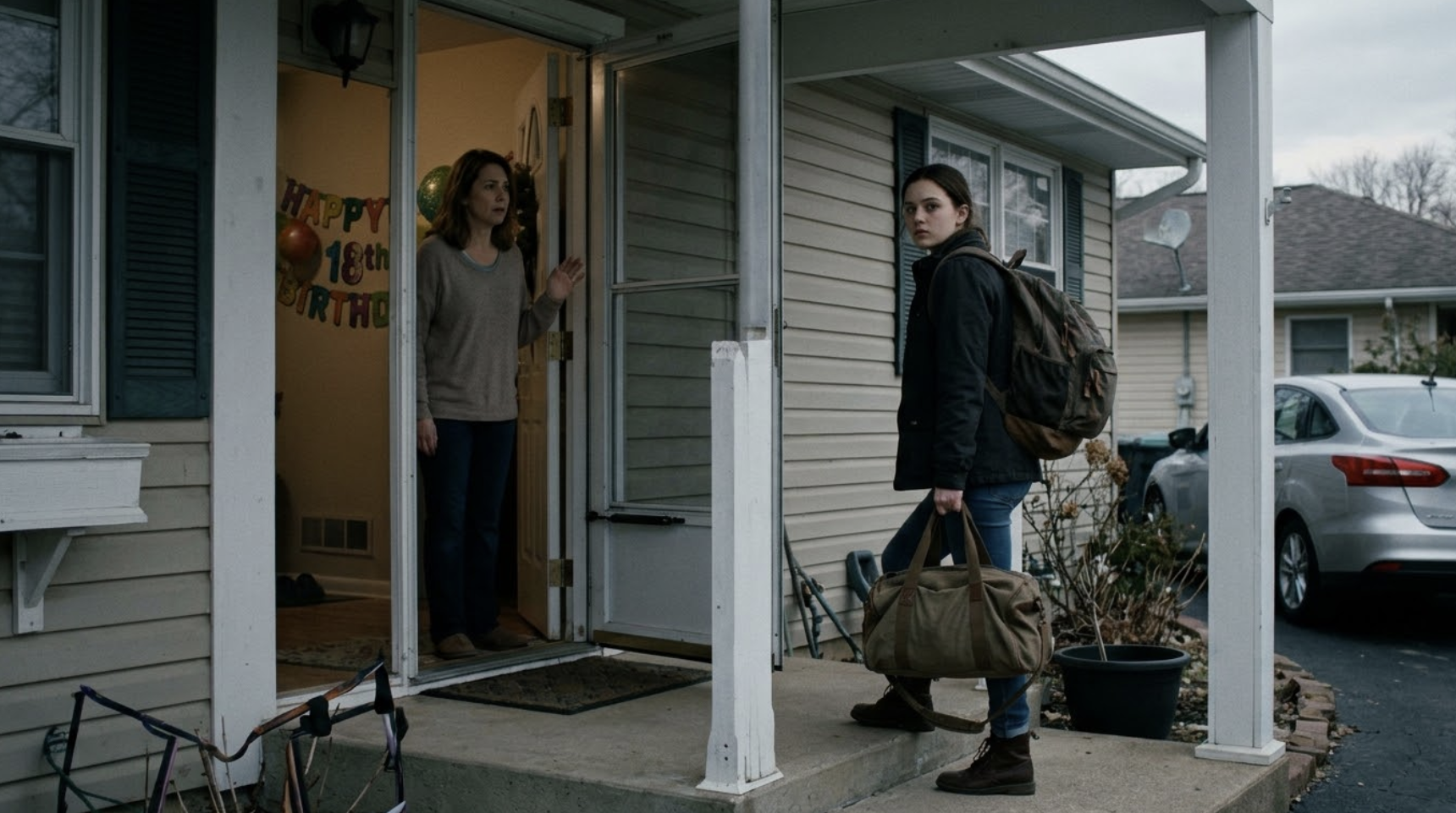
The house I had left with two duffel bags.
Now it was in danger because my parents had continued spending money they didn’t have to keep Steven happy.
“Adam,” Aunt Linda said softly, “I don’t want you to feel responsible. I just thought you deserved to know the truth.”
I thanked her and ended the call.
Then I sat there for a long time.
I wasn’t suddenly eager to save my parents.
But I couldn’t ignore the fact that there was more happening than they had told me.
And one question kept returning to my mind.
If my parents were already struggling so badly, why had they bought Steven another expensive car?
I decided I needed to know exactly what was going on.
Not because I planned to pay their debts.
But because I was tired of being given half-truths.
The next morning, I called Aunt Linda again.
“Can you tell me which bank they’re dealing with?”
She gave me the name.
Then she said something else.
“Adam, there’s another reason I think you should look into this.”
“What is it?”
She lowered her voice.
“Your father mentioned that he had been expecting some money from your grandfather’s estate. He said it was supposed to help the family.”
I frowned.
“My grandfather died years ago.”
“I know. That’s why I thought it was strange.”
I sat completely still.
My grandfather had been the one person in my childhood who had always treated Steven and me equally.
He used to take us fishing, buy us ice cream, and ask about our schoolwork.
When I won the science fair, he was the first person who called to congratulate me.
He had died when I was fifteen.
I remembered attending his funeral and standing beside Mom while she cried.
I remembered him telling me shortly before he died that I should never let anyone convince me I was worth less than someone else.
But I had never heard anything about money from his estate.
“Did he leave an inheritance?” I asked.
Aunt Linda went quiet.
“I believe he did.”
“How much?”
“I don’t know, sweetheart. But I remember your grandfather mentioning that he wanted to make sure both grandchildren were taken care of.”
Both grandchildren.
Steven and me.
I felt my heartbeat quicken.
“Did he leave something for me?”
Aunt Linda sighed.
“That’s what I think you need to find out.”
I ended the call and immediately searched through my old documents.
I found my grandfather’s funeral program, a few photographs, and an envelope containing some birthday cards.
At the bottom of the box was a folded letter.
It was written in my grandfather’s familiar handwriting.
My name was on the front.
I opened it carefully.
Inside was a short message.
Dear Adam,
I hope you never forget how special you are. You have a good heart, and I know you will grow into a strong man.
I have made arrangements to help you when you reach adulthood. Your parents know about them, and I trust they will make sure you receive what is yours.
Never believe that being responsible means you deserve less love.
With all my love,
Grandpa.
I read the letter once.
Then again.
And a third time.
My hands began to shake.
What arrangements?
What had my grandfather left me?
And why had my parents never mentioned it?
I turned the letter over, hoping to find another note.
There was nothing.
Then I noticed something I had missed.
At the very bottom, in tiny handwriting, was a telephone number and the name of a law office.
I immediately searched the number.
The law office still existed.
I picked up my phone and called.
A receptionist answered.
“Good morning, Henderson and Miller. How may I direct your call?”
“Hello. My name is Adam. My grandfather, Robert, may have left some documents with your office several years ago. I found a letter mentioning an arrangement for me, and I was hoping someone could help me understand it.”
There was a pause.
“May I have your grandfather’s full name?”
I gave it to her.
Another pause followed.
Then she asked for his date of death.
I provided that too.
“One moment, please.”
I waited.
After a minute, a different voice came onto the line.
“Mr. Adam? My name is Daniel Henderson. I’m one of the attorneys here.”
“Hello.”
“Your grandfather was a client of ours. I believe we may have something relevant to your inquiry.”
My mouth went dry.
“What kind of something?”
The attorney paused.
“Before I discuss anything, I’ll need to verify your identity and review the estate documents. However, I can tell you that your grandfather made specific arrangements concerning you.”
I gripped the phone tighter.
“Did my parents know?”
There was a brief silence.
Then he answered carefully.
“Yes. Your parents were informed of the arrangements at the time.”
My stomach tightened.
“Can I come to your office?”
“Certainly. We have an appointment available tomorrow morning.”
I agreed.
After ending the call, I sat motionless on my couch.
For five years, I had believed that leaving my parents meant leaving everything behind.
But apparently, there was something my grandfather had wanted me to receive.
Something my parents had known about.
Something they had never told me.
And suddenly, their desperate request for fifteen thousand dollars seemed even more suspicious.
Because if my grandfather had made arrangements to help me when I became an adult, then I needed to know one thing.
What exactly had my parents done with what was supposed to be mine?
PART 4
The next morning, I arrived at Henderson and Miller’s office fifteen minutes early.
I hadn’t slept much the night before.
My grandfather’s letter sat inside my jacket pocket. I had read it so many times that I could almost remember every word without looking.
I have made arrangements to help you when you reach adulthood.
Those words kept repeating in my head.
What had he arranged?
Why had my parents never told me?
And most importantly, where had the money gone?
A receptionist greeted me and asked me to wait. A few minutes later, a middle-aged man wearing glasses stepped out of an office.
“Adam?”
I stood.
“Yes.”
He extended his hand.
“I’m Daniel Henderson. It’s good to finally meet you.”
We walked into his office. He offered me coffee, but I declined. I was too nervous to drink anything.
He opened a thick file on his desk.
“Your grandfather was a very thoughtful man,” he began. “He was particularly concerned about the future of his grandchildren.”
I nodded.
“Before he passed away, he established an inheritance arrangement. He wanted both you and Steven to have financial support when you became adults.”
I leaned forward.
“What kind of support?”
Mr. Henderson turned a document toward me.
“Your grandfather established two separate trust accounts. One in your name and one in Steven’s. Each account was funded with $75,000.”
I stared at him.
“Seventy-five thousand?”
“Correct. The accounts were established independently. Your grandfather wanted to make sure neither grandchild would feel overlooked or treated unfairly.”
I couldn’t speak.
Seventy-five thousand dollars.
My grandfather had thought about me.
He had thought about me even when I was growing up feeling invisible.
Mr. Henderson continued.
“The conditions were straightforward. Each beneficiary would gain access to the funds upon reaching eighteen, provided the required administrative steps were completed.”
I swallowed.
“Did my parents know about this?”
“Yes. They were appointed as temporary custodial representatives while you were minors. They were responsible for helping with the administrative arrangements, but they were not the beneficial owners of the money.”
I looked down at the documents.
“Did I ever receive my money?”
Mr. Henderson studied me for a moment.
“No, Adam. According to our records, the funds were transferred into an account managed by your parents’ designated financial institution. We sent several notices concerning the release process, but we never received the final acknowledgment from you.”
My stomach tightened.
“Why not?”
He turned another page.
“Your parents were listed as the primary contacts. They were expected to notify you when you became eligible.”
I sat back.
“They never told me.”
Mr. Henderson didn’t look surprised.
“I’m sorry to hear that.”
I stared at the paperwork.
For years, I had worked extra shifts, skipped meals, and worried about whether I could afford textbooks.
I had lived in a tiny apartment with secondhand furniture because I believed I had no other choice.
And somewhere, there had been money my grandfather had specifically saved for me.
Money that could have helped me start my adult life.
“Can you tell me where it went?” I asked.
Mr. Henderson folded his hands.
“That is what we need to investigate. The original trust documentation shows that the funds were intended for your benefit. However, we need to obtain the relevant financial records before determining whether the money was properly handled.”
I nodded.
“What do I need to do?”
“First, we’ll verify your identity and your current legal rights as the beneficiary. Then we’ll request the account statements and transaction history. If funds were improperly transferred or used, we can discuss the appropriate legal steps.”
I looked at him.
“Can I get copies of everything?”
“Absolutely.”
He began making copies.
While the machine hummed in the background, I noticed another document in the file.
It had a date written across the top.
The date was two months after my eighteenth birthday.
I pointed toward it.
“What’s that?”
Mr. Henderson picked it up.
“That’s a correspondence record.”
He read through it silently.
Then his expression changed.
“What is it?” I asked.
He looked at me.
“Your father contacted our office shortly after you turned eighteen.”
My chest tightened.
“What did he say?”
“He informed us that you were no longer living at home and that he believed you were unwilling to participate in the inheritance arrangements.”
I stared at him.
“That’s not true.”
“I understand.”
“Did he tell you I had refused the money?”
Mr. Henderson examined the letter.
“His correspondence indicates that he requested additional time to manage the accounts because you were supposedly not ready to handle the funds independently.”
I felt my jaw tighten.
I had been eighteen.
I had been working, attending college, paying rent, and managing my own life.
I wasn’t ready to handle money?
But I had been ready to work forty hours a week while studying.
I had been ready to survive without their help.
I had been ready to leave their house with two bags and no guarantee that life would be easy.
Yet my father had apparently decided I wasn’t ready to receive something that belonged to me.
“Did you approve his request?”
Mr. Henderson shook his head.
“No. Our office required additional documentation. The matter was never properly finalized.”
I looked at the documents again.
“So the money might still be there?”
“Possibly. We need to verify that.”
He paused.
“Adam, I want to ask you something. Have your parents recently contacted you?”
I nodded.
“Three days ago.”
“Why?”
“They need money. They said they were struggling with the payments on Steven’s car.”
Mr. Henderson’s expression became more serious.
“That may be relevant.”
“How?”
He turned another page.
“Because your grandfather’s trust arrangement also included a provision requiring us to review any unusual requests involving the beneficiaries’ funds.”
I frowned.
“What kind of requests?”
“Your father made another inquiry about the accounts several months ago.”
I felt my heartbeat quicken.
“Another inquiry?”
“Yes. He asked whether any remaining funds could be released to cover what he described as urgent family financial obligations.”
I couldn’t believe what I was hearing.
“Did he mention my name?”
Mr. Henderson nodded.
“He specifically referred to both beneficiaries.”
I leaned back.
For the first time, I felt something stronger than sadness.
I felt anger.
Not the kind that made me want to shout.
The kind that made everything suddenly clear.
My parents had known about the money.
They had known I was entitled to it.
They had known I had left home without receiving it.
And now, five years later, they were asking me to help them with their financial problems.
I looked at Mr. Henderson.
“I want to know everything.”
He nodded.
“Then we’ll start with the records.”
CONTINUE READ NEXT PART
