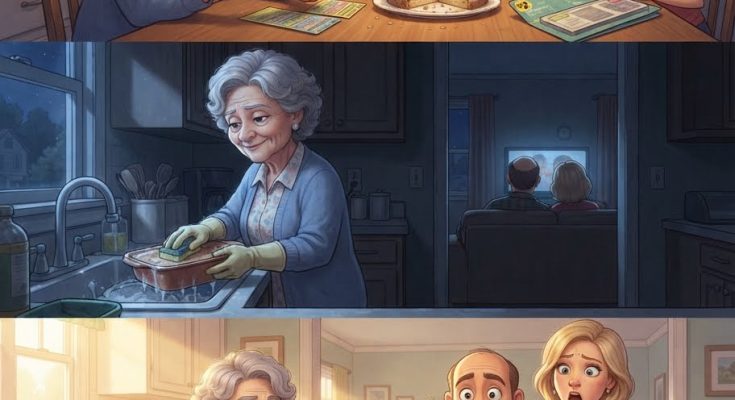
I Won $11 Million From the Birthday Card They Gave Me as a Joke—Then I Revealed Who Owned Their House, STORY BY DRAMAVERDICT.

- PART 3 He was wearing the dark jacket he wore whenever he wanted to look important. He had an important meeting that day, or at least that was what he had told Renata the night before. He kissed her quickly on the cheek, grabbed his keys, and walked toward the front door without even looking at me. Then he saw the envelope. It was addressed to: Daniel Fenn Current Occupant 1178 Oak Hollow Drive He frowned. “Mom, did you order something?” I shook my head. “No.” He picked it up. The return address was printed in black letters: H & D Bait and Tackle LLC P.O. Box 1847 Daniel stopped. Only for a second. But I saw it. His thumb moved along the edge of the envelope. “Huh.” Then Renata appeared at the bottom of the stairs. “What is it?” “Something from the landlord.” She walked over. “Probably another rent increase.”
- Daniel laughed. “Wouldn’t surprise me.” They had been complaining about that landlord for months. The irony almost made me smile. Daniel tore open the envelope. There were three pages inside. He read the first sentence. Then the second. Then he stopped moving. His face changed before he even reached the bottom. It was not confusion. It was recognition. He read the letter again. Slowly. Renata leaned over his shoulder. “What does it say?” He didn’t answer. “Daniel?” Still nothing. Then Renata took the letter from him. Her eyes moved across the page. I watched her eyebrows rise. Then fall. Then rise again. “Effective January first,” she whispered. Daniel stared straight ahead. “The property has changed ownership?” Renata looked at him. “Apparently.” Daniel swallowed. “Who bought it?” Renata looked down again. “H and D…” She stopped. “H and D what?” “Bait and Tackle.” Daniel’s mouth opened slightly. He laughed once. Not because anything was funny. Because sometimes the human body laughs when the mind has nowhere else to put shock.
- “That’s impossible.” He reached for the paper again. His eyes moved toward the signature at the bottom. The owner. The authorized representative. And beneath it, in neat blue ink, was a name he had seen thousands of times on Christmas cards, school forms, grocery lists, and notes taped to the refrigerator. Dolores Fenn. The kitchen went silent. Daniel looked at the signature. Then he looked at me. For the first time in ten months, I let my face tell the truth. I didn’t smile. I didn’t look angry. I simply looked tired. Renata was still holding the second page. “Mom?” I took a sip of coffee. “Yes?” She looked from the paper to me. “What is this?” “It is a letter.” “From the landlord.” “Yes.” Daniel stepped closer. “You own this house?” I looked at my son. “No.” His face tightened. “You don’t?” I shook my head. “Not anymore.” He frowned. “Mom, what does that mean?” I set down my mug. “It means I owned it before you knew I did.” Neither of them spoke. The clock above the refrigerator ticked. One second. Two. Three. Renata finally found her voice. “When did you buy this place?” “Last spring.” “You bought our house?”
“The house you live in.”
Daniel stared at me.
“With what money?”
There it was.
The question I had known would come eventually.
Not How are you?
Not Why did you leave?
Not Are you okay?
With what money?
I looked at the man I had raised.
The boy who once slept on my shoulder during thunderstorms.
The teenager whose school lunches I packed before sunrise.
The young father I had helped when his first child was born.
And I suddenly realized that for ten months I had been waiting to see if he would discover my worth.
He hadn’t.
He was still trying to calculate it.
“I had some savings,” I said.
It was not a lie.
It was simply nowhere near the whole truth.
Daniel shook his head.
“Mom, this is insane.”
Renata looked at the letter again.
“Why would you do this?”
I turned toward her.
“I could ask you the same question.”
She stiffened.
“What do you mean?”
“You gave me two dollars for my birthday.”
Daniel looked uncomfortable.
“Mom…”
“And then you told me you had found me a wonderful place to live.”
Renata crossed her arms.
“We were trying to help you.”
I nodded.
“Of course.”
“We thought you would be happier there.”
“Sunrise Pines.”
She stared at me.
“Yes.”
“The budget wing.”
Her cheeks reddened.
“That was what we could afford.”
I gave a little smile.
“That’s the part you still don’t understand.”
“What?”
“You were not choosing a place for me.”
“I was choosing a place for you,” Daniel said, louder now. “You have been living here for four years, Mom. We thought this arrangement had gone on long enough.”
I looked at him carefully.
“An arrangement?”
He stopped.
“Is that what you call it?”
He rubbed his forehead.
“You know what I mean.”
“No, Daniel. I don’t.”
Renata stepped in.
“You had your own room. We paid the bills. We fed you. We included you in our family.”
I looked at her.
“I cooked your meals.”
She opened her mouth.
I continued.
“I packed your children’s lunches.”
Daniel looked down.
“I watched the children when you worked late.”
Renata glanced away.
“I cleaned your house.”
Silence.
“I did your laundry.”
“Mom, this isn’t fair.”
“No,” I said quietly. “It isn’t.”
That sentence landed harder than shouting would have.
I reached into the pocket of my robe.
For ten months I had carried nothing in that pocket but tissues, mints, and sometimes my house key.
Now I placed the key ring on the table.
Three keys.
One for the front door.
One for the garage.
One for the house in Savannah.
Renata stared at them.
“What are those?”
“The first is for this house.”
She looked confused.
“The second is for the garage.”
Daniel frowned.
“And the third?”
“My future.”
He looked at me.
“What?”
I stood.
“My home in Savannah.”
Daniel stared.
“You bought another house?”
“Yes.”
“When?”
“June.”
“You’ve been planning to leave?”
“For a long time.”
His voice became softer.
“Why didn’t you tell me?”
I looked at him for several seconds before answering.
“Because every time I tried to tell you how lonely I was, you gave me another chore.”
His expression collapsed slightly.
I walked to the counter and picked up my purse.
“I am leaving today.”
Renata’s head snapped toward me.
“Today?”
“Yes.”
“Where are you going?”
“Home.”
Daniel stepped in front of the door.
“Mom, wait.”
I stopped.
“Please.”
It was the first time he had said please to me in a very long time.
I looked at him.
He was pale.
Not angry anymore.
Scared.
“Why are you doing this to us?”
I almost laughed.
Instead I said, “I’m not doing anything to you.”
He looked confused.
“I’m finally doing something for me.”
He lowered his eyes.
“How much money do you have?”
There it was again.
I looked toward the clock.
7:28.
My taxi was due at 7:30.
I could hear the distant sound of a car slowing outside.
“I have enough.”
“Enough for what?”
“To stop being afraid.”
Renata suddenly grabbed the letter.
“Does this mean we’re being evicted?”
“No.”
She blinked.
“No?”
“The house is owned by my company.”
“What company?”
“H and D Bait and Tackle.”
Daniel stared.
“You used Dad’s company?”
“Yes.”
“But that company closed years ago.”
“No.”
He frowned.
“It never really closed.”
He looked at the letter again.
“You kept it?”
“I kept the name.”
And suddenly his expression changed.
He remembered.
I could almost see the memory forming in his mind.
A little boy.
A hot summer.
His father standing in the garage beside rows of tackle boxes.
Black letters painted across every cardboard box.
H & D Bait and Tackle.
Harold and Dolores.
His parents.
His childhood.
He sank slowly into a chair.
“Mom…”
His voice broke.
“Was this Dad’s idea?”
“No.”
“Did Dad leave you money?”
“No.”
“Then where…”
I looked at him.
“I won the lottery.”
Neither of them moved.
The words seemed too ordinary to carry what they meant.
“I won eleven million dollars.”
Renata dropped the letter.
Daniel stared at me.
The kitchen became completely still.
Outside, a car horn sounded.
My taxi had arrived.
Daniel stood.
“Eleven…”
He couldn’t finish.
“Million?”
I nodded.
“When?”
“Ten months ago.”
Renata shook her head.
“No.”
I looked at her.
“Yes.”
“You knew all this time?”
“Yes.”
“And you stayed here?”
“Yes.”
“Why?”
I picked up my suitcase from beside the kitchen chair.
“Because I wanted to know what would happen if I became worth something.”
Daniel stood there with tears in his eyes.
“Mom, you were always worth something.”
I believed he meant it.
That was what made the next part so painful.
Because there is a difference between saying someone has value…
and treating them as though they do.
My suitcase had already been packed.
Inside were three dresses, four blouses, two sweaters, my medications, Harold’s old watch, six photographs, and the recipe book I had written by hand over forty years.
Nothing else.
You learn how little you need when you have spent years making sure everyone else has enough.
Daniel moved toward me.
“Don’t go.”
I looked at him.
“I have to.”
“Please.”
“I already forgave you.”
His face crumpled.
“I didn’t know.”
“I know.”
“I swear I didn’t know.”
“I know.”
Renata was crying now too.
“Mom, we didn’t mean…”
I stopped her gently.
“I know you did what you thought was best.”
She nodded.
“But I need you to understand something.”
Neither spoke.
“I was not waiting for money.”
I looked at my son.
“I was waiting for kindness.”
He covered his mouth.
“And when it came time to choose between keeping a sixty-three-dollar electric bill low and making room for your mother at the table, you chose the bill.”
Daniel closed his eyes.
I could see him trying to remember every small moment.
Every coupon.
Every complaint.
Every time he had said, “Mom, can you…”
Every time I had answered, “Of course.”
He started crying.
I wanted to hug him.
For a moment, the old instinct returned.
The mother in me wanted to drop everything, hold his face in both hands, and tell him that none of it mattered.
But the woman I had become in those ten months stopped me.
Love was not the same thing as surrender.
I stepped toward the door.
Daniel moved aside.
“I’ll call you,” he whispered.
I nodded.
“When you’re ready,” I said.
I opened the door.
Cold air rushed in.
I stepped onto the porch.
Then I heard Renata behind me.
“Mom.”
I turned.
She was standing in the kitchen doorway.
She held the birthday card.
The cheap one.
The one with the scratch ticket sleeve.
The price sticker was still visible.
“$2.”
She looked at it.
Then at me.
“I thought this was funny.”
“I know.”
“I didn’t think…”
“I know.”
She started crying again.
“I am sorry.”
This time, I believed her.
I gave her a small nod.
“Take care of yourself, Renata.”
Then I walked to the taxi.
The driver got out and opened the trunk.
I placed my suitcase inside.
Daniel stood on the porch.
He didn’t come after me.
Maybe because he understood.
Maybe because for the first time in his life, he knew that asking me to stay was not the same as giving me a reason to.
I got into the back seat.
As the taxi pulled away, I looked through the rear window.
My son stood with his hands in his pockets.
My daughter-in-law had one arm wrapped around herself.
The house looked exactly the same.
But it wasn’t.
Neither was I.
Twenty minutes later, my lawyer called.
“Everything went according to plan?”
“Yes.”
“And the trust?”
“Ready.”
“Your Savannah house is fully furnished.”
“Good.”
“Your financial adviser has also prepared the charitable foundation documents.”
I smiled.
“I want to help women over sixty who suddenly find themselves without a home.”
There was silence on the other end.
“That’s a large commitment.”
“I know.”
“Why that particular cause?”
I looked out the window.
“Because I know what it feels like to be told that there is no room for you.”
He understood.
After the call ended, I rested my head against the glass.
The road stretched south.
I watched familiar buildings disappear.
And for the first time in years, I wasn’t afraid of what came next.
I didn’t know that before the day was over, Daniel would discover something else.
Something that would change everything.
Something I had not told him.
Because the lottery money was only the beginning.
And my husband’s old tackle business…
had left behind one final surprise.
A surprise buried in a bank box Harold had opened thirty-one years earlier.
A box I had only just learned about.
And inside that box was a letter addressed to my son.
A letter Harold had written before he died.
A letter Daniel had never seen.
A letter that began with five words:
“If you are reading this…”
PART 4
“If you are reading this, Daniel, then your mother has finally decided that you are old enough to know the truth.”
That was the first sentence.
I had read it three times that morning in my lawyer’s office.
Each time, I had to stop.
Not because I did not understand the words.
Because I understood exactly why Harold had written them.
The bank box had been discovered during a routine review of the old H & D Bait and Tackle records. Harold had opened the box in 1995, not long before our lives changed forever.
I knew about the business.
I knew about the shop.
I knew about the years Harold spent leaving the house before sunrise and coming home smelling like fishing line, motor oil, and cedar.
What I did not know was that Harold had created something much larger than the little business Daniel remembered.
The company had owned land.
Small pieces at first.
A storage lot.
A warehouse.
Then another piece of property near the river.
Harold had sold most of them over the years.
But one parcel remained.
And he had placed it into a trust.
A trust bearing my name.
Not because he believed I would become rich.
Because he knew one day I might need to protect myself.
My lawyer pushed the letter across the desk.
“You should decide whether Daniel gets this.”
I stared at the handwriting.
Harold’s handwriting.
The slanted letters.
The heavy pressure on the capital H.
The little line beneath his signature.
I touched the paper.
“I think he should.”
But I wasn’t ready yet.
I put the letter into my purse.
And I went to Savannah.
My new house was exactly as I remembered it.
Yellow siding.
White shutters.
Two rocking chairs on the porch.
A magnolia tree near the driveway.
Rose bushes that needed pruning.
The kitchen was painted the pale buttery color I had always loved but had never dared use because Harold preferred everything “practical.”
I stood in the middle of that kitchen and laughed.
Not a nervous laugh.
Not the strange laugh people make when they don’t know how to react.
A real laugh.
I was seventy-three years old.
And I had finally painted my kitchen yellow.
I spent my first night there alone.
I ordered Chinese food.
I opened a bottle of sparkling cider.
I sat on the porch in my robe and listened to the cicadas.
No television.
No arguments.
No footsteps upstairs.
No one asking where the towels were.
No one asking why I had bought strawberries.
No one telling me the heat was too high.
Just silence.
Beautiful silence.
At about nine that evening, my phone rang.
Daniel.
I watched it vibrate.
For a moment, I didn’t answer.
Then I did.
“Hello?”
“Mom.”
His voice was different.
Quiet.
Almost young.
“How are you?”
“I’m fine.”
“I don’t know what to say.”
“Then don’t say anything.”
He exhaled.
“I’ve been thinking about what you said.”
“I imagine you have.”
“I went through the house.”
I frowned.
“What do you mean?”
“I went through the kitchen. Your room. The cabinets.”
I could hear him swallowing.
“I found the birthday cards.”
My chest tightened.
“I forgot how many there were.”
“What do you mean?”
“I found all the cards you saved.”
There was a pause.
“The cards we gave you.”
I closed my eyes.
“You saved them all.”
“Why?”
I looked out at the dark yard.
“Because I am your mother.”
“Even the bad ones?”
“Especially the bad ones.”
He was silent.
Then he asked the question I had expected.
“How much did you actually win?”
I smiled sadly.
“Eleven million.”
Another long silence.
“After taxes?”
“After taxes and after setting up the trust.”
“How much is left?”
“Enough.”
“That’s not an answer.”
“It is the only one you’re getting tonight.”
“I understand.”
I could hear something in his voice.
Not greed.
Fear.
“Mom?”
“Yes?”
“Are you coming back?”
I looked around the yellow kitchen.
“No.”
He breathed out slowly.
“I thought so.”
“Daniel.”
“Yeah?”
“You need to be careful with the house.”
He paused.
“What do you mean?”
“I mean the new lease.”
“We’ll pay.”
“I know.”
“But…”
“If you can afford the rent, you can stay.”
“And if we can’t?”
“You’ll have ninety days.”
“That’s fair.”
“It is.”
He was quiet again.
“Mom?”
“Yes?”
“I really am sorry.”
I swallowed.
“I know.”
“Goodnight.”
“Goodnight, Daniel.”
I hung up.
Then I cried.
Not because I wanted to go back.
Because I didn’t.
And realizing that hurt more than I expected.
Three days later, I received a package.
No return address.
Inside was a photograph.
My family.
Taken twelve years earlier.
Harold was standing in the middle.
Daniel was beside him.
I was on the other side.
Everyone was smiling.
Even Renata.
I turned the photograph over.
There was writing on the back.
Renata’s handwriting.
You deserve better than what we gave you.
Underneath it was another sentence.
Please don’t give up on Daniel.
I stared at the words for a long time.
Then I placed the photograph beside Harold’s letter.
Something was changing.
I could feel it.
But I wasn’t ready to forgive everyone simply because they were finally afraid of losing me.
Forgiveness had to mean something.
It couldn’t be another thing a mother gave away for free.
Two weeks passed.
I settled into Savannah.
I joined a community garden.
I hired a woman named Ms. Eloise to help with the heavier work around the house.
I attended a Sunday church service.
I bought a ridiculous amount of yellow flowers.
I learned how to sleep without waiting for someone else to come through the front door.
And then, on a Wednesday morning, my lawyer called.
“Mrs. Fenn, we have a problem.”
My stomach tightened.
“What kind of problem?”
“Your son has been approached by a developer.”
“What developer?”
“Oak Hollow Properties.”
I sat down.
“Why?”
“They want the house.”
I frowned.
“They already live there.”
“They want the whole block.”
I looked out the window.
“What does that have to do with me?”
“Their proposal requires purchasing your property.”
I understood immediately.
“If I refuse?”
“They will try to acquire the surrounding properties first.”
“And Daniel?”
“Your son’s lease gives him protection.”
“For how long?”
“Until the lease ends.”
“When does it end?”
“December.”
It was August.
Four months.
My lawyer continued.
“There is something else.”
I waited.
“The developer has offered Daniel a significant amount of money to break his lease early.”
I closed my eyes.
Of course.
Money.
Always money.
“How much?”
“Forty thousand.”
I almost laughed.
“Does he know the property belongs to me?”
“Yes.”
“What did he say?”
“He refused.”
I stared at the wall.
“Are you sure?”
“He told them the house isn’t for sale.”
Something inside me shifted.
That was the first time Daniel had protected something that belonged to me.
Even if he was protecting the house because it was the only home he had.
It still mattered.
“Did he tell them why?”
“No.”
“Good.”
I thought about the boy he had been.
The boy who would stand in front of his sister when the neighbor’s dog scared her.
The boy who used to give me half his Halloween candy because he thought mothers should get treats too.
Maybe that boy was still inside the man he had become.
Maybe he had just gotten lost.
A week later, Daniel arrived in Savannah.
He didn’t call first.
He just appeared.
I opened the door and found him standing there with two bags.
He looked exhausted.
“You came all the way here?”
He nodded.
“I didn’t know where else to go.”
I stepped aside.
“Come in.”
He looked around.
“Yellow.”
“Yes.”
He smiled faintly.
“Dad would have hated it.”
“He would have complained about it for six months.”
Daniel laughed.
And suddenly he looked eight years old again.
We sat in the kitchen.
I made coffee.
He looked at the cup in his hands.
“I almost took the forty thousand.”
I said nothing.
“Not because I wanted to sell the house.”
“I know.”
“I needed the money.”
“I know.”
“Renata was furious when I refused.”
“What did she say?”
“That you had enough money to buy ten houses and that I was being stupid.”
I looked at him.
“And what did you tell her?”
“I told her it wasn’t ours to sell.”
That sentence mattered.
More than he knew.
He looked down.
“Mom, I keep thinking about the last ten months.”
“So do I.”
“I didn’t realize how cruel we were.”
I didn’t correct him.
“We made you feel like you had to earn your right to live with us.”
I folded my hands.
“Yes.”
“I don’t know how to fix that.”
“You don’t.”
He looked up.
“You don’t?”
“No.”
“Then what do I do?”
“Start by becoming someone who wouldn’t do it again.”
He nodded.
“I’ve been trying.”
“I can see that.”
There was silence.
Then he reached into his jacket.
“I brought something.”
He placed a small box on the table.
I opened it.
Inside was my wedding ring.
My breath caught.
I had lost that ring shortly after Harold died.
I had thought one of the children had accidentally thrown it away.
“I found it under the dresser.”
Daniel looked at me.
“I found it while I was cleaning your room.”
I touched the ring.
“You kept it?”
“I thought you might want it.”
I closed my hand around it.
“Thank you.”
He looked relieved.
Then his eyes moved to the envelope beside my coffee cup.
Harold’s letter.
He had seen his father’s handwriting before.
“What’s that?”
I looked at him.
“Something your father wrote.”
He went still.
“About me?”
“Yes.”
“Can I read it?”
I reached for the envelope.
“Not yet.”
He nodded.
“I understand.”
Then I said something I had never expected to say.
“Tomorrow.”
His eyes widened.
“Tomorrow?”
“Yes.”
“You’ll let me read it?”
“Yes.”
He stood.
“Thank you.”
At the door he stopped.
“Mom?”
FINAL PART: I Won $11 Million From the Birthday Card They Gave Me as a Joke—Then I Revealed Who Owned Their House, STORY BY DRAMAVERDICT.
“Yes?” “I don’t deserve you.” I gave him a small smile. “No.” He looked hurt. Then I added: “But you can become the kind of son who does.” He nodded. And he left. The next morning, Daniel returned. He sat at the kitchen table. I put Harold’s letter in front of him. His hands shook. “Ready?” “No.” I almost smiled. “Neither am I.” He opened it. And began to read. If you are reading this, Daniel, then you are old enough to understand something about money. Money is not what makes a family strong. But money reveals what is already there. I have watched you grow from a boy into a man. I have watched you struggle. I have watched you make mistakes. I have watched you succeed. Your mother thinks you are stronger than you are. And I think you are kinder than you sometimes remember to be.
Daniel stopped. His eyes filled. I looked away. He continued. One day, your mother may have very little money. Or she may have more than either of us expects. It will not matter. The only question that will matter is this: When she needs you, will you make her feel like family? Daniel wiped his eyes. He continued. If you ever find yourself measuring your mother’s worth against a grocery bill, a rent payment, or a room in your house, stop. Remember who she was before you had a name. She carried you before you could walk. She fed you before you could feed yourself. She stayed awake when you were sick. She believed in you when you didn’t believe in yourself. You don’t repay that with money. You repay it with love. Daniel’s tears fell onto the paper. He didn’t stop reading.
And if you fail her, Daniel, don’t tell yourself that saying sorry fixes everything. It doesn’t. Trust is rebuilt slowly. You will have to prove yourself with ordinary things. Showing up. Listening. Helping without being asked. Remembering birthdays. Making room at the table. And when you finally understand all of this, don’t be ashamed to tell her you were wrong. Your mother doesn’t need a perfect son. She needs a son who knows how to come home. The letter ended there. Underneath was Harold’s signature. Harold Fenn Daniel put the letter down. He covered his face with both hands. I sat across from him. For several minutes, neither of us spoke.
Then he said something so quietly I almost didn’t hear it. “I remember.” “What?” “The table.” I frowned. “When I was little, Dad always made me sit next to you.” I smiled. “He said you talked too much.” “He said you were the only person who would keep me from becoming spoiled.” I laughed softly. “I failed at that.” “No.” Daniel looked at me. “You didn’t.” He wiped his face. “I did that myself.” Then he stood and walked around the table. He knelt beside my chair. I didn’t know what to do. He took my hands. “Mom.” “Yes?” “I’m sorry.” I nodded. “I know.” “No. Let me finish.” So I did. “I’m sorry for every time I made you feel unwelcome.” He squeezed my hands. “I’m sorry for every time I treated what you did as something you owed us.”
My eyes filled.
“I’m sorry for that birthday.”
He laughed through tears.
“God, that stupid card.”
I smiled.
“It was a pretty card.”
“No.”
He shook his head.
“It was cruel.”
“Yes.”
“I’m sorry.”
“I know.”
He bowed his head.
Then he asked:
“Can I come visit you again?”
I smiled.
“You may.”
“Can I bring the kids?”
“Absolutely.”
“Can we stay?”
“You can sleep on the sofa.”
He laughed.
“Fair.”
And for the first time in years, the kitchen felt full.
Not because of money.
Because someone had finally made room.
But there was one more thing to settle.
The house.
The developer had not given up.
Two weeks later, representatives arrived at my lawyer’s office with a new proposal.
They wanted to buy the entire block.
I declined.
They raised the offer.
I declined again.
Eventually, my lawyer told them:
“The property is not for sale.”
The lead representative asked:
“Why?”
I smiled.
“Because my son lives there.”
He blinked.
“Your son?”
“Yes.”
“And you own the property?”
“Yes.”
“Then why wouldn’t you sell?”
I picked up my purse.
“Because some things are more valuable than money.”
The representative looked confused.
My lawyer smiled.
The meeting ended.
But I didn’t stop there.
I bought the two neighboring properties as well.
Then I offered Daniel a choice.
He could continue renting.
Or he could buy the house from me at the exact amount still owed on the mortgage.
No profit.
No hidden conditions.
Just a fair chance.
He refused at first.
“I can’t take your money.”
“It’s not my money. It’s a house.”
“I’ll never be able to repay you.”
“You don’t repay kindness by pretending you don’t need it.”
He looked at me.
“What do you want?”
“Renters.”
He laughed.
“That’s it?”
“Good tenants.”
He smiled.
“Deal.”
We signed the agreement three months later.
Not mother and son.
Landlord and tenant.
Because sometimes boundaries are the healthiest form of love.
By Christmas, things looked different.
Daniel visited every Sunday.
He called me without needing anything.
Renata started sending photographs of the children.
She apologized properly.
Not once.
Repeatedly.
She eventually asked if I would come to dinner.
I said yes.
But I drove myself.
I left when I wanted.
And I noticed something.
Nobody asked me to cook.
Renata had made the meal.
The table had six places.
Mine was at the head.
I looked at Daniel.
He smiled.
“Your seat.”
I sat down.
And nobody mentioned money.
Not once.
After dinner, my granddaughter brought me a gift.
It was wrapped in yellow paper.
I opened it.
A handmade picture frame.
Inside was a photograph of all of us standing on my Savannah porch.
My house.
My yellow kitchen behind us.
My grandchildren smiling.
Daniel standing beside me.
Renata on the other side.
On the bottom, written in childish handwriting, were the words:
HOME IS WHERE WE MAKE ROOM FOR EACH OTHER.
I looked at Daniel.
He was crying.
So was I.
But this time, the tears weren’t about what I had lost.
They were about what we had rebuilt.
A year later, I created the Dolores Fenn Foundation.
Its first program paid for emergency housing and legal assistance for older women who were being pushed out of homes by relatives who had decided they were inconvenient.
My lawyer asked why I cared so much about that.
I told him:
“Because nobody should have to win eleven million dollars before their family remembers they are a human being.”
The foundation grew.
Then it grew again.
And eventually, one newspaper called me “the lottery grandmother.”
I hated the name.
So I refused every interview.
I wasn’t interested in becoming famous.
I had already learned that attention and love were not the same thing.
What mattered was smaller.
Every Thanksgiving, my family came to Savannah.
My grandchildren helped in the garden.
Daniel fixed things around the house.
Renata brought food.
And I sat at my yellow kitchen table.
One day, years later, Daniel asked me a question.
“Mom, do you ever regret winning that ticket?”
I looked at him.
“No.”
“Even though it changed everything?”
“It didn’t change everything.”
He frowned.
“What do you mean?”
I smiled.
“The money changed where I lived.”
I looked around the kitchen.
“The truth changed who I became.”
Then I reached into my purse.
I still had the birthday card.
The same cheap card.
The same price sticker.
Two dollars.
Inside was the original lottery ticket.
Framed now.
I handed it to him.
He laughed.
“You kept this?”
“Of course.”
“Why?”
I looked at my son.
“Because sometimes the smallest gift can become the biggest lesson.”
He nodded.
Then I added:
“And because it reminds me that I should never again mistake being tolerated for being loved.”
Daniel looked down at the framed ticket.
“I love you, Mom.”
“I love you too.”
He smiled.
“Happy birthday.”
I laughed.
“It isn’t my birthday.”
“I know.”
He looked at the ticket.
“Just wanted to get it right this time.”
And that was the real prize.
Not the eleven million dollars.
Not the houses.
Not the trust.
Not the foundation.
It was sitting at a table where nobody was counting what I cost.
Where nobody was measuring what I contributed.
Where nobody was wondering how long I could stay.
I was simply Dolores.
Seventy-four years old.
A mother.
A grandmother.
A widow.
A woman who had spent too many years believing she had to earn her place.
And finally, at the head of my yellow kitchen table, surrounded by people who had learned what home really meant, I understood something Harold had tried to teach our son all those years ago.
Love was never supposed to be a debt.
And family was never supposed to feel like a bill.
Somewhere along the way, I had lost myself trying to keep everyone else comfortable.
The eleven-million-dollar ticket did not save me.
It simply gave me the courage to save myself.
And once I did…
I finally had something money could never buy.
Peace.
PART 5
Final Part
The years that followed were quieter than I expected.
Daniel kept the house, and he kept his promise.
He called every Sunday.
Not when he needed money.
Not when something had gone wrong.
Just to ask, “How are you, Mom?”
Sometimes we talked for ten minutes.
Sometimes for an hour.
Sometimes neither of us had much to say.
That was okay too.
Renata changed slowly.
She never became the woman I once wished she would be. But she became kinder. She learned how to apologize without adding a reason afterward. She learned that helping someone did not mean making them feel indebted.
And my grandchildren grew up knowing one simple rule:
Nobody at Grandma Dolores’s table was ever unwanted.
One summer afternoon, Daniel brought the old birthday card to my house.
The same cheap card.
The same faded price sticker.
He held it out to me.
“I think you should keep this.”
I laughed.
“I thought you wanted it.”
“I did.”
He looked at the card.
“But I think you’ve already carried it long enough.”
I opened it.
Inside, the old scratch-ticket sleeve was empty.
The winning ticket was framed above my desk.
I had once thought that little piece of paper had changed my life.
But I knew better now.
The money had bought me freedom.
The truth had given me courage.
And forgiveness had given me peace.
I looked at Daniel.
“Do you know what I remember most about that birthday?”
He shook his head.
“Not the eleven million dollars.”
I smiled.
“I remember deciding that, no matter what happened next, I would never again beg someone to make room for me.”
Daniel’s eyes filled with tears.
“You never should have had to.”
“No,” I said. “But I’m glad I learned.”
He hugged me.
A real hug.
The kind where neither person is keeping track of what it costs.
That evening, after everyone left, I sat alone on my porch and watched the sunset turn the sky gold.
I thought about Harold.
About the little bait shop.
About the boy Daniel used to be.
About the woman I had been.
And I finally understood the lesson that had taken me seventy-three years to learn:
Sometimes losing the life you were desperately trying to hold together is how you find the life you were supposed to have.
I never needed eleven million dollars to become worthy.
I had been worthy all along.
The money only gave me the freedom to stop living as though I wasn’t.
And that was the greatest prize of all.
PART 6 — THE NAME HAROLD NEVER MENTIONED I thought peace would arrive quietly. For a while, it did. Savannah gave me mornings that belonged entirely to me. I woke when I wanted. I drank coffee on the porch while the magnolia leaves moved in the breeze…
I worked in the garden until my knees complained. I volunteered twice a week with the foundation. Daniel called every Sunday. Renata sent photographs of the grandchildren. Nobody asked me for money. Nobody asked me to solve anything. And perhaps that was why the telephone call frightened me so much. It came on a Thursday morning at 8:17. I was standing in my yellow kitchen cutting strawberries when my lawyer’s name appeared on the screen. I wiped my hands on a towel. “Good morning.” There was a pause. Not a long one. But I had known him long enough to recognize when he was choosing his words. “Mrs. Fenn, are you alone?” The knife stopped in my hand. “Yes.” “Could you sit down?” I hated those words. Doctors said them. Police officers said them. Lawyers said them when the next sentence was going to divide your life into before and after. I pulled out a chair. “I’m sitting.” “Do you remember the safe-deposit box connected to H & D Bait and Tackle?” “Of course.” Harold’s letter to Daniel had come from that box. I still thought about it sometimes. Especially the line about making room at the table. “There was another item associated with the account,” my lawyer said.
“What kind of item?” “Not inside the box.” I frowned. “Then where?” “Apparently, Harold left instructions with the bank concerning a separate envelope.” I felt a strange pressure behind my ribs. “What envelope?” “It was supposed to be released under a specific condition.” “What condition?” “Transfer or liquidation of the final H & D property.” I looked toward the window. My roses moved gently outside. “I haven’t liquidated anything.” “No.” His voice became quieter. “But the developer’s attempts to acquire the Oak Hollow properties triggered a title review.” I said nothing. “The review caused the bank’s archival department to examine several old records.” “And?” “They found Harold’s instructions.” My fingers tightened around the telephone. “How old?” “Thirty-one years.” For a moment, the kitchen disappeared. Thirty-one years. I could see Harold at fifty-two. Brown hair beginning to gray at the temples. Work boots beside the back door. Coffee in the same chipped green mug every morning. Thirty-one years ago was before Daniel married Renata. Before the grandchildren. Before Harold got sick. Before I became a widow. Before anybody called me a burden.
“What did Harold leave?” “An envelope.” “For me?” Another pause. “No.” I felt the first true chill. “Who is it for?” “A woman named Margaret Vale.” I did not recognize the name. That should have relieved me. It didn’t. “Who is Margaret Vale?” “We don’t know.” I stood despite being told to sit. “What does she have to do with my husband?” “Mrs. Fenn—” “Who is she?” “I genuinely don’t know.” I walked to the sink. Outside, a bird landed on the fence. Everything looked offensively normal. “Is she alive?” “We are checking.” “Have you opened the envelope?” “No.” “Why not?” “Because it isn’t addressed to you.” That irritated me. It also made me trust him. Harold had been dead for years, but whatever secret he had left behind was still being treated as belonging to someone. “Does Daniel know?” “No.” “Renata?” “No.” “Anyone?” “Only the bank, my office, and now you.”
I stared at the strawberries on the cutting board. One had rolled onto its side. A little red stain spread beneath it. “What exactly does the envelope say?” “I have a scanned image of the exterior.” “Read it.” Paper moved on the other end. Then he read slowly. “To Margaret Vale.” He paused. “If circumstances require this letter to be delivered, please forgive how long it took.” My throat tightened. There was another line. I could tell from his silence. “What else?” “Mrs. Fenn—” “Read it.” He exhaled. “Tell Daniel nothing until Margaret has read this.” The kitchen became completely still. “Daniel?” “Yes.” “My Daniel?” “I assume so.” I sat again. This time because my legs demanded it. Harold had left a letter to a woman I had never heard of. And somehow my son’s name was written on the outside.
I thought of every possibility at once.
An affair.
A debt.
A child.
A business partner.
A mistake.
A crime.
A promise.
A secret family.
Grief has an ugly talent.
It teaches your mind exactly where to stab you.
“Find her,” I said.
“We’re already trying.”
“Don’t contact Daniel.”
“We won’t.”
“Don’t contact Renata.”
“Of course.”
“And don’t open that envelope.”
“We legally can’t without authorization unless certain conditions are met.”
“I don’t care about legally.”
My voice cracked.
“I mean don’t open it.”
“I understand.”
I ended the call.
Then I remained at the table for nearly twenty minutes.
I didn’t cry.
I was angry that I wanted to.
Harold and I had been married forty-six years.
Forty-six.
You think that buys you the whole person.
It doesn’t.
Marriage gives you access to somebody’s mornings.
Their bad habits.
Their sleeping sounds.
Their favorite chair.
Their temper.
Their fears.
Their body aging beside yours.
But perhaps nobody ever possesses the complete map of another human being.
There are always locked rooms.
I simply hadn’t known Harold had one.
At 9:03, Daniel called.
I almost didn’t answer.
Then I remembered that he knew nothing.
“Hello?”
“Morning, Mom.”
His voice sounded cheerful.
That made everything worse.
“Morning.”
“You busy?”
“No.”
“Renata wants to bring the kids down Saturday.”
I closed my eyes.
“Saturday?”
“If that’s okay.”
“Of course.”
“She says she’ll bring lunch.”
“Tell her she doesn’t need to.”
“I did.”
He laughed.
“You know Renata.”
I nearly said, No, apparently I don’t know anyone.
Instead I asked, “Daniel?”
“Yeah?”
“Did your father ever mention someone named Margaret?”
Silence.
It lasted only a second.
But I heard it.
“Margaret who?”
“Vale.”
Another pause.
“No.”
My heart began beating faster.
“You’re sure?”
“Yeah.”
His voice had changed.
Not much.
But enough.
“Why?”
“No reason.”
“Mom.”
“What?”
“Why are you asking me about Dad?”
“I found an old piece of paperwork.”
“What kind?”
“Business.”
“H & D?”
“Yes.”
Daniel became quiet.
Then he said, “Dad had a customer named Margaret.”
I gripped the phone.
“You just said you didn’t know her.”
“I don’t.”
“Daniel.”
“I don’t, Mom.”
“Then how do you know she was a customer?”
He sighed.
“Because I remember the name.”
“From where?”
“I don’t know.”
“Try.”
“Mom, I was a kid.”
“Try.”
Silence again.
Then his voice softened.
“There was a photograph.”
Every muscle in my body tightened.
“What photograph?”
“I don’t know if it was her.”
“Tell me.”
“I found it in Dad’s truck once.”
I stood.
“When?”
“I was maybe thirteen.”
That would have been years before the letter.
“What was in the photograph?”
“A woman.”
“With your father?”
“No.”
“Then what?”
“She was standing outside a building.”
“What building?”
“I don’t know.”
“Daniel.”
“I really don’t.”
He sounded frustrated now.
“It looked like a little house or office.”
“Was anything written on it?”
He went silent.
I waited.
“Daniel?”
“I think so.”
“What?”
“I don’t remember.”
“Yes, you do.”
“Mom—”
“Your voice changes when you’re trying to protect me.”
He stopped.
That was something mothers knew.
Even when their sons were fifty.
“Tell me.”
Finally, he whispered, “There was writing on the back.”
“What did it say?”
“I only remember part of it.”
“What part?”
He took a breath.
“Thank you for keeping your promise.”
My hand went cold.
“Whose handwriting?”
“I don’t know.”
“Was it your father’s?”
“No.”
“You are certain?”
“Pretty sure.”
A woman’s photograph.
In my husband’s truck.
With a handwritten message thanking him for keeping a promise.
And thirty-one years later, a sealed envelope existed with her name on it.
I sat down again.
“Why didn’t you ever tell me?”
“I was thirteen.”
“Did your father know you found it?”
“Yeah.”
“What happened?”
Daniel hesitated.
“He got angry.”
“Your father?”
“Not angry like yelling.”
“What did he do?”
“He took it from me.”
“And?”
“He told me not to go through other people’s things.”
That sounded exactly like Harold.
“And then?”
“Nothing.”
“Daniel.”
“There isn’t anything else.”
I knew there was.
“Daniel.”
He exhaled.
“That night I heard you two arguing.”
My heart stopped.
“We argued?”
“Yeah.”
“About what?”
“I don’t know.”
“You heard us.”
“I heard Dad.”
“What did he say?”
Another long silence.
Then Daniel spoke.
“He said, ‘I gave my word.’”
The memory did not belong to me.
That was what frightened me.
I remembered arguments with Harold.
Money.
Daniel.
His hours at the shop.
His smoking.
His stubborn refusal to see a doctor.
But I could not remember one in which he had said those words.
I gave my word.
“What did I say?”
“I couldn’t hear you.”
“And your father?”
“I remember one more thing.”
“What?”
“He said, ‘Dolores doesn’t need to carry this.’”
I stopped breathing for a second.
“Are you sure?”
“Yes.”
“Why didn’t you tell me?”
“Because the next morning everything was normal.”
Normal.
The most dangerous word in a family.
Normal could hide almost anything.
I ended the conversation ten minutes later without telling Daniel about the envelope.
For the rest of the day, I walked around my house looking at photographs of my husband.
Harold at twenty-six on our wedding day.
Harold holding newborn Daniel.
Harold standing beside his first fishing boat.
Harold asleep in a lawn chair with his mouth open.
Harold and me at our fortieth anniversary.
Same face.
Different man now.
Or perhaps I was simply seeing the shadows for the first time.
At 4:42 that afternoon, my lawyer called again.
“We found her.”
I stood immediately.
“Margaret?”
“Yes.”
“She’s alive?”
“Yes.”
“Where?”
“North Carolina.”
“How old?”
“Eighty-one.”
I tried to calculate.
She would have been around fifty when Harold wrote the instructions.
“Did you contact her?”
“Not yet.”
“Why?”
“There’s something you need to know first.”
I closed my eyes.
“What?”
“Margaret Vale isn’t her legal name anymore.”
“What is?”
“Margaret Lawson.”
The name still meant nothing.
“And?”
“She has one daughter.”
I didn’t like the direction of his voice.
“What is her daughter’s name?”
“Rebecca.”
I waited.
“And Rebecca has a son.”
My stomach tightened.
“How old?”
“Fifty-two.”
Almost Daniel’s age.
I gripped the edge of the counter.
“What is his name?”
My lawyer said it.
And for a moment, I thought I had misheard him.
“Say that again.”
He repeated the name.
“Harold Lawson.”
I couldn’t speak.
The grandson of the woman my husband had secretly written to was named Harold.
My lawyer continued carefully.
“That may mean nothing.”
“Or it may mean everything.”
“Exactly.”
I stared at the wall.
“Does he look like my husband?”
“We haven’t investigated that.”
“Do it.”
“Mrs. Fenn—”
“Please.”
My voice was quieter now.
“I need to know what I am walking into.”
“I understand.”
That evening I did something I had not done since Harold’s funeral.
I took his watch from the drawer beside my bed.
The same watch I had packed when I left Daniel’s house.
I wound it.
It ticked.
Tiny.
Steady.
Unconcerned.
“You stubborn old man,” I whispered.
“What did you do?”
The watch offered no answer.
Saturday morning, Daniel arrived with Renata and the children.
I had barely slept.
Renata hugged me at the door.
She had gotten better at hugging.
Before, her hugs had felt ceremonial.
Now she actually held on.
“You look tired,” she said.
“Didn’t sleep well.”
“Everything okay?”
I almost laughed.
“No.”
Her smile disappeared.
“What happened?”
“Nothing you need to worry about yet.”
Yet.
Daniel heard it.
He carried the food into the kitchen but kept looking at me.
During lunch, I watched him.
His hands.
Harold’s hands.
His laugh.
Harold’s laugh when something genuinely surprised him.
The way he tilted his head when listening.
Harold again.
Genetics had always seemed comforting.
That day they felt like evidence.
My granddaughter noticed me staring.
“Grandma?”
“Yes, sweetheart?”
“Why are you looking at Dad like that?”
Daniel stopped chewing.
Renata looked at me.
I smiled.
“I was remembering when he was your age.”
Daniel lowered his eyes.
After lunch, the children went outside.
Renata joined them.
Daniel stayed behind.
He waited until the back door closed.
“Okay.”
“What?”
“Tell me.”
“Tell you what?”
“Whatever you’re hiding.”
I folded the dish towel.
“I am not hiding anything.”
“Mom.”
I looked at him.
He was no longer the man who had asked how much money I had.
He was my son.
And for the first time, I wondered whether protecting him was repeating Harold’s mistake.
“There’s another letter.”
Daniel froze.
“From Dad?”
“Yes.”
“For me?”
“No.”
“Who?”
I watched his face.
“Margaret Vale.”
Nothing.
Then recognition.
Small but unmistakable.
“The woman from the photograph.”
“Yes.”
He pulled out a chair.
“What does it say?”
“I don’t know.”
“You haven’t opened it?”
“It isn’t mine.”
He rubbed his face.
“Why would Dad leave her a letter?”
“I don’t know.”
“And why now?”
“Because it was attached to the old H & D records.”
Daniel looked toward the backyard.
“What aren’t you telling me?”
I hesitated.
Then I said, “She has a grandson.”
He looked back at me.
“So?”
“His name is Harold.”
Daniel stared.
I didn’t have to explain.
His expression changed.
“No.”
“I didn’t say anything.”
“You didn’t have to.”
“Daniel—”
“Dad didn’t have another family.”
“I don’t know.”
“He wouldn’t.”
“I don’t know.”
“He loved you.”
“I know.”
“Then don’t do this.”
“I’m not doing anything.”
“You’re sitting there thinking my father had some secret child.”
“I’m sitting here wondering why your father secretly left instructions for a woman you remember from a photograph.”
Daniel stood.
“Dad wasn’t like that.”
“I was married to him.”
“Exactly.”
“So perhaps you can understand why I need answers.”
He walked toward the window.
For several seconds, he said nothing.
Then he whispered, “What if you don’t like them?”
I looked at my son.
“I survived losing your father.”
I paused.
“I survived losing myself.”
I folded my hands on the table.
“I can survive the truth.”
He turned toward me.
“Then I’m coming with you.”
“Where?”
“To meet her.”
“I haven’t decided whether I’m going.”
“Yes, you have.”
I almost smiled.
He knew me too well.
“I’ll drive.”
“No.”
“Mom.”
“I said no.”
“You’re seventy-four.”
“And you’re irritating.”
That made him laugh despite himself.
The tension broke for half a second.
Then the back door opened.
Renata entered.
She looked at both of us.
“What happened?”
Daniel and I exchanged a glance.
“Family history,” I said.
Renata set down the children’s empty lemonade glasses.
“That sounds ominous.”
“It may be nothing.”
She looked at Daniel.
He didn’t answer.
Renata had changed enough to understand that silence sometimes meant she should not push.
“Okay,” she said.
“If you need me, I’m outside.”
She left.
Daniel watched the door close.
“She’s trying.”
“I know.”
“She feels terrible about everything.”
“I know.”
“Do you forgive her?”
I thought about it.
“More than I used to.”
He nodded.
“Is that enough?”
“For today.”
He accepted that.
Three days later, my lawyer called.
His first words were:
“We received a response from Margaret.”
I sat at the kitchen table.
“What did she say?”
“She agreed to receive the letter.”
“That’s all?”
“No.”
My heart accelerated.
“What else?”
“She asked who discovered it.”
“What did you tell her?”
“That the current representative of H & D Bait and Tackle had located the instructions.”
“Did you use my name?”
“Not initially.”
“And?”
“She asked whether Dolores was still alive.”
My skin prickled.
“She knows me.”
“Apparently.”
“Did you tell her?”
“Yes.”
“What did she say?”
He paused.
“She started crying.”
I stared at the tabletop.
“Did she say why?”
“No.”
“Anything else?”
“She asked whether Daniel was alive.”
That frightened me more.
“And?”
“I said yes.”
“What did she say?”
“She asked whether he had children.”
I closed my eyes.
“What did you tell her?”
“That he did.”
“Then?”
“She became very quiet.”
I stood.
“Where is she?”
“I can send you the address.”
“I’m going.”
“I suspected you might.”
“When can she meet?”
“Tomorrow.”
That surprised me.
“So soon?”
“She specifically asked not to wait.”
I called Daniel.
He answered on the second ring.
“Mom?”
“Pack a bag.”
Silence.
Then:
“You found her.”
“Yes.”
“When?”
“We leave at seven tomorrow morning.”
“I’ll be there at six-thirty.”
“You don’t need—”
“Six-thirty.”
He hung up.
I smiled despite myself.
Harold had done that too.
The next morning, Daniel arrived at 6:21.
He brought coffee.
Mine was exactly how I liked it.
No sugar.
A little milk.
Ordinary things.
Showing up.
Listening.
Remembering.
Harold’s letter had been right.
Trust returned through ordinary things.
We drove north.
For the first hour, neither of us talked much.
Then Daniel asked, “Are you scared?”
“Yes.”
“Me too.”
“What are you scared of?”
He kept his eyes on the road.
“Finding out Dad wasn’t who I thought he was.”
I looked out the window.
“And you?”
I thought carefully.
“Finding out he was exactly who I thought he was.”
Daniel glanced at me.
“I don’t understand.”
“Sometimes good people keep terrible secrets because they convince themselves they’re protecting someone.”
He nodded slowly.
We stopped for lunch outside Charleston.
Daniel barely ate.
I drank coffee I didn’t want.
Then my lawyer called.
“Mrs. Fenn.”
“Yes?”
“Margaret received Harold’s envelope this morning.”
My pulse jumped.
“She opened it?”
“Yes.”
“What did it say?”
“I don’t know.”
“You didn’t ask?”
“It was addressed to her.”
I sighed.
“Right.”
“But she called immediately afterward.”
I waited.
“She wants to see you.”
“We’re already driving.”
“There’s something else.”
Of course there was.
“What?”
“She asked you to bring Daniel.”
I looked at my son.
He noticed.
“What?”
I raised a finger.
“How did she know he was coming?”
“She didn’t.”
My lawyer paused.
“She said there is something Daniel needs to see.”
“What?”
“She wouldn’t tell me.”
Daniel pulled into a parking lot when he saw my face.
“Mom?”
I ended the call.
“Margaret wants you there.”
His jaw tightened.
“Why?”
“She has something to show you.”
“What?”
“I don’t know.”
Daniel leaned back in his seat.
For a moment, neither of us moved.
Then he started the car again.
“Let’s go.”
Margaret lived in a small brick house at the end of a quiet street.
There was nothing dramatic about it.
No mansion.
No gates.
No evidence of some secret fortune.
Just a bird feeder.
A blue sedan.
White curtains.
A porch with two wooden chairs.
Daniel parked across the street.
Neither of us got out.
“That’s it?” he asked.
“That’s the address.”
He stared at the house.
“I feel ridiculous.”
“So do I.”
“What if Dad just owed her money?”
“Then we’ll have driven six hours to learn your father was terrible at paying bills.”
Daniel laughed nervously.
“I’d actually prefer that.”
“So would I.”
We got out.
The walk from the car to the porch felt longer than the drive.
I raised my hand.
Before I could knock, the door opened.
The woman standing there was small.
Smaller than me.
Silver hair cut to her shoulders.
Blue cardigan.
Dark trousers.
Her eyes found mine immediately.
She knew me.
I could see it.
“Dolores.”
It wasn’t a question.
“Margaret?”
Her lips trembled.
Then she looked at Daniel.
Her hand flew to her mouth.
Daniel stopped.
Margaret stared at him.
Not casually.
Not politely.
She stared as if a ghost had stepped onto her porch.
“Oh my God.”
Daniel looked at me.
Then back at her.
Margaret’s eyes filled with tears.
“You look exactly like him.”
Daniel swallowed.
“My father?”
Margaret closed her eyes.
“No.”
One word.
That was all.
But everything inside me shifted.
Daniel stepped backward.
“What?”
Margaret opened the door wider.
“Please come inside.”
Nobody moved.
I looked at her.
“If not Harold, then who does he look like?”
Margaret’s face collapsed.
She began crying.
And suddenly I knew.
Not the answer.
But the shape of it.
Whatever Harold had hidden was not an affair.
It was older.
Deeper.
Something connected to Daniel himself.
Margaret wiped her cheeks.
“I promised Harold I would never tell you unless he gave permission.”
My heart hammered.
“He is dead.”
“I know.”
“He has been dead for years.”
“I know.”
“Then tell me.”
She looked at Daniel.
“I can’t do it on the porch.”
We entered.
Her living room smelled faintly of lavender.
Family photographs covered one wall.
I tried not to look.
Then I saw one.
A young man in a military uniform.
Dark hair.
Long face.
A smile I recognized without ever having seen it before.
Because Daniel had that smile.
My son saw it too.
He walked toward the photograph.
His face went pale.
“Who is that?”
Margaret stood behind us.
Her hands shook.
“His name was Samuel.”
“Was?”
“He died in 1994.”
Daniel looked at me.
Then Margaret.
“Who was he?”
Margaret closed her eyes.
“My brother.”
Daniel turned back to the photograph.
I couldn’t stop staring at the man’s eyes.
Daniel’s eyes.
Not similar.
The same.
“Why do I look like him?”
Margaret sat down.
“Dolores.”
I remained standing.
“Tell us.”
She reached toward an envelope on the coffee table.
Harold’s envelope.
It had been opened.
Beside it sat a second object.
A photograph.
Margaret picked it up.
“I think you should sit.”
“No.”
My voice surprised even me.
“I have spent too much of my life being told to sit before somebody tells me something painful.”
Margaret nodded.
“Fair enough.”
She handed me the photograph.
I looked down.
Harold stood beside a much younger Margaret.
Between them was the man from the military photograph.
Samuel.
All three were smiling.
On the back was a date.
May 1973.
I looked at Margaret.
“What is this?”
“Before Daniel was born.”
“Obviously.”
She flinched.
I regretted the sharpness immediately.
But I did not apologize.
Not yet.
“How did Harold know your brother?”
“They grew up together.”
“No.”
I shook my head.
“Harold never mentioned a Samuel.”
“I know.”
“Why?”
Margaret looked toward Daniel.
“Because Samuel asked him not to.”
Daniel stepped closer.
“Why?”
Margaret took a breath.
“Because Samuel was in trouble.”
“What kind?”
“He had come home from overseas carrying things he couldn’t talk about.”
She looked at the photograph.
“He drank.”
“He disappeared for days.”
“He owed people money.”
“He was angry.”
“But Harold kept trying to help him.”
Daniel sat now.
I remained standing.
“Where do I fit into this?” he asked.
Margaret’s eyes filled again.
“Your mother was pregnant.”
My heart stopped.
“What?”
She looked at me quickly.
“Not you.”
Silence.
Daniel stared.
Margaret continued.
“There was another woman.”
I gripped the photograph.
“Her name was Elaine.”
Daniel whispered, “Who was Elaine?”
Margaret looked at him.
And the next words came slowly.
“She was Samuel’s girlfriend.”
Daniel stopped breathing.
So did I.
“No,” he whispered.
Margaret nodded through tears.
“She became pregnant in 1973.”
I looked at Daniel.
His face had emptied.
He was no longer angry.
He was no longer frightened.
He looked like a man standing at the edge of his own identity.
“Margaret,” I said.
She looked at me.
“Where is Elaine?”
Margaret’s eyes lowered.
“She died three days after giving birth.”
Daniel stood so fast the chair scraped against the floor.
“No.”
I reached for him.
He moved away.
“No.”
“Daniel—”
“No, Mom.”
He looked at Margaret.
“What are you saying?”
Margaret was openly crying now.
“Samuel couldn’t take care of a baby.”
“No.”
“His life was falling apart.”
“No.”
“Harold knew.”
Daniel shook his head.
“No.”
I could barely hear myself.
“What happened to the baby?”
Margaret looked directly at me.
For one terrible second, she couldn’t say it.
Then she whispered:
“Harold took him.”
The room vanished.
I heard Daniel make a sound beside me.
Not a word.
Just air leaving his body.
I stared at Margaret.
“What did you say?”
“Harold took the baby.”
“Where?”
Her lips trembled.
“Home.”
My knees weakened.
I finally sat.
“No.”
Margaret reached toward me.
I pulled away.
“No.”
“Dolores—”
“I gave birth to Daniel.”
She froze.
Daniel looked at me.
“I gave birth to my son.”
My voice rose.
“I was there.”
“I know.”
“I held him.”
“I know.”
“I nursed him.”
“I know.”
“I have photographs.”
“I know.”
“Then what are you telling me?”
Margaret looked confused.
Then frightened.
She grabbed Harold’s letter from the table.
“No.”
She whispered it to herself.
“No, no, no.”
Daniel stared at her.
“What?”
Margaret unfolded the letter with trembling hands.
She scanned the first page.
Then the second.
Her face changed.
“Oh, Harold.”
“What?” I demanded.
Margaret looked up.
“I misunderstood.”
Daniel stepped forward.
“Misunderstood what?”
She looked at him.
“The baby wasn’t you.”
Silence.
I almost collapsed with relief.
Daniel grabbed the back of the chair.
“Then why do I look like Samuel?”
Margaret stared at Harold’s letter.
“Because…”
She stopped.
“What?”
“Because the baby was your brother.”
Daniel went completely still.
I felt something break open inside my chest.
“My what?”
“Your brother.”
Daniel’s voice barely existed.
“I have a brother?”
Margaret shook her head.
“I don’t know.”
“What do you mean you don’t know?”
“I don’t know what happened after Harold took him.”
Daniel looked at me.
I had no answer.
No memory.
Nothing.
Margaret held out Harold’s letter.
“Dolores.”
I looked at it.
“What?”
“There’s a page for you.”
I stared.
“What do you mean?”
“Harold wrote your name.”
She turned the final sheet around.
There it was.
In my husband’s handwriting.
Dolores.
Just my name.
My hand shook as I took the page.
For several seconds, the letters blurred.
Then I began to read.
Dolores,
If Margaret has given you this page, then the truth has already begun coming apart.
There is something I should have told you before we married.
Something I tried to bury because I believed burying it was the same as protecting you.
It wasn’t.
I stopped.
Daniel whispered, “Mom?”
I raised my hand.
I needed silence.
I continued.
Samuel was more than my friend.
He saved my life once.
And when Elaine died, I made him a promise concerning their child.
A promise I kept.
But keeping it required me to lie to you.
My eyes filled.
I looked at Margaret.
“What lie?”
She shook her head.
“Keep reading.”
I looked back down.
I never brought that child into our marriage.
I never raised him beneath our roof.
But I knew where he was.
I knew who raised him.
And for years, I made sure he was safe.
Daniel whispered, “Who?”
I kept reading.
There will come a day when Daniel deserves to know that he was not our only son in every way that mattered.
My hands began shaking harder.
Not our only son.
In every way that mattered.
I reached the next line.
Then stopped.
Because Harold had written a name.
A name I recognized.
A name Daniel recognized too.
A name that had been part of our family for decades.
I looked at my son.
He saw my face.
“Who is it?”
I couldn’t answer.
“Mom.”
Margaret was crying again.
“Who?”
Daniel demanded.
I lowered the letter.
And before I could speak, somebody knocked on Margaret’s front door.
Three slow knocks.
Margaret went white.
She looked at the clock.
Then at me.
Then at Daniel.
“Are you expecting someone?” I asked.
“No.”
The knocking came again.
Three times.
Daniel moved toward the window.
Margaret stood.
“Don’t.”
He stopped.
“Why?”
She stared at the door.
“Because there’s only one other person who knew you were coming today.”
I felt the opened letter trembling between my fingers.
“Who?”
Margaret looked at me.
Her answer was almost a whisper.
“The man Harold trusted with the baby.”
The third knock came.
This time followed by a man’s voice from the other side of the door.
“Margaret?”
Daniel froze.
I knew that voice.
I had heard it at Christmas dinners.
At birthdays.
At Harold’s funeral.
I had heard that voice comfort me beside my husband’s coffin.
Daniel slowly turned toward me.
He recognized it too.
“Mom…”
I stared at the door.
The man outside knocked once more.
And then he said my name.
“Dolores?”
I stopped breathing.
Because the man standing on the other side of Margaret’s door wasn’t a stranger.
He was someone I had trusted for more than forty years.
And according to Harold’s letter, he knew exactly what had happened to Samuel and Elaine’s baby.
But I still didn’t know the worst part.
I didn’t know why Harold had hidden the child.
I didn’t know why this man had kept the secret after Harold died.
And I didn’t know that before we left Margaret’s house, Daniel would discover a second photograph.
One taken only six months earlier.
A photograph proving that the child Harold had protected all those years…
might still be alive.
PART 7 — THE MAN AT MARGARET’S DOOR Nobody moved. The voice came through the door again. “Dolores?” There are voices you recognize before your mind has time to attach a face to them. This was one of those voices. Older now. Rougher. But unmistakable. Daniel looked at me. His lips parted. “Uncle Raymond?” I couldn’t answer. Raymond Fenn. Harold’s younger brother…
The man who had stood beside my husband at our wedding. The man who had held Daniel when he was baptized. The man who had helped carry Harold’s coffin. The man who had sat beside me after the funeral and told me, “Anything you ever need, Dolores, you call me.” That Raymond. Margaret closed her eyes. Daniel whispered, “What is he doing here?” “I don’t know.” But Margaret did. I could see it. She had gone completely pale. “Margaret.” She looked at me. “You said only one other person knew we were coming.” She nodded. “Raymond?” Another knock. “Margaret, I know you’re in there.” Daniel moved toward the door. I caught his arm. “Wait.” He looked at me. “Why?” “Because we don’t know what we’re opening that door to.” “It’s Uncle Ray.” “Exactly.” That stopped him. Margaret walked slowly toward the door. Her hand rested on the lock. Then she looked back. “Harold made him promise too.” My stomach tightened. “Promise what?” “To protect the child.” Daniel shook his head. “Everybody seems to know about this except us.” The bitterness in his voice was unmistakable. Margaret looked ashamed. “I’m sorry.” “Stop saying that.” Daniel’s voice rose. “I’m fifty-two years old.”
He pointed at Harold’s letter. “My father wrote letters about some child who might be my brother.” He pointed toward the door. “My uncle apparently helped hide him.” Then toward Margaret. “And you knew.” Margaret lowered her eyes. Daniel looked at me. “And my mother is standing here finding out at the same time I am.” His voice cracked. “Who exactly was everybody protecting?” Nobody answered. Daniel laughed once. There was nothing humorous in it. “That’s what I thought.” The knocking stopped. For a moment, silence returned. Then Raymond spoke through the door. “I know Daniel is there.” Daniel’s face changed. “Open it.” I hesitated. “Mom.” “All right.” Margaret unlocked the door. Raymond stood on the porch. He was seventy-nine now. His shoulders had narrowed. His white hair was thinner than the last time I had seen him. He wore khaki pants, a blue button-down shirt, and the brown leather shoes he seemed to have owned since the Reagan administration. For one absurd second, I noticed that one shoelace was untied. Ordinary details become strangely important when your world is coming apart. Raymond looked at Margaret first. Then me. Then Daniel. His face fell.
“Daniel.” Daniel stared at him. “Uncle Ray.” Raymond swallowed. “I was hoping Harold’s letter would explain things before I got here.” Daniel laughed bitterly. “Which things?” Raymond didn’t answer. “The secret baby?” Still nothing. “The dead woman?” Nothing. “The fact that Dad apparently spent decades helping somebody I never knew existed?” Raymond lowered his eyes. Daniel stepped closer. “Or the part where you knew?” “Daniel—” “How long?” Raymond looked at him. “How long did you know?” “Since the beginning.” Daniel turned away. His hands went to the back of his head. “Jesus.” I watched Raymond. Forty-six years of family dinners rearranged themselves inside my memory. Raymond coming over when Harold worked late. Raymond disappearing with Harold for entire Saturdays. Raymond giving Daniel unusually expensive birthday gifts some years and nothing at all in others.
Raymond refusing to talk about the early days of H & D.
Things that had seemed disconnected suddenly had a string running through them.
“Come inside,” Margaret said.
Raymond stepped through the doorway.
Nobody offered him coffee.
Nobody sat.
I held Harold’s letter.
“There is a name on this page.”
Raymond looked at it.
His expression told me everything.
“You know the name.”
“Yes.”
“Who is he?”
Raymond looked at Daniel.
Then at me.
“I think you should finish Harold’s letter.”
“I think I have spent enough time doing what dead men instructed me to do.”
Raymond flinched.
Good.
I was angry.
Not screaming angry.
Seventy-four-year-old angry.
The kind that had learned patience could cut more deeply than volume.
“Tell me.”
Raymond took a breath.
“The child was named Michael.”
Daniel frowned.
“Michael who?”
“Michael Samuel Vale.”
Margaret began crying.
Daniel looked toward the photographs.
“Where is he?”
Raymond’s eyes lowered.
“I don’t know.”
“That’s a lie.”
“I haven’t known for several years.”
“Several years?”
Daniel stepped closer.
“So you did know.”
“Yes.”
“Where was he?”
Raymond looked at me.
“With us.”
My heartbeat changed.
“What does that mean?”
“Not in your house.”
“Then whose?”
Raymond’s jaw tightened.
“Mine.”
Silence.
I stared at him.
“Yours?”
He nodded.
“For how long?”
“Almost three years.”
Margaret sat down.
She seemed to know some of this.
But perhaps not all.
Raymond continued.
“After Elaine died, Samuel fell apart.”
“He was already struggling.”
“Her death destroyed whatever stability he had left.”
“He couldn’t care for an infant.”
“Harold tried.”
“Margaret tried.”
“We all tried.”
“But Samuel kept disappearing.”
Daniel spoke quietly.
“So Dad took the baby.”
“Temporarily.”
“To you?”
“Eventually.”
Raymond nodded.
“Your father brought Michael to me.”
“Why not Mom?”
That question came from Daniel.
Raymond looked at me.
“Because Dolores was pregnant.”
The room went silent again.
I stared at him.
“Pregnant with Daniel?”
“Yes.”
I felt cold.
Raymond continued.
“You were seven months along.”
“Harold was terrified.”
“He thought bringing a newborn into your house without explanation would destroy everything.”
I almost laughed.
“So instead he lied.”
“Yes.”
Raymond didn’t defend him.
That surprised me.
“He lied.”
I looked down at Harold’s handwriting.
“Where was Michael after he lived with you?”
“Samuel’s aunt took him.”
Margaret looked up.
“My aunt Evelyn.”
Raymond nodded.
“She lived in Virginia.”
“She and her husband couldn’t have children.”
“They agreed to raise Michael.”
Daniel frowned.
“Did Dad keep seeing him?”
“Yes.”
“How often?”
“Once or twice a year at first.”
“Later, less.”
“Did I ever meet him?”
Raymond hesitated.
That hesitation was enough.
Daniel stepped forward.
“Did I?”
“Yes.”
My son froze.
“When?”
“You were children.”
“I don’t remember.”
“You weren’t supposed to.”
Daniel stared at him.
“What kind of answer is that?”
Raymond rubbed his forehead.
“There was a family picnic.”
“Which one?”
“At Lake Murray.”
I remembered.
The memory arrived so sharply that I nearly dropped Harold’s letter.
Lake Murray.
Summer of 1982.
Daniel had been eight.
Harold had insisted we drive almost three hours for a picnic with “business friends.”
There had been another boy.
Thin.
Dark-haired.
Maybe nine.
He and Daniel spent the afternoon throwing stones into the lake.
I remembered taking a photograph.
My mouth went dry.
“The boy with the red bicycle.”
Raymond looked at me.
“Yes.”
Daniel stared.
“You remember him?”
I could barely speak.
“His name was Mike.”
Raymond nodded.
“Michael.”
I put a hand over my mouth.
I remembered him.
Not clearly.
But enough.
He had scraped his knee.
I cleaned it.
He had thanked me twice.
He had called Harold “Mr. Fenn.”
And when we drove home, Harold had been unusually quiet.
That night I asked why.
He told me he was tired.
Another lie.
One of hundreds, perhaps.
Small lies protecting one enormous truth.
Daniel sank into a chair.
“I played with my brother.”
“Half brother,” Raymond said automatically.
Daniel looked up sharply.
“Don’t.”
Raymond stopped.
“Don’t reduce this to fractions.”
His voice shook.
“If Dad considered him family, and he was part of our lives, then don’t sit there doing percentages.”
Raymond nodded.
“You’re right.”
Daniel looked toward me.
“Mom?”
“I’m fine.”
I wasn’t.
He knew.
But for once he allowed me to have the lie.
Margaret picked up the second photograph.
The recent one.
The photograph mentioned before Raymond arrived.
She handed it to me.
“This came six months ago.”
I looked down.
A man stood outside a marina.
Gray hair.
Blue windbreaker.
Sunglasses resting on top of his head.
He was smiling beside a fishing boat.
Behind him was a sign.
VALE MARINE REPAIR.
Daniel leaned over my shoulder.
“That’s him?”
Margaret nodded.
“Michael.”
My heart squeezed.
There was Harold in him.
Not in the face.
Something about the posture.
The way he rested one hand against the boat.
Harold had stood like that beside everything he owned.
As though touching it reminded him it was real.
“Where was this taken?”
“Maryland.”
“When?”
“Six months ago.”
“You said Raymond hasn’t known where Michael was for years.”
Margaret nodded.
“He hasn’t.”
“Then who sent this?”
She turned the photograph over.
Three words were written on the back.
I AM READY.
Daniel read them aloud.
“Ready for what?”
Margaret looked at Raymond.
Raymond looked genuinely shocked.
“You never told me about this.”
“You stopped answering my calls.”
“For good reason.”
“What reason?”
Margaret’s face hardened.
“You know exactly why.”
A new tension entered the room.
Older than the secret we were uncovering.
Raymond stepped toward her.
“Margaret.”
“No.”
She stood.
“You don’t get to come into my house after six years and pretend you were the only one keeping Harold’s promise.”
Raymond’s jaw tightened.
Daniel looked between them.
“What happened six years ago?”
Neither answered.
I was becoming tired of silence.
“What happened?”
Margaret walked toward a cabinet.
She opened a drawer.
Then another.
From the second drawer, she removed a thick brown envelope.
She placed it on the table.
“Michael found out.”
Raymond closed his eyes.
Daniel whispered, “Found out what?”
“Everything.”
Margaret looked at him.
“Who his father was.”
“Who Harold was.”
“Who Raymond was.”
“And…”
Her eyes moved to me.
“Who you were.”
My stomach tightened.
“Me?”
“Yes.”
“Why would I matter?”
Margaret didn’t answer immediately.
She pushed the brown envelope toward me.
“Because Harold wrote about you.”
I stared at it.
“What is that?”
“Copies of letters.”
“Whose?”
“Harold’s.”
I sat.
My hands suddenly felt heavy.
“How many?”
“Twenty-seven.”
The number hurt.
Twenty-seven letters.
Twenty-seven conversations my husband had somewhere outside our marriage.
Twenty-seven pieces of himself he had given to a secret I never knew existed.
“Over how many years?”
“Thirty-two.”
Daniel sat beside me.
I opened the envelope.
The first letter was dated 1975.
Dear Evelyn,
Thank you for sending Michael’s school photograph.
Dolores saw me looking at it yesterday.
I told her he was the son of a customer.
I hated lying to her.
I stopped reading.
Raymond looked away.
My eyes burned.
There it was.
Not speculation.
Not misunderstanding.
Harold knew exactly what he was doing.
He knew lying hurt.
And he did it anyway.
I turned to another.
1982.
The year of the picnic.
Michael and Daniel got along better than I expected.
For one afternoon I watched both boys together and wondered what life would have looked like if everything had happened differently.
Dolores cleaned Michael’s knee when he fell.
He watched her afterward with a look I couldn’t understand.
Maybe children recognize kindness before they understand where it comes from.
I closed my eyes.
Daniel whispered, “Mom.”
“Don’t.”
He stopped.
I continued reading.
1991.
Michael graduated.
1995.
Michael married.
1998.
His daughter was born.
2004.
His marriage ended.
2010.
Michael opened a marine repair business.
Then the letters stopped.
“Why?”
I looked at Margaret.
“Why do they stop?”
“Harold got sick.”
That made sense.
But something else didn’t.
“If Michael knew about Harold, why didn’t he come to the funeral?”
“He didn’t know everything then.”
Raymond answered.
“He thought Harold was an old family friend.”
“When did he learn the truth?”
“Six years ago.”
“How?”
Margaret looked toward Raymond.
This time Raymond answered.
“DNA.”
Daniel stared.
“A DNA test?”
“One of those ancestry kits.”
“Michael’s daughter bought it for him as a Christmas gift.”
“The results connected him to the Fenn family.”
My pulse quickened.
“To whom?”
Raymond hesitated.
“Daniel’s daughter.”
Daniel stood.
“My daughter?”
“She had taken one too.”
“When?”
“College.”
Daniel’s face went white.
“Emma?”
“Yes.”
I remembered.
Emma had gone through a genealogy phase.
She had talked about percentages at Thanksgiving.
Irish.
Scottish.
A little German.
Nobody had paid attention.
“Did Emma know?”
“No.”
“How could she not?”
“The connection appeared distant enough that she ignored it.”
“But Michael didn’t.”
“No.”
Daniel paced.
“So he started asking questions.”
“Yes.”
“He contacted me first.”
Raymond’s voice became quieter.
“He sent a message asking how we were related.”
“What did you tell him?”
“Nothing.”
“You ignored him?”
“At first.”
“Why?”
“Because Harold had made me promise.”
Daniel laughed bitterly.
“Dad’s been dead for years.”
“A promise doesn’t die with the person who made you give it.”
“Sometimes it should.”
Raymond looked at him.
“I know that now.”
Margaret pointed at him.
“No.”
“You know it because the truth escaped you.”
Raymond turned.
“That’s not fair.”
“Fair?”
Her voice rose.
“You kept that man from knowing where he came from.”
“I protected him.”
“From what?”
“Samuel.”
“Samuel was dead.”
“Not then.”
The room went still.
Margaret’s anger disappeared.
Daniel stopped pacing.
I looked at Raymond.
“What?”
He seemed to realize he had said too much.
“Samuel didn’t die in 1994?”
Raymond looked at Margaret.
She stared at him.
“You told me he did.”
Raymond said nothing.
Margaret stepped backward.
“You told me my brother died in 1994.”
“He disappeared in 1994.”
“You said he was dead.”
“I believed he was.”
“No.”
Her voice broke.
“You said there was a body.”
Raymond looked sick.
“I was trying to make you stop searching.”
Margaret slapped him.
The sound cracked through the room.
Nobody moved.
Raymond didn’t touch his cheek.
He simply stood there.
“You let me mourn my brother.”
“I know.”
“For thirty-two years.”
“I know.”
“You let me bury an empty coffin.”
“I know.”
Margaret’s knees seemed to weaken.
Daniel caught her arm.
She pulled away and sat.
I stared at Raymond.
“Is Samuel alive?”
“I don’t know.”
“That’s not good enough.”
“The last confirmed sighting was twelve years ago.”
“Where?”
“Arizona.”
Margaret began crying.
Not softly.
Not politely.
Thirty-two years came out of her all at once.
“You bastard.”
Raymond closed his eyes.
“I’m sorry.”
“You don’t get to be sorry.”
“I know.”
“You took my brother from me.”
“He was dangerous.”
“He was sick.”
“He threatened Michael.”
That stopped her.
“What?”
Raymond finally sat.
“When Michael was eleven, Samuel found Evelyn.”
Margaret stared.
“He showed up drunk.”
“He demanded his son.”
“Evelyn refused.”
“He threatened to take Michael.”
“Harold intervened.”
“That’s why the family moved.”
“That’s why Michael’s surname changed.”
“That’s why the records became complicated.”
“Harold wasn’t hiding Michael from Dolores because he was ashamed.”
“He was hiding Michael from Samuel.”
I looked at him.
“Then why hide him from me?”
Raymond’s answer came quietly.
“Because Samuel knew your name.”
Cold spread through me.
“What does that mean?”
“He knew Harold had a wife.”
“He knew you had Daniel.”
“And he told Harold that if anyone tried to keep Michael away from him…”
Raymond couldn’t finish.
“What?”
“He would come after Harold’s family.”
Daniel’s face hardened.
“He threatened Mom?”
“Yes.”
“And me?”
“Yes.”
Silence.
For the first time, Harold’s lie looked different.
It didn’t become right.
But it acquired a shadow I hadn’t seen before.
Fear.
I looked at the letters again.
My husband had spent decades carrying a promise, a frightened child, a dangerous friend, and a threat against his own family.
And he had carried it alone.
I hated him for that.
I loved him for that.
Both feelings existed at once.
That was grief’s cruelty.
It refused to make the dead simple.
Daniel sat beside me.
“So where is Michael now?”
Margaret wiped her face.
“I don’t know.”
“What about the marina?”
“Closed.”
“When?”
“Three months ago.”
My heart sank.
“After this photograph?”
“Yes.”
“Why?”
Margaret reached for the brown envelope again.
“There was something else with the photograph.”
She removed a folded sheet of paper.
“What?”
“A note.”
She handed it to Daniel.
He read silently.
Then his face changed.
“What does it say?”
He didn’t answer.
“Daniel.”
He handed it to me.
The handwriting was firm.
Margaret,
I know enough now.
I know about Samuel.
I know about Harold.
I know about Raymond.
And I know there is a family in Savannah that has no idea I exist.
I am not asking for money.
I am not asking for property.
I don’t want anything that belongs to them.
I only want the truth.
But there is one thing I need to understand before I decide whether to contact Dolores and Daniel.
Samuel found me.
My eyes stopped.
I read the sentence again.
Samuel found me.
Below it:
He is alive.
And he told me Harold lied about everything.
The room disappeared around me.
Daniel took the note.
“He is alive.”
Raymond looked stunned.
“When was this written?”
“Six months ago.”
Margaret whispered.
“Why didn’t you tell anyone?”
“I tried.”
“Who?”
“Raymond.”
“I never got this.”
“I mailed you a copy.”
“I never received it.”
Margaret frowned.
Then she looked toward the front window.
Something about her expression changed.
“What?”
I asked.
She didn’t answer.
She walked to the curtain.
She looked outside.
Then stepped back.
“Margaret?”
“There was a car.”
“What car?”
“A gray sedan.”
“Where?”
“Across the street.”
Daniel moved toward the window.
“It’s gone.”
Margaret’s breathing quickened.
“I’ve seen it before.”
Raymond stood.
“When?”
“Twice this week.”
“Why didn’t you tell me?”
“I haven’t spoken to you in six years.”
Daniel looked at the note again.
“Could Samuel have followed Michael?”
Raymond’s expression darkened.
“If he’s alive, anything is possible.”
I felt suddenly ridiculous.
Seventy-four years old.
Eleven million dollars.
A trust.
Properties.
Lawyers.
I had thought money had finally given me control over my life.
Yet there I stood in a stranger’s living room learning that my dead husband had been protecting a child from a man who might still be alive.
Money could buy security systems.
It could not rewrite history.
Daniel turned to Raymond.
“Where was Samuel last seen?”
“Tucson.”
“When?”
“Twelve years ago.”
“Doing what?”
“Living under another name.”
“What name?”
Raymond hesitated.
“Thomas Reed.”
Daniel took out his phone.
“What are you doing?”
“Searching.”
“Don’t.”
“Why?”
“Because if Samuel is alive and looking for Michael, we don’t know what kind of man he is now.”
Daniel looked at him.
“He’s eighty.”
“So?”
“My mother is seventy-four and just bought half a neighborhood because somebody annoyed her.”
Despite everything, I said, “Three properties is not half a neighborhood.”
Daniel looked at me.
“Not helping, Mom.”
Margaret laughed.
One short broken laugh through tears.
It was strange.
But we needed it.
Then Daniel’s phone rang.
He looked at the screen.
His expression changed.
“Who is it?”
“Renata.”
“Answer.”
He did.
“Hey.”
I watched his face.
The color drained from it almost immediately.
“What?”
He stood.
“Slow down.”
Margaret and Raymond both looked at me.
I couldn’t hear Renata.
Only Daniel.
“When?”
Silence.
“Did she see him?”
Another silence.
“Call the police.”
My stomach tightened.
“Daniel?”
He raised a hand.
“Lock the doors.”
He listened.
“No, don’t go outside.”
Another pause.
“We’re coming.”
He ended the call.
“What happened?”
Daniel looked at me.
“Someone came to the house.”
“What house?”
“Our house.”
Oak Hollow.
“Who?”
“An older man.”
My heart started pounding.
“What did he want?”
“He asked for you.”
I stared at him.
“Me?”
“He asked Renata if Dolores Fenn still owned the property.”
Raymond stood very still.
“What did he look like?”
Daniel swallowed.
“White hair.”
“Thin.”
“Walked with a cane.”
Margaret covered her mouth.
Raymond whispered, “Samuel.”
Daniel looked at him.
“You can’t know that.”
“No.”
“But that’s how Margaret described him the last time she saw him.”
Margaret nodded.
“Did Renata speak to him?”
“Through the doorbell camera.”
“What did she say?”
“That you don’t live there.”
“And then?”
Daniel’s face tightened.
“He said he knew.”
A chill moved through me.
“What else?”
Daniel looked directly at me.
“He said, ‘Tell Dolores that Harold still owes me a son.’”
Nobody spoke.
The sentence sat in the room like something alive.
Harold still owes me a son.
Margaret started crying again.
Raymond moved toward the door.
“Where are you going?”
Daniel asked.
“Oak Hollow.”
“No.”
“I need to see the camera footage.”
“So do the police.”
“Daniel—”
“No.”
My son’s voice changed.
Calm.
Firm.
It reminded me of Harold.
“We’re not running around chasing an eighty-year-old man because of secrets nobody bothered telling us.”
He looked at Raymond.
“You give the police everything.”
“Every name.”
“Every address.”
“Every lie.”
Raymond stared at him.
“Understood?”
After a moment, Raymond nodded.
“Understood.”
I looked at my son.
Something inside me hurt with pride.
Not because he was protecting me.
Because he was finally thinking beyond himself.
Then Margaret’s telephone rang.
She stared at it.
Unknown number.
Nobody moved.
It rang again.
“Don’t answer,” Raymond said.
Margaret looked at me.
I looked at Daniel.
Daniel said quietly, “Speaker.”
Margaret answered.
“Hello?”
Silence.
Then breathing.
A man’s breathing.
Old.
Ragged.
Margaret’s face went white.
“Who is this?”
The voice answered.
“Maggie.”
Margaret nearly dropped the phone.
Raymond grabbed the back of a chair.
Only one person had ever called her Maggie.
Her brother.
“Samuel?”
Silence.
Then:
“You shouldn’t have opened Harold’s letter.”
Margaret began shaking.
“Where are you?”
“Doesn’t matter.”
“Samuel.”
“Is Dolores there?”
Everyone looked at me.
I stepped closer.
“Yes.”
Silence.
Then the man laughed softly.
“Dolores Fenn.”
My skin crawled.
“You don’t know me.”
“Oh, I know plenty about you.”
“Where is Michael?”
The laughter stopped.
“Ask your husband.”
“My husband is dead.”
“That’s convenient.”
I gripped the table.
“Where is Michael?”
Samuel coughed.
Then said:
“Michael isn’t who Harold told you he was.”
“What does that mean?”
“Ask Raymond.”
Everyone looked at him.
Raymond shook his head.
“I don’t know what he’s talking about.”
Samuel heard him.
“Ray.”
Raymond’s face hardened.
“Samuel.”
“Still cleaning up Harold’s mess?”
“You stay away from Dolores.”
Samuel laughed.
“Always protecting her.”
“What do you want?”
“I want what was stolen.”
“Michael wasn’t stolen.”
“He was my son.”
“You threatened him.”
“You don’t know what happened.”
“I was there.”
“No.”
Samuel’s voice sharpened.
“You were there for the story Harold gave you.”
The room went silent.
“What story?” I asked.
Samuel breathed into the telephone.
Then he said something that changed the expression on Raymond’s face.
“Ask him who signed Michael’s original birth certificate.”
I looked at Raymond.
He stared at the floor.
“Raymond?”
Nothing.
“Raymond.”
Daniel stepped toward him.
“Who signed it?”
Raymond whispered, “Samuel.”
Samuel laughed through the phone.
“Wrong.”
Margaret stood.
“What?”
Samuel’s voice became almost gentle.
“Harold did.”
My heart stopped.
Raymond shook his head.
“No.”
“Tell her.”
“That’s not what happened.”
“Tell her, Ray.”
“Harold signed as witness.”
“Tell her the other name.”
Daniel grabbed Raymond’s shoulder.
“What other name?”
Raymond pulled away.
Samuel continued.
“Look at the certificate.”
Margaret whispered, “I don’t have it.”
“I do.”
Silence.
“Where are you?”
Margaret demanded.
Samuel ignored her.
“Dolores.”
I hated hearing my name in his mouth.
“What?”
“If you want to know who your husband really was…”
He coughed.
“…come find me.”
“Where?”
“I’ll call again.”
“No.”
“Goodbye, Dolores.”
“Wait.”
The line went dead.
Margaret stared at the telephone.
Daniel turned to Raymond.
“What was he talking about?”
Raymond said nothing.
I stepped toward him.
“Who was listed on Michael’s birth certificate?”
His eyes met mine.
“I never saw the final certificate.”
“That’s not what I asked.”
“Dolores.”
“Who?”
He swallowed.
“I saw the application.”
“And?”
“Harold’s name was on it.”
My hands went cold.
“As what?”
Raymond looked toward Margaret.
She seemed as confused as I was.
Then he looked at Daniel.
Finally, back at me.
“As father.”
The room tilted.
Daniel caught my arm.
“Mom.”
I pulled away.
“No.”
“Dolores, listen to me.”
“No.”
“It may have been paperwork.”
“What paperwork requires my husband’s name under father?”
“There were reasons.”
“Then give me one.”
Raymond opened his mouth.
Nothing came.
Daniel stared at him.
“Was Michael Dad’s biological son?”
“I don’t know.”
“You don’t know?”
“No.”
“After fifty years of secrets, that’s your answer?”
“I swear.”
Daniel turned toward me.
I couldn’t look at him.
Because suddenly the entire story had changed again.
If Harold was Michael’s father, then Samuel wasn’t protecting his own son.
He had been claiming a child who might never have belonged to him.
And if that was true, why had Harold allowed Michael to be raised somewhere else?
Why had he hidden him from me?
Why had he continued writing?
Why had he never brought his son home?
Then Margaret whispered:
“There is one person who would know.”
We all looked at her.
“Who?”
“Evelyn.”
Raymond shook his head.
“Evelyn died.”
Margaret looked at him.
“No.”
Another lie entered the room.
Raymond stared.
“What?”
“She didn’t die.”
“You told me—”
“I told you what she asked me to tell you.”
Raymond looked furious.
“Where is she?”
“She moved.”
“Where?”
Margaret hesitated.
Then said:
“Georgia.”
My stomach tightened.
“Where in Georgia?”
Margaret looked directly at me.
“Savannah.”
Nobody spoke.
Savannah.
My new home.
The city where I had gone to escape my old life.
The city where I had built my yellow kitchen.
The city where I believed I had started over.
“How long has she lived there?”
I asked.
“Nine years.”
“Address?”
“I have it.”
Daniel stared at me.
“Mom.”
I knew what he was thinking.
Coincidence.
Or something else.
Then Margaret added the detail that made coincidence impossible.
“Evelyn knew you moved there.”
“How?”
“Michael told her.”
My mouth went dry.
“Michael knew where I lived?”
“Yes.”
“How?”
Margaret looked toward the opened letter.
“Harold left instructions.”
“What instructions?”
“If you ever left Daniel’s house…”
She swallowed.
“…Michael was supposed to make sure you were safe.”
I stared at her.
“Harold died before I moved.”
“I know.”
“Then how could he know?”
“He didn’t know when.”
“He simply believed someday you might need to leave.”
The anger inside me suddenly disappeared.
Something sadder replaced it.
Harold.
Even dead, still trying to protect me.
Still arranging people around my life.
Still making decisions without asking.
Still loving me in the most infuriating way possible.
Daniel looked at the recent photograph again.
“Six months ago.”
“What?”
“The picture of Michael.”
He turned it over.
I AM READY.
“What if he wasn’t saying he was ready to meet Margaret?”
I looked at him.
“What if he meant he was ready to meet us?”
Nobody answered.
Then my phone buzzed.
A text message.
Unknown number.
My heart started pounding.
Daniel stepped beside me.
“Don’t open it.”
I already had.
There was no message.
Only a photograph.
My yellow house.
Taken from across the street.
Today.
I stared at the timestamp.
Thirty-seven minutes earlier.
Daniel whispered, “Mom…”
Another message arrived.
This time there were six words.
YOU NEED TO COME HOME NOW.
Daniel immediately called the police.
I barely heard him.
Because a third message appeared.
Another photograph.
My porch.
Closer.
Then a fourth.
My front door.
And sitting on the welcome mat was a small wooden box.
I recognized it.
I had seen boxes like it thousands of times.
H & D Bait and Tackle.
Harold used them for his most expensive handmade lures.
There was a piece of white paper taped to the lid.
Even through the photograph, I could read the handwriting.
FOR DOLORES ONLY.
My hands shook.
Then one final message arrived.
This one made me sit down.
Because beneath the photograph was a sentence.
A sentence from someone who apparently knew exactly what Harold had hidden.
DO NOT LET DANIEL OPEN THE BOX.
I looked at my son.
He had stopped speaking to the police dispatcher.
He had seen it too.
“Why can’t I open it?”
I didn’t answer.
Because for the first time since the scratch ticket changed my life, money was the furthest thing from my mind.
Somebody had been outside my home.
Somebody knew where I was.
Somebody knew Daniel was with me.
And somebody had left Harold’s old box on my porch with a warning specifically about my son.
I thought the secret was Michael.
I thought the question was whether Harold had another son.
I was wrong.
Because whatever waited inside that wooden box was connected to Daniel.
And somewhere between Margaret’s house and Savannah, I began to understand something much more frightening.
Harold had not hidden one family secret.
He had hidden two.
And the second one had been buried for fifty-two years.
PART 8 — THE BOX ON MY PORCH We left Margaret’s house twenty-three minutes later. Nobody said goodbye properly. There was no way to. Some conversations end. Others simply break apart because nobody has enough strength left to keep standing inside them. Daniel drove. Raymond followed in his own car…
Margaret stayed behind with the police officer who had arrived to take her statement about Samuel’s call. I sat in the passenger seat holding my phone with both hands. The photograph of my porch was still open. My yellow house. My front door. The little wooden H & D box on the welcome mat. FOR DOLORES ONLY. And the message beneath it: DO NOT LET DANIEL OPEN THE BOX. Daniel glanced at the screen. Then back at the road. “You know I’m going to ask.” “I know.” “Why me?” “I don’t know.” “Why specifically me?” “I don’t know.” “Mom.” “I said I don’t know.” He gripped the steering wheel tighter. “I’m sorry.” I looked at him. His jaw was tense. He had spent the last several hours learning that his father had kept an entire human being hidden from our family. Now someone had left a box outside my house and warned me to keep it from him. He had every right to be angry. “I’m sorry too.” “For what?” “For all of this.” He glanced at me. “You didn’t do it.” “No.” I looked out the window. “But I married the man who did.” Daniel was quiet. Then he said something I wasn’t expecting. “Dad loved you.” I laughed once. Softly. Sadly. “That doesn’t make the lies disappear.” “I know.”
“It almost makes them worse.” “I know.” I turned toward him. “Do you?” He didn’t answer immediately. Then he said, “I think I do now.” I waited. “When Renata and I were having problems a few years ago, I didn’t tell you.” I frowned. “What kind of problems?” “Bad ones.” “How bad?” He exhaled. “We almost separated.” I stared at him. “You never told me.” “No.” “Why?” “Because I thought I was protecting you.” The words hit hard. He continued. “You had just lost Dad.” “You were already fragile.” “At least that’s what I told myself.” “And what was the truth?” He gave a bitter smile. “The truth was I didn’t want you to see that I had failed.” I looked at my son. He kept his eyes on the road. “So I lied.” “Not directly.” “I left things out.” “I changed details.” “I pretended everything was fine.” He swallowed. “And eventually I started believing that because my reason felt loving, the dishonesty didn’t count.” I looked down. “That sounds familiar.” “Yeah.” We drove another mile. Then Daniel said: “Maybe Dad did the same thing.” “Maybe.” “That doesn’t make it right.” “No.” “But maybe it makes him human.” I looked at him. For a moment I could hear Harold in his voice. Not the words. The compassion.
That infuriating ability to find mercy when I was not finished being angry. “You’ve become very wise since you started paying rent to your mother.” Daniel laughed. “I knew there had to be a lesson in there somewhere.” The laugh lasted only a second. Then his face became serious again. “Mom.” “Yes?” “If that box says something about me…” I waited. “I want to know.” “I know.” “Even if it’s bad.” “I know.” “Promise you won’t hide it.” That one hurt. Because suddenly I understood how easy it would be to make Harold’s mistake. To open the box alone. To read something painful. To decide Daniel did not need to know. To call that love. I looked at him. “I promise.” He nodded. “Thank you.” We drove south. At 4:16, the Savannah police called me. An officer was already at my house. The box was still on the porch. Nobody had touched it. There were no obvious wires. No unusual weight. No signs of tampering. But because an unknown person had delivered it while sending threatening or potentially threatening messages, the officer wanted us to wait until they inspected it. Daniel put the call on speaker. “Can you tell who left it?” he asked. “We’re checking nearby cameras.” “My mother has a doorbell camera.” “We reviewed it.” I leaned forward. “And?” The officer paused. “The person avoided it.” My stomach tightened. “How?” “They came from the side yard.” Daniel looked at me. The officer continued. “Your camera catches part of the walkway but not the full porch approach from the garden side.”
“That means they knew the camera angle,” Daniel said.
“Possibly.”
“Was it a man?”
“We only have a partial image.”
“What kind?”
“Tall.”
“Dark jacket.”
“Baseball cap.”
“Walked without visible difficulty.”
Daniel looked at me.
“Not Samuel.”
“Not necessarily,” the officer said.
“The footage isn’t clear enough to make that determination.”
I thought about Samuel using a cane at Oak Hollow.
If that man had been Samuel.
If.
We didn’t even know that much.
The whole story was becoming a series of people assuming identities because faces were hidden or names had changed.
“Don’t open the box until we get there,” I said.
“We won’t.”
Another hour passed.
Then Raymond called Daniel.
Daniel put him on speaker.
“I spoke with Margaret.”
“What did she say?”
“She remembered something.”
I closed my eyes.
Of course she did.
Every hour seemed to produce a new memory somebody had kept locked away for decades.
“What?”
Daniel asked.
“The box.”
I looked at my phone.
“What about it?”
“She thinks she knows which one it is.”
Daniel’s grip tightened on the wheel.
“How?”
“Harold had six presentation boxes made in 1988.”
“I remember those.”
That surprised me.
I did remember.
Cedar boxes.
Small brass hinges.
H & D branded into the top.
Harold had given them to important clients at Christmas.
Or at least that was what he told me.
“There were six?” I asked.
“Yes.”
“I thought there were five.”
“There were supposed to be five.”
My stomach sank.
“What happened to the sixth?”
“Harold kept it.”
“Why?”
Raymond hesitated.
“Because it contained documents.”
“What documents?”
“I never knew.”
Daniel laughed bitterly.
“Uncle Ray, you know a truly impressive amount of nothing for a man who helped keep a fifty-year secret.”
Raymond ignored the jab.
“I knew Harold didn’t want it destroyed.”
“Where did he keep it?”
“At first, in the H & D office.”
“Later?”
“I thought it went into the bank box.”
“It wasn’t there,” I said.
“No.”
“That’s why Margaret thinks this may be it.”
Daniel looked at me.
“If it is, somebody had it.”
“Yes.”
“Who?”
Raymond didn’t answer.
Then he said:
“There’s another detail.”
I nearly shouted.
“Raymond.”
“I’m telling you.”
“Then stop introducing every sentence like a doctor giving a diagnosis and say it.”
Daniel looked at me.
Despite himself, he smiled.
Raymond sighed.
“Harold once told me the sixth box was for Daniel.”
My son’s smile disappeared.
“What?”
“He said, ‘If I don’t get the chance, this goes to the boy when he’s ready.’”
I stared at Daniel.
“When did he say that?”
“1992.”
Daniel would have been eighteen.
“Why didn’t you ask what was inside?”
“I did.”
“And?”
“He said it wasn’t my business.”
That sounded like Harold too.
Daniel spoke quietly.
“So maybe the warning isn’t about keeping the box from me forever.”
“What do you mean?”
“What if it’s the opposite?”
I waited.
“What if whoever sent it doesn’t want me to open it because Dad did?”
That possibility settled between us.
Someone had known Harold’s instructions.
Someone had taken the box.
Someone had delivered it to me.
And someone specifically wanted Daniel excluded.
“Who would know about Harold’s plan?” I asked.
Raymond answered:
“Very few people.”
“Name them.”
“Me.”
“Margaret?”
“Possibly.”
“Evelyn?”
“Yes.”
“Michael?”
“Maybe later.”
“Samuel?”
Silence.
Then Raymond said:
“Possibly.”
That was not helpful.
“Anyone else?”
“There was one accountant.”
“Name?”
“Leonard Price.”
I remembered him.
Thin man.
Gray suits.
Always carried peppermints.
“He died years ago.”
“Yes.”
“Family?”
“One son.”
“Name?”
“Martin.”
Daniel suddenly looked at me.
“What?”
I asked.
“Martin Price.”
“What about him?”
“I know that name.”
“From where?”
He thought.
Then snapped his fingers.
“The developer.”
My blood ran cold.
“Oak Hollow Properties?”
“One of the representatives.”
“You’re sure?”
“I saw his name on an email.”
“Martin Price?”
“Yeah.”
Raymond went silent.
I sat upright.
“The accountant’s son works for the developer trying to buy our property?”
“It seems so,” Daniel said.
“Coincidence?”
Nobody answered.
I hated coincidence now.
Coincidence was becoming the word people used right before another secret opened.
“Raymond,” I said.
“Yes?”
“What exactly did Leonard Price know?”
“Everything financial.”
“Only financial?”
“I don’t know.”
“Did he know about Michael?”
A pause.
“I believe so.”
“Why?”
“Because H & D paid Evelyn regularly.”
My heart sank.
“Paid her?”
“For Michael.”
Daniel looked toward me.
“How much?”
“It varied.”
“Why?”
“School.”
“Medical.”
“Living expenses.”
“Harold didn’t want Evelyn carrying everything alone.”
That was Harold.
I could picture him doing it.
Quietly.
Stubbornly.
Without telling me.
“How were the payments recorded?”
I asked.
“Consulting expenses.”
I closed my eyes.
More lies.
Not criminal perhaps.
But lies hidden inside ledgers.
“What if Martin found the old records?” Daniel said.
I looked at him.
“That could explain why the developer suddenly cares about this property.”
Raymond responded immediately.
“No.”
“Why not?”
“Because the H & D property itself is valuable enough to explain that.”
“Maybe.”
Daniel’s voice became sharper.
“But if Martin knows the history, maybe he knows more.”
I looked at my son.
“What are you thinking?”
“That the developer may not just want the house.”
“What else would they want?”
He stared ahead.
“Whatever Dad hid in the property records.”
I felt cold.
The parcel.
The old trust.
Harold’s scattered land deals.
The final H & D property.
The letter trigger.
Everything seemed connected through ownership records.
“Call your lawyer,” Daniel said.
I did.
He answered quickly.
I explained Martin Price.
There was a long pause.
“I’m checking something.”
We waited.
Keyboard sounds.
Then:
“Mrs. Fenn.”
“Yes?”
“Martin Price is vice president of acquisitions for Oak Hollow Properties.”
Daniel muttered something under his breath.
My lawyer continued.
“And his father, Leonard, appears on multiple historical filings for H & D.”
“What filings?”
“Property transfers.”
“Trust documentation.”
“Two loans.”
“And one sealed settlement.”
I sat straighter.
“Settlement?”
“Yes.”
“With whom?”
“It’s not visible in the electronic record.”
“Why?”
“The file predates digitization.”
“Can you get it?”
“I can request the archive.”
“Do it.”
“I already am.”
Daniel looked at me.
“Ask the date.”
“What date was the settlement?”
My lawyer answered:
“March 1974.”
Daniel was born in May 1974.
Two months later.
Nobody in the car spoke.
“Who signed it?”
I asked.
“Harold.”
“Anyone else?”
“I only see initials.”
“What initials?”
“E.V.”
Evelyn Vale.
I knew it before anyone said it.
Daniel whispered:
“Evelyn.”
My lawyer said:
“That would be my guess.”
My chest tightened.
A settlement between Harold and Evelyn two months before Daniel was born.
A child.
A hidden identity.
Money.
Property.
A secret box.
And a developer whose executive was the son of Harold’s accountant.
I was beginning to see a shape.
I did not like it.
“Anything else?” Daniel asked.
My lawyer hesitated.
“Yes.”
“What?”
“The settlement references a custodial transfer.”
My mouth went dry.
“Of what?”
“That’s not clear.”
“Child custody?”
“Possibly.”
“Property?”
“Possibly.”
“Money?”
“Possibly.”
Daniel laughed once.
“Very useful.”
“I’m sorry.”
I interrupted.
“Get the archive.”
“I will.”
“And find everything you can on Martin Price.”
“I’ve already started.”
We ended the call.
Then Daniel said:
“Mom.”
“Yes?”
“What if Michael isn’t the only thing Dad transferred?”
I looked at him.
“What do you mean?”
“What if he gave Evelyn something to hold for him?”
“The box?”
“Maybe.”
“Or land.”
“Or shares.”
“Or something tied to the trust.”
“And now Martin knows.”
I thought about Oak Hollow Properties trying repeatedly to buy the block.
About forty thousand dollars offered to Daniel just to break a lease.
Too much money for convenience.
Unless they wanted speed.
Unless they were trying to close something before a record surfaced.
“What if they were trying to trigger the title review?” I said.
Daniel frowned.
“Why would they do that?”
“Maybe they weren’t.”
I looked at him.
“Maybe they were trying to prevent it.”
He understood immediately.
“If they bought the property quietly before the old trust records were examined…”
“Then whatever was hidden might stay hidden.”
Silence.
Daniel slowed the car slightly.
“Mom.”
“Yes?”
“We need to assume somebody knows more than we do.”
“I already assume everybody knows more than I do.”
“That’s not funny.”
“It wasn’t meant to be.”
We reached Savannah just after sunset.
Two police vehicles were parked outside my house.
So was Raymond’s car.
He had taken a faster route.
My neighbors had gathered in little clusters.
Of course they had.
Nothing attracts attention like two police cars outside the yellow house owned by the elderly woman everybody knows gardens in slippers.
I got out.
Ms. Eloise hurried across the lawn.
“Dolores!”
“I’m fine.”
“What happened?”
“Someone left something.”
“Is it a bomb?”
“No.”
“I heard it might be a bomb.”
“Who told you that?”
“Nobody.”
“Then why did you say it?”
She lowered her voice.
“Because there are two police cars.”
I almost laughed.
“Go home, Eloise.”
“I’ll bring pie later.”
“Fine.”
Daniel shook his head.
“I like her.”
“So do I.”
The officer met us at the walkway.
“The box appears safe.”
“Appear?”
“We scanned it.”
“No wires.”
“No electronic components.”
“No explosive residue.”
“You can open it.”
Daniel looked at me.
I looked at the porch.
There it was.
Smaller than I expected.
Old cedar.
Brass hinges dark with age.
H & D burned across the top.
My husband’s hands had probably touched it.
That realization hurt more than the threatening messages.
I walked toward it.
Daniel followed.
The officer said:
“We photographed everything.”
“No usable prints on the outside.”
“Whoever handled it may have worn gloves.”
I stopped.
“Can we take it inside?”
“Yes.”
Daniel reached for it.
I stopped him.
The warning flashed in my mind.
DO NOT LET DANIEL OPEN THE BOX.
He noticed.
“You promised.”
“I know.”
“Then don’t start doing what Dad did.”
I hated when children used your own lessons against you.
Even when they were fifty-two.
I nodded.
“Together.”
We carried it inside.
Raymond came in behind us.
The police officer stayed nearby.
I placed the box on my yellow kitchen table.
The same table where I had learned to sit without waiting to be useful.
Now it held a secret from my husband’s life.
Daniel sat across from me.
Raymond remained standing.
“Open it,” Daniel said.
I touched the latch.
Locked.
“There’s a key?”
Raymond moved closer.
“Harold used tiny brass keys.”
“Where?”
“He wore one on his key ring.”
My breath caught.
Harold’s keys.
I had kept them after he died.
Most were meaningless now.
Old shop keys.
Truck keys.
A tiny brass key I had never identified.
I stood.
“Mom?”
“I think I have it.”
I went upstairs.
My hands shook as I opened the small wooden jewelry chest in my bedroom.
Harold’s old keys were still inside a cloth pouch.
I emptied them onto the bed.
There it was.
Small.
Brass.
Almost black with age.
I carried it downstairs.
Raymond stared.
“That’s it.”
I sat.
Inserted the key.
It turned.
One click.
Daniel breathed out.
I opened the lid.
Inside lay a stack of documents tied with faded blue ribbon.
A small cassette tape.
A photograph.
And a sealed envelope.
Daniel’s name was written on it.
Not “Daniel Fenn.”
Just:
Danny.
My hand went to my mouth.
Harold had not called him Danny after he turned twelve.
Daniel stared.
“That’s Dad’s handwriting.”
“Yes.”
He reached toward it.
The police officer said:
“Before you handle everything, we should document the interior.”
We waited while photographs were taken.
It felt absurd.
My family’s secrets catalogued under fluorescent evidence lights.
After several minutes, the officer stepped back.
“You can proceed.”
Daniel picked up the envelope.
Then stopped.
The warning again.
“Do not let Daniel open the box.”
Not “do not let Daniel read the letter.”
Perhaps the sender wanted to frighten us.
Perhaps they wanted us to distrust each other.
Daniel looked at me.
“I’m opening it.”
I nodded.
He broke the seal.
Inside were two sheets.
He began reading silently.
His face changed almost immediately.
“What?”
I asked.
He raised a finger.
Wait.
I hated waiting.
Then he lowered the letter.
“This isn’t about Michael.”
“What is it about?”
He swallowed.
“Me.”
Raymond stepped closer.
Daniel began reading aloud.
Danny,
If you are opening this, there is a good chance I did not get to explain something I should have told you myself.
First, your mother did nothing wrong.
If you are angry, be angry with me.
Do not put one ounce of this on her.
I closed my eyes.
Even from the grave, Harold knew exactly where my son’s anger might go.
Daniel continued.
There were two boys born into my responsibility in the spring of 1974.
One was Michael.
One was you.
You were never hidden from me.
Michael was.
That difference shaped every decision I made afterward.
I loved you both.
But not in the same way.
Daniel stopped.
His voice cracked.
“I loved you both.”
He looked at me.
“What does that mean?”
“I don’t know.”
Raymond had gone pale.
“Keep reading,” he whispered.
Daniel looked down.
You were my son in every way that matters.
Nothing you learn after this sentence changes that.
If someone tells you blood makes you less mine, they are wrong.
My heart stopped.
Daniel’s eyes lifted slowly.
“No.”
I stared at him.
He looked terrified now.
“No.”
He read the sentence again.
If someone tells you blood makes you less mine, they are wrong.
Daniel stood.
His chair scraped backward.
“What the hell does that mean?”
Raymond whispered:
“Oh, Harold.”
I turned on him.
“You know.”
“No.”
“You know something.”
“I suspected.”
“Suspected what?”
Raymond sat.
For the first time, he looked old.
Truly old.
“There were rumors.”
“What rumors?”
Daniel demanded.
Raymond looked at me.
“About the hospital.”
My body went cold.
“The hospital where Daniel was born?”
“Yes.”
“What about it?”
“There was an incident.”
“What incident?”
“A records problem.”
Daniel stared.
“What kind of records problem?”
Raymond swallowed.
“Two newborn boys.”
I could hear my heartbeat.
“No.”
“Dolores—”
“No.”
“Listen.”
“I gave birth to Daniel.”
“Yes.”
“I held him.”
“I brought him home.”
“Yes.”
“Then stop.”
Raymond looked at the letter.
“Harold found out years later that there may have been a mix-up.”
The room disappeared.
I gripped the table.
Daniel whispered:
“A mix-up?”
Raymond nodded.
“At the hospital.”
“No.”
“The babies had similar surnames.”
“No.”
“One bassinet card was handwritten incorrectly.”
“No.”
“Harold was contacted quietly.”
“No.”
“Stop saying that.”
My voice rose.
“Stop saying words as though repeating them makes them true.”
Daniel came around the table.
“Mom.”
I stood.
“No.”
I looked at my son.
My son.
Fifty-two years of my son.
Skinned knees.
School plays.
Fevers.
Arguments.
Graduation.
Wedding.
Grandchildren.
A cheap birthday card.
A kitchen confrontation.
Savannah.
All of it.
Blood had never once needed to introduce itself.
“Keep reading,” I said.
Daniel looked down.
His hands shook.
Harold’s letter continued.
I never told your mother because by the time I learned there might be a question, you were already ours.
Not legally.
Not biologically.
Ours.
You called me Dad.
You reached for Dolores when you were hurt.
You slept between us during storms.
There was no laboratory result on earth that could make me carry you into another house and call you somebody else’s child.
Daniel stopped reading.
Tears fell onto the paper.
I sat.
Not because I wanted to.
Because my legs no longer belonged to me.
Daniel whispered:
“So Dad knew I might not be his.”
Raymond said:
“Yes.”
I looked at him.
“Did he know whether Daniel was mine?”
Raymond’s expression broke.
“That was the question.”
I stared.
“What?”
“The possible switch involved two mothers.”
I felt sick.
“No.”
Daniel moved closer.
“Mom.”
I pushed the chair backward.
“No.”
I looked at Raymond.
“Who was the other mother?”
He said nothing.
I already knew the answer was going to hurt.
“Who?”
His voice was barely audible.
“Elaine.”
The room went silent.
Daniel looked as though someone had struck him.
“Michael’s mother?”
Raymond nodded.
I could not process it.
Elaine.
Samuel’s girlfriend.
The woman who died three days after giving birth.
Two boys.
Spring 1974.
One hidden.
One raised by me.
Hospital records.
A possible switch.
Suddenly the resemblance between Daniel and Samuel made terrible sense.
Daniel whispered:
“If I was Elaine’s baby…”
He couldn’t finish.
I finished for him.
“Then Michael might have been mine.”
No one spoke.
My own words broke me.
I stood so quickly the chair fell.
“No.”
I walked away from the table.
“No.”
“Mom.”
“Don’t.”
I went to the sink.
My hands gripped the edge.
I had spent fifty-two years believing I had one son.
Now I was being told there might have been two.
Or that the one I raised had been born to another woman.
Or that the child Harold protected in secret might have been the baby I carried.
The baby who kicked beneath my ribs.
The baby whose nursery I painted pale green.
The baby whose name I whispered before he was born.
Daniel stood behind me.
“Mom.”
I turned.
He was crying.
And in that moment, none of it mattered.
I crossed the kitchen and held him.
He buried his face against my shoulder.
He was taller than me.
Older than Harold had been when many of these secrets began.
But he was my child.
My son.
No letter could remove fifty-two years.
“I’m sorry,” he whispered.
I pulled back.
“For what?”
“If I’m not—”
“Don’t.”
“But—”
“Do not finish that sentence.”
He stared at me.
“You are my son.”
His face crumpled.
“Do you understand?”
He nodded.
“I don’t care what that paper says.”
I held his face in both hands.
“I don’t care what a birth certificate says.”
“I don’t care what blood says.”
“You are my son.”
He closed his eyes.
I hugged him again.
Behind us, Raymond was crying quietly.
I didn’t care.
Not yet.
After several minutes, Daniel returned to the letter.
There was one final paragraph.
He read aloud.
The only reason I kept investigating was because there was another mother who never got the chance to ask questions.
Elaine died believing Michael was her child.
Dolores lived believing Daniel was hers.
If the hospital made a mistake, then two women were robbed of the truth.
I could not undo that.
But I could make sure both boys were protected until somebody was strong enough to face it.
Daniel lowered the page.
Below the paragraph Harold had written:
The proof is on the tape.
Nobody moved.
We all looked at the cassette.
Small.
Black.
A handwritten label.
MARCH 18, 1996.
Daniel picked it up.
“What’s on it?”
Raymond shook his head.
“I don’t know.”
I looked at him.
“You really don’t?”
“No.”
“Then why do you look afraid?”
“Because that date means something.”
“What?”
“Harold met Evelyn that day.”
My stomach tightened.
“Why?”
“He told me she finally had evidence.”
Daniel held up the cassette.
“This?”
“Maybe.”
The police officer spoke from the doorway.
“If you want to preserve it, I recommend making a digital copy before playing the original.”
I almost laughed.
Technology.
After fifty years of secrets, our next answer depended on whether an old cassette tape still worked.
“We have a player,” Raymond said.
Everyone looked at him.
“At my motel.”
Daniel stared.
“You travel with a cassette player?”
Raymond looked offended.
“It’s a recorder.”
“That does not improve this.”
Despite everything, I smiled.
Then my phone buzzed.
Unknown number.
Again.
I opened it.
One message.
YOU OPENED IT.
Daniel saw.
“How would they know?”
I looked toward the windows.
The curtains were open.
Daniel immediately closed them.
Another message arrived.
YOU SHOULD HAVE LISTENED.
Raymond took out his phone.
“Call the police.”
“They’re already here,” I said.
The officer stepped forward.
“Show me.”
I handed him the phone.
Then a third message arrived.
This time it was a photograph.
Not of my house.
Not of Daniel.
Not of Margaret.
A hospital nursery.
Old.
Black and white.
Two bassinets.
Two newborns.
The image looked like it had been photographed from an older photograph.
Underneath:
BABY FENN.
BABY VALE.
My heart stopped.
Daniel whispered:
“Oh my God.”
There was more.
A second photograph arrived.
Two hospital bracelets.
One labeled:
DOLORES FENN — MALE.
The other:
ELAINE VALE — MALE.
Then a final message.
THE BRACELETS WERE SWITCHED BEFORE THE PHOTOGRAPH WAS TAKEN.
I sat.
The officer asked:
“Who is sending these?”
“I don’t know.”
Another message appeared.
But this one was different.
It contained an address.
A Savannah address.
Daniel stared.
“That’s twenty minutes from here.”
I looked at Raymond.
He had gone completely white.
“What?”
He pointed at the address.
“That’s Evelyn’s house.”
I stared at him.
Margaret had told us Evelyn lived in Savannah.
Now whoever had been messaging me wanted us there.
Daniel said:
“No.”
“What?”
“We call the police.”
The officer nodded.
“Agreed.”
“We don’t just drive over.”
“I agree.”
I looked at the address.
Then another message arrived.
COME ALONE, DOLORES.
Daniel shook his head.
“Absolutely not.”
Then:
IF YOU WANT TO KNOW WHICH BABY YOU BROUGHT HOME.
I felt my entire body go cold.
Daniel reached for my phone.
I held it tighter.
“No.”
“Mom.”
“No.”
“You are not going alone.”
“I didn’t say I was.”
“You’re thinking it.”
“I am thinking many things.”
Another message.
EVELYN HAS BEEN WAITING FIFTY-TWO YEARS TO TELL YOU.
Raymond whispered:
“She knew.”
I turned.
“What?”
“If that message is true…”
He stared at the address.
“Evelyn knew the whole time.”
The anger that rose inside me was unlike anything I had felt before.
Not at Renata.
Not at Daniel.
Not even at Harold.
Fifty-two years.
If Evelyn had known.
If she had known that the child she raised might have been mine.
If she had looked at Michael every day while I raised Daniel and said nothing.
I wanted answers.
Not tomorrow.
Not after another lawyer.
Not after another archived record.
Now.
But Daniel was already calling the police station.
And this time I let him.
Because love was not surrender.
And courage was not stupidity.
We would go to Evelyn’s house.
But not alone.
Not without the police.
Not without the tape.
Not without every piece of Harold’s secret we had managed to uncover.
Twenty-eight minutes later, we stood outside a small white bungalow on the edge of Savannah.
Two officers were with us.
Raymond stood behind me.
Daniel beside me.
The house looked almost abandoned.
Curtains closed.
Grass too high.
Mail overflowing from the box.
I felt sick.
One officer knocked.
No answer.
Again.
Nothing.
Then Daniel pointed.
“Mom.”
A light was on inside.
Faint.
Back room.
The officer tried the door.
Unlocked.
He ordered us to remain outside.
We did.
For perhaps thirty seconds.
Then he called from inside.
“Mrs. Fenn?”
My stomach dropped.
I stepped into the doorway.
The house smelled old.
Dust.
Medicine.
Lavender.
And something else.
A cassette recorder sat on the living room table.
Beside it was another cedar H & D box.
Open.
Empty.
The officer stood near the hallway.
“There’s an elderly woman in the bedroom.”
“Alive?”
“Yes.”
“But weak.”
My breath left me.
Evelyn.
After fifty-two years.
Still alive.
Still holding the truth.
A paramedic arrived moments later.
They checked her.
She was conscious.
Barely.
When they told her Dolores Fenn was there, her eyes opened.
She whispered:
“Dolores.”
Everybody knew my name.
I was getting tired of it.
I stepped into the room.
Evelyn was ninety.
Tiny beneath the blankets.
Her hair was white.
Her hands trembled.
But her eyes were sharp.
She looked at me.
Then Daniel.
And when she saw him, she started crying.
“Oh.”
That one sound broke something inside me.
“You knew,” I said.
She closed her eyes.
“You knew.”
“Yes.”
Daniel stepped closer.
“Knew what?”
Evelyn looked at me.
“I need to tell her first.”
“No,” I said.
“You tell both of us.”
She looked toward Daniel.
Then nodded.
“I raised Michael.”
“We know.”
“I loved him.”
“I’m sure.”
“But he wasn’t mine.”
“I know.”
She began coughing.
The paramedic helped her drink water.
Then Evelyn whispered:
“Harold brought him to me because he was afraid.”
“Of Samuel?”
“Yes.”
“And because of the hospital?”
Her eyes met mine.
That was the answer.
“You knew about the switch.”
“I knew there might have been one.”
“Might?”
“Yes.”
“Which child was mine?”
Evelyn began crying harder.
“That is what Harold spent half his life trying to prove.”
Daniel sat beside the bed.
“Did he?”
She looked at him.
“Yes.”
My heart stopped.
“And?”
Evelyn turned toward the cassette recorder on the dresser.
“There is a tape.”
“We found one.”
She shook her head.
“No.”
“Not Harold’s.”
“Mine.”
Daniel looked at me.
Evelyn continued.
“I recorded a conversation with the nurse.”
“What nurse?”
“The one who worked the nursery the night you both gave birth.”
My body went cold.
“Is she alive?”
“No.”
“When did you record it?”
“1996.”
The date.
March 18, 1996.
Same as Harold’s cassette.
“Was Harold there?”
“Yes.”
“What did she say?”
Evelyn looked at me for a very long time.
Then she whispered:
“She said the bracelets were switched.”
My knees weakened.
“Accidentally?”
Evelyn closed her eyes.
“No.”
One word.
The room froze.
Daniel leaned closer.
“What?”
“It wasn’t an accident.”
Nobody spoke.
I could barely hear myself.
“Then who switched them?”
Evelyn began trembling.
“I never knew his real name.”
“Whose?”
“The man who paid her.”
Raymond moved toward the bed.
“Paid her?”
“Yes.”
“To switch two babies?”
“Yes.”
“Why?”
Evelyn looked toward the living room.
Toward the cedar box.
Then back at me.
“Because one of the boys stood to inherit something.”
My heart started pounding.
“What?”
“Land.”
Raymond whispered:
“The river parcel.”
Evelyn nodded.
“More than that.”
“What more?”
“Mineral rights.”
Daniel stared.
“Mineral rights?”
Evelyn coughed.
“Harold didn’t know at first.”
“But Leonard Price did.”
The accountant.
Martin Price’s father.
Everything suddenly aligned.
The old settlement.
The land.
The hidden child.
The developer.
The trust.
The records.
I felt sick.
“Leonard arranged the switch?”
Raymond asked.
Evelyn shook her head.
“I don’t know.”
“But he knew afterward.”
“How?”
“Because he was the one who paid me.”
I stared.
“Paid you for what?”
Her eyes filled with shame.
“To stay quiet.”
Silence.
There it was.
Not protection.
Not only protection.
Money.
Harold’s accountant had paid Evelyn to keep silent about a possible baby switch tied to valuable property.
My hands curled.
“You took it?”
Evelyn cried.
“Yes.”
“For how long?”
“Three years.”
“Why?”
“Because Michael needed doctors.”
“Because Samuel was dangerous.”
“Because I was scared.”
She looked at Daniel.
“And because I told myself the truth would destroy both boys.”
I laughed bitterly.
Everyone had the same excuse.
Protection.
Always protection.
Always silence dressed as love.
“Then why stop taking the money?”
“Harold found out.”
Of course.
“What did he do?”
“He nearly killed Leonard.”
Raymond whispered:
“I remember that fight.”
I turned.
“You knew?”
“I knew Harold punched him.”
“I never knew why.”
Evelyn continued.
“Harold stopped the payments.”
“He made me promise never to accept another dollar.”
“And then?”
“He started investigating.”
“He wanted DNA testing.”
“But in the 1990s it was harder.”
“He needed samples.”
“From whom?”
“You.”
My heart stopped.
“Me?”
“And Elaine.”
“Elaine was dead.”
“Yes.”
“But the hospital kept pathology material.”
Daniel whispered:
“Oh God.”
“Did Harold test it?”
Evelyn looked at him.
“Yes.”
Nobody moved.
“Where are the results?” I asked.
Evelyn stared at me.
“I gave them to Michael.”
Daniel stood.
“When?”
“Six months ago.”
The photograph.
I AM READY.
“What did they show?”
Evelyn closed her eyes.
Then she said:
“I never read them.”
I almost shouted.
“Why?”
“They were sealed.”
“Harold made me promise.”
“Enough with Harold’s promises!”
My voice filled the room.
Everyone went silent.
I stood over the bed.
“I loved that man.”
“I buried that man.”
“I have spent days discovering how many people allowed his promises to become more important than my right to know my own life.”
Evelyn cried.
“I’m sorry.”
“I am tired of sorry.”
My voice broke.
“Where is Michael?”
She looked at me.
“I don’t know.”
“Who does?”
Her eyes shifted toward the doorway.
Then she whispered:
“Martin.”
The room froze.
“Martin Price?”
“Yes.”
“Why?”
“Because Michael went to confront him.”
“When?”
“Three months ago.”
The marina closed three months ago.
My heart raced.
“About the baby switch?”
“Yes.”
“And the land.”
“What land?”
“The river parcel Harold placed in trust.”
Raymond looked sick.
“Who owns it?”
Evelyn stared at Daniel.
Then at me.
“Legally?”
“Yes.”
“That depends on which baby was which.”
No one spoke.
She continued.
“The inheritance followed blood.”
“And if the babies were switched…”
Daniel whispered:
“Then the wrong son may have inherited.”
Evelyn nodded.
“And Oak Hollow Properties needs that ownership question settled before they can complete their development.”
Everything clicked.
They didn’t simply want my house.
They wanted the old H & D chain clean.
The property.
The rights.
The inheritance.
The identity.
Daniel said:
“So Martin has Michael.”
Evelyn started crying.
“I don’t know.”
“He called me once.”
“When?”
“Seven weeks ago.”
“What did he say?”
“He told me Michael was becoming unreasonable.”
My blood went cold.
“What does that mean?”
“I asked where Michael was.”
“He said, ‘Somewhere safe until he understands what’s at stake.’”
Daniel immediately looked at the police officer.
The officer was already taking notes.
I stepped closer to Evelyn.
“Do you have Martin’s number?”
She nodded.
“In my address book.”
The police moved.
Everything became fast after that.
Questions.
Names.
Search warrants.
Calls.
The paramedics preparing Evelyn for hospital transport.
But I barely heard any of it.
Because Daniel had noticed something beside the cassette recorder.
A small white envelope.
He picked it up.
“Mom.”
I turned.
My name was on it.
Not Harold’s handwriting.
Michael’s.
I knew because Margaret had shown me his note.
I opened it.
Inside was one page.
Dolores,
If you are reading this, Evelyn finally decided you deserve the truth.
I am sorry it took me so long.
I spent six months deciding whether meeting you would heal anything or only create another wound.
Then I read the DNA results.
I stopped breathing.
Daniel stood beside me.
“Read it.”
My eyes moved to the next line.
The result is clear.
There was no hospital switch.
I stared.
“What?”
Daniel grabbed the page.
He read.
Then read again.
“No switch?”
Raymond whispered.
Evelyn, still on the bed, opened her eyes.
“What?”
I continued.
Daniel is your biological son.
Michael was Elaine’s.
The bracelets were deliberately switched on paper, but the babies themselves were not.
The false record was created to make it appear that a switch had happened.
My heart pounded.
A fake switch.
Why?
The next line answered.
Someone wanted Harold to believe Michael might be his child so he would sign the custodial and property papers.
Daniel whispered:
“This was about the land from the beginning.”
I read on.
Harold spent decades believing he might have failed both of us.
He didn’t.
The real deception was financial.
And Martin knows his father started it.
My hands shook.
Then came the final paragraph.
I confronted Martin Price on May 4.
I recorded the meeting.
If I disappear, he is the reason.
The recording is not with Evelyn.
It is hidden somewhere Harold would have considered safe.
There is only one clue:
THE PLACE WHERE DANIEL LEARNED TO FISH.
Daniel looked at me.
I knew immediately.
So did he.
Lake Murray.
The picnic.
The red bicycle.
The afternoon Daniel played with Michael without knowing they were connected.
Raymond whispered:
“Harold’s old fishing cabin.”
Daniel turned.
“What cabin?”
I stared at him.
Harold had told Daniel it burned down decades ago.
It hadn’t.
I knew because I had received tax notices for it after Harold died and quietly transferred them to Raymond.
Another secret.
But this one was mine.
Daniel looked at my face.
“Mom?”
I swallowed.
“The cabin still exists.”
He stared.
“You knew?”
“Yes.”
“Why didn’t you tell me?”
“Because your father asked me not to.”
The irony was so painful I almost laughed.
Daniel just looked at me.
Then I said:
“And I think I finally understand why that has to stop.”
Outside, a police radio crackled.
Evelyn was being wheeled toward the ambulance.
Raymond stood silent.
Michael was missing.
Martin Price may have known where he was.
And somewhere at an old fishing cabin tied to the one afternoon our two families accidentally touched, there was allegedly a recording capable of explaining the entire scheme.
But before we could leave, Evelyn reached for my wrist.
“Dolores.”
I bent toward her.
“What?”
Her eyes filled with fear.
“Don’t go to the cabin at night.”
“Why?”
“Because Martin knows about it.”
My stomach tightened.
“How?”
“His father used it too.”
Then she whispered one last sentence before the paramedics moved her.
“There’s a room beneath the floor Harold never told Raymond about.”
I looked at Raymond.
His face told me he had never heard of it.
Daniel whispered:
“What room?”
Evelyn was already being wheeled away.
She looked back once.
And said:
“The room where Leonard kept the original records.”
The ambulance doors closed.
I turned toward Daniel.
He stared at me.
Then toward the darkening sky.
The fishing cabin was almost four hours away.
Somewhere inside it could be Michael’s recording.
The real hospital records.
The financial documents.
Proof of fraud.
Maybe even proof of what had happened to Michael after he confronted Martin.
And for the first time since this began, we had something stronger than a secret.
We had a place.
But we also had a problem.
Because when the police checked the cabin property records twenty minutes later, the ownership had changed.
Three days earlier.
The new owner was:
OAK HOLLOW PROPERTIES.
And according to the county system, demolition was scheduled to begin the next morning.